1068
1068
 Request Call Back
 Contact
 1068
1068
Understanding Exotropia: Causes, Symptoms and Treatment Options
Published on: Dec 24, 2025
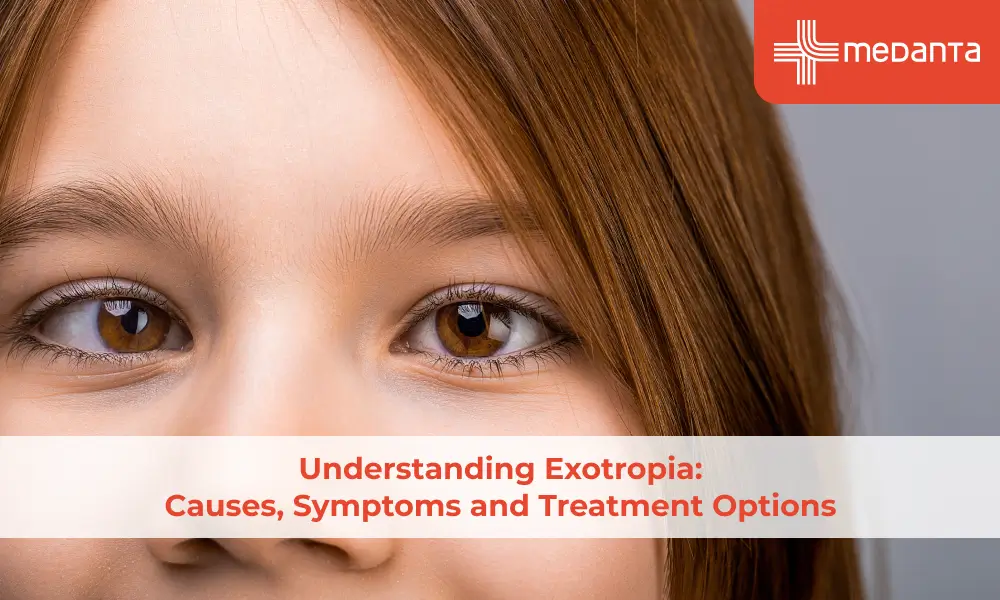
TABLE OF CONTENTS
- What is Exotropia?
- Causes of Exotropia
- Symptoms and Signs to Watch For
- Types of Exotropia
- Diagnosis and Eye Examination Techniques
- Non-surgical Management
- Surgical Options and Recovery
- Living with Exotropia: Lifestyle Adjustments and Support
- Complications of Untreated Exotropia
- Future Trends in Exotropia Treatment and Research
- Conclusion
- FAQs
Exotropia is the most prevalent form of strabismus worldwide. The condition manifests when one eye turns outward while the other maintains forward focus. Young patients particularly struggle with this condition. Families can better direct their children's care by understanding exotropia's causes, symptoms, and treatment options. This article explores diagnostic methods, surgical and non-surgical treatments, and offers effective strategies for managing daily life with exotropia.
What is Exotropia?
Exotropia describes a condition where one or both eyes turn outward away from the nose. This misalignment makes the eyes drift towards the ears, unlike crossed eyes. The intermittent form of exotropia emerges as the most common variant. It accounts for 86% of all cases. Researchers discovered that intermittent exotropia affected many preschool children. The simple type appeared in approximately 75% of these cases. The condition often follows a predictable path. It begins as exophoria, progresses to intermittent exotropia, and might evolve into constant exotropia without proper treatment.
Causes of Exotropia
Multiple factors can lead to exotropia:
Genetic factors - Many families pass down strabismus through generations. Research shows about 30% of children have a relative with this condition.
Eye muscle weakness or imbalance - Six muscles control eye movement. Problems with any of these muscles can lead to misalignment
Neurological conditions - People with cerebral palsy, Down syndrome, hydrocephalus, and brain tumours face higher risks
Poor vision - Vision that's very poor in one eye can trigger sensory exotropia
Symptoms and Signs to Watch For
People should look for these common signs:
Eyes that deviate outward (sometimes or always)
One eye that squints or closes in bright sunlight
Eyes that feel strained and need rubbing
Regular headaches
Vision that appears double (diplopia)
Reduced depth perception
Types of Exotropia
Type | Description | Characteristics |
Intermittent | Eyes turn outward occasionally | Most common type that appears during tiredness, illness, or daydreaming |
Constant | Eyes maintain outward position | Shows up at all distances; appears less often than the intermittent type |
Congenital/Infantile | Starts at birth or early infancy | Links often exist with craniofacial anomalies or cerebral palsy |
Sensory | Develops in the eyes with poor vision | Can start at any age |
Consecutive | Results from esotropia surgery | Appears as a secondary condition after crossed eye treatment |
Diagnosis and Eye Examination Techniques
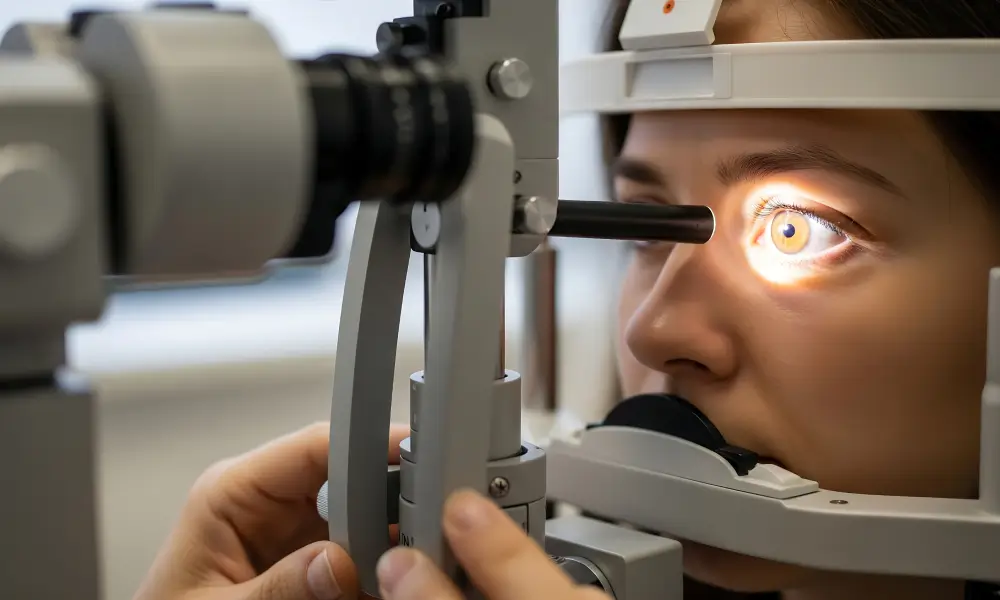
Eye doctors use several tests to diagnose exotropia:
Visual acuity test: Reading eye charts or watching visual behaviour in young children
Cover test: Looking at eye movement after covering one eye to spot misalignment
Refraction test: Checking the eye's focus with corrective lenses
Tests of alignment and focus: Looking at eye coordination
Examination after pupil dilation: Looking inside eye structures
Non-surgical Management
The original treatment plan includes:
Eye patching: Covering the stronger eye strengthens the weaker one
Corrective lenses: Glasses help, especially when you have myopic cases
Prism lenses: Light redirection into the eyes reduces double vision
Vision therapy: Eye exercises that improve coordination and fusion
Botulinum toxin injections: These help realign eyes in some cases
Surgical Options and Recovery
Doctors recommend surgery as exotropia advances, especially when you have deviations over 20-25 prism diopters. The surgeon makes a small incision to reach and reposition the eye muscles. Recovery takes 1-2 weeks, and redness fades over 12 weeks. Patients might feel:
Eye pain for a few days
Watery eyes for several weeks
Temporary double vision
Living with Exotropia: Lifestyle Adjustments and Support
Recovery guidelines suggest:
No swimming for four weeks
Avoiding contact sports for six weeks
Using prescribed eye drops for 2-4 weeks
Regular check-ups to track healing
Complications of Untreated Exotropia
Intermittent exotropia can progress to constant exotropia without treatment. What it all means:
The misaligned eye might develop amblyopia (lazy eye)
Binocular vision and depth perception could be lost
Vision in one eye might worsen
Social and psychological challenges can develop
Future Trends in Exotropia Treatment and Research
3D imaging and simulation along with minimally invasive procedures are shaping the new future in exotropia treatment. Recently, AI involvement not only helps detect exotropia earlier but also measures eye deviation more accurately.
Conclusion
Exotropia can affect anyone, but children deal with this challenge more often. Quick detection helps prevent the condition from becoming constant exotropia. Parents should get professional help right away if they notice their child squinting, closing one eye in bright light or having headaches.
The path from diagnosis to treatment might feel overwhelming at first. Modern medical advances have made exotropia treatment more effective than ever. Understanding the mechanisms, symptoms and treatment options gives you the ability to make smart choices about eye health care. People with exotropia can achieve clearer vision and better eye coordination through timely treatment.
FAQs
What is exotropia and how does it differ from esotropia?
Exotropia happens when one or both eyes turn outward toward the ears. Esotropia works differently - the eyes turn inward toward the nose (crossed eyes). This condition affects all but one of these four children with eye misalignments.
What causes one eye to turn outward?
Several factors can make eyes turn outward:
Eye muscles become unbalanced
Brain and eye signals don't work properly
Family history plays a role
Mechanisms like cataracts affect eye alignment
Can exotropia be corrected without surgery?
Yes! Several non-surgical treatments work well:
Glasses or contact lenses help correct vision
Eye patches strengthen the weaker eye
Vision therapy helps build eye strength
Prism lenses improve alignment
Overcorrecting minus lens therapy shows results
How is exotropia diagnosed in children and adults?
A complete eye examination includes:
Tests to check visual acuity
Cover tests that show eye alignment
Refraction tests with corrective lenses
Eye dilation reveals internal structures
What are the signs parents should watch for in kids?
Parents should look for these signs:
Eyes drift outward, especially when you have fatigue or daydreaming
Kids squint or close one eye in bright light
Eye rubbing occurs with outward drift
Kids complain of headaches or eye strain
At what age is surgery recommended for exotropia?
The patient's age doesn't determine the need for surgery. Doctors recommend surgery when:
Exotropia happens often
Other treatments haven't worked
Patients see double
Binocular vision gets worse
How successful is surgery to correct exotropia?
The success rates of exotropia surgery change over time. The original results look promising - 83.8% success right after surgery. Better outcomes usually happen with smaller eye deviation angles before surgery.
Can vision therapy help with exotropia?
Vision therapy is a great way to get results without surgery. The focus stays on improving control rather than just arranging the eyes. Office exercises plus home practice have shown great results. These exercises help control eye deviation in both surgical and non-surgical patients. Regular home practice makes all the difference. This therapy works especially well when you have convergence insufficiency type exotropia.
What happens if exotropia stays untreated?
Exotropia can worsen from occasional to constant outward eye turning without treatment. The patient's vision could change permanently. Problems like double vision, poor depth perception, and amblyopia might develop. Loss of binocular vision affects daily tasks that need depth perception.
Can adults get exotropia?
Yes, adults can develop exotropia, though it happens less often than in children. People over 12 years old respond differently to treatment. They might need special adjustments to their surgical plan.