1068
1068
 Request Call Back
 Contact
 1068
1068


The Medanta Institute of Gastrosciences is dedicated to offering all patients holistic, advanced medical care via research, combining traditional and modern methods.
Enquiry Form

Search for Hospitals
Gastrosciences Highlights

01
24*7 Centre for GI bleed management
02
Comprehensive care of GI- Liver diseases
03
GI Medicine focuses on IBS, IBD, and GERD, addressing common disorders
04
24*7 acute trauma care management of gastro, liver and splenic injuries
05
World renouned expertise in ERCP and EUS; State of the art diagnostic and Therapeutic procedures facilities
06
Comprehensive care for all digestive disorders from common to complex
About the Speciality
The Institute of Gastrosciences provides end-to-end care for all conditions affecting the digestive tract, pancreas or liver, including tumours and cancers. We provide the full spectrum of multi-disciplinary, collaborative care, from preventive to curative, and diagnostic to surgical. Led by pioneers of minimally invasive gastrointestinal surgery, including robotic procedures, the institute brings together doctors skilled in treating all diseases and conditions of the oesophagus, stomach, liver, pancreas, biliary tract, and small and large intestines. Together, they offer holistic wellness options to patients with a focus on disease reversal, and long-term management for improved quality of life. We are a high-volume centre for advanced surgeries like Whipple Surgery, Lap Cholecystectomy, Liver Biopsy and Bariatric Surgery with internationally comparable success rates backed by state-of-the-art diagnostic and therapeutic technologies.
Gastrosciences Sub-specialities
Our Chairman Message
Our gut is the second brain and we are dedicated to offering the most advanced, holistic care for all organs of the gastrointestinal system, including liver and pancreas. Our world-class team collaborates across medical, surgical, and allied fields so each patient gets the most effective treatment tailored to their unique needs in a trusting and empathetic environment.

Gastroenterology Team
Nurturing the Digestive System for a Healthier You


Our Institute is led by doctors who are among the pioneers of robotic procedures for GI conditions in India and have been instrumental in creating protocols for treatment of many complex conditions. We have established expertise in endoscopic retrograde chloangiopancreatography (ERCP) and endoscopic ultrasound (EUS).

We offer comprehensive care for all problems affecting the gastrointestinal system, from the oesophagus to the stomach, intestines, liver, bile duct and rectum.

Our trained team of gastroenterologists, GI surgeons, bariatric surgeons, and GI-onco surgeons, is skilled at treating complex conditions using treatments such as Whipple Procedure, Lap Cholecystectomy, and Lap Gastrectomy.
Our Treatments
Gastro disorders demand careful intervention and prompt treatment:
01
Crohn's Disease
Crohn's disease is a persistent condition characterized by inflammation in the digestive tract lining, leading to symptoms such as abdominal discomfort, reduced body weight, frequent diarrhea, anemia, and persistent fatigue.
02
Pancreatitis
Pancreatic inflammation characterized by upper abdominal discomfort, queasiness, and retching.
03
Celiac Disease
Celiac Disease is an autoimmune response triggered by the consumption of gluten, a protein present in wheat, barley, and rye. The hallmark symptom often manifests as diarrhea. Additional symptoms encompass bloating, excessive gas, fatigue, anemia due to a low blood count, and susceptibility to osteoporosis.
04
Ileostomy
An ileostomy is a surgical procedure in which the surgeon opens the abdominal wall to bring the end or loop of the small intestine out onto the surface of the skin. This procedure is necessary when the large intestine is not capable of safely releasing the intestinal waste.
05
Endoscopic Ultrasound
Endoscopic ultrasound diagnostic test (EUS test) is a combination of endoscopy and ultrasound. It is a procedure performed for clinical assessment of the digestive tract by producing detailed images of the complete digestive tract, chest, and other organs.
06
Laparoscopic Cholecystectomy
Lap Cholecystectomy is one of the minimally invasive techniques practiced to remove gallbladder and gallstones. After the introduction of this new medical technique, surgeons have been able to view the inside of the body better, improvising on the surgical incisions.
07
Capsule Endoscopy
Capsule endoscopy is a medical process that is used to examine the small intestine. During this diagnostic test, the patient is asked to swallow a capsule that has an inbuilt camera. This camera captures endless pictures of the digestive organs, which are displayed on the computer screen.
Ailments
Gastro disorders demand careful intervention and prompt treatment:
GESTATIONAL DIABETES
Gestational diabetes, also known as diabetes in pregnancy, is a medical condition where women have high blood sugar levels during pregnancy. It typically occurs when the body can not produce enough insulin to regulate blood sugar levels during pregnancy.In India, about 3-16% of women, with higher cases in urban areas, experience diabetes during pregnancy. A study conducted in Tamil Nadu stated a prevalence of 17.8% in urban areas and 9.9% in rural areas. Globally, the estimated gestational diabetes accounts for 15% of all pregnancies, but this can vary by region and population.Gestational diabetes can increase the risk of complications during pregnancy, including preeclampsia, preterm birth, and the need for cesarean delivery. It can also increase the risk of developing type 2 diabetes for both the mother and baby. Therefore, it is crucial for pregnant women to be screened for gestational diabetes and to manage their blood sugar levels during pregnancy.
Gilbert's Syndrome
Gilbert’s Syndrome (GS) is an inherent disease of the liver in which the liver enzyme (the protein molecule) cannot properly process bilirubin, which leads to yellowing of eyes and skin.
Gastroesophageal reflux disease
Gastroesophageal reflux disease is chronic digestive disease which occurs when stomach acid flows back into food pipe.
Ulcer
Ulcers are painful sores in the stomach or small intestine that develop when the stomach acid damages the line of the digestive tract. The most common symptom of a stomach ulcer is a burning or gnawing pain.
Gastrointestinal bleeding
Gastrointestinal bleeding is a medical emergency that requires immediate attention due to its potentially life-threatening nature. In such critical situations, therapeutic endoscopy plays a crucial role in diagnosis, localisation, and treatment. In gastrointеstinal bleeding, blood appear іn thе dіgеstive systеm. Numеrous condіtіons, such as pеptic ulcеrs, gastrіtіs, varices, and cancer, can cause this blееding. Common symptoms of gastrointestinal bleeding include hematemesis (vomiting blood), melena (dark, tarry stools), and hematochezia (bright red blood in stools).
Latest Technology Utilisation
Medanta's Gastroenterology Department has the latest technologies on the market like:
- Da Vinci Robotic Surgery
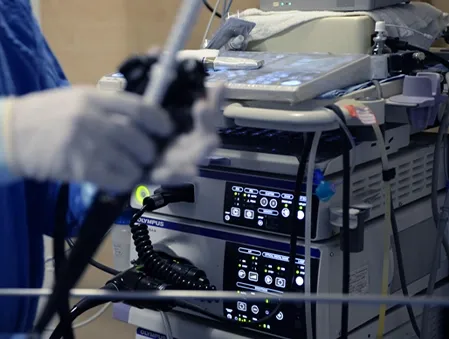
- Echoendoscope
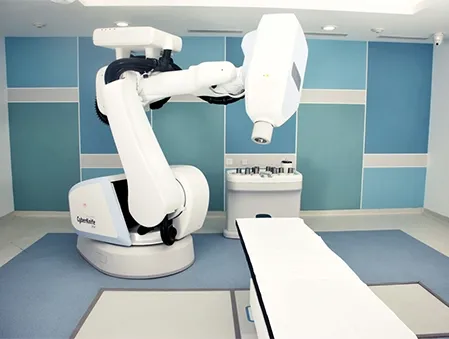
- Cyberknife
Da Vinci Robotic Surgery
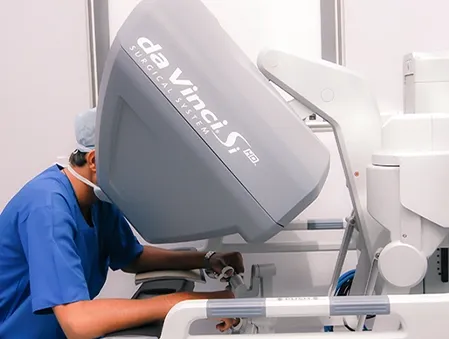
The Da Vinci Surgical System is a robotic surgical platform designed to enhance complex surgical procedures, with a surgeon overseeing its operation from a console. Its name, "Da Vinci Surgery," pays homage to Leonardo Da Vinci, whose pioneering studies in human anatomy paved the way for the development of the first-ever robotic system in the history of medicine.