1068
1068
 Request Call Back
 Contact
 1068
1068
Health Benefits of Oats: Nutritional Value, Oatmeal Benefits, and Their Role in Weight Loss
Published on: May 06, 2026
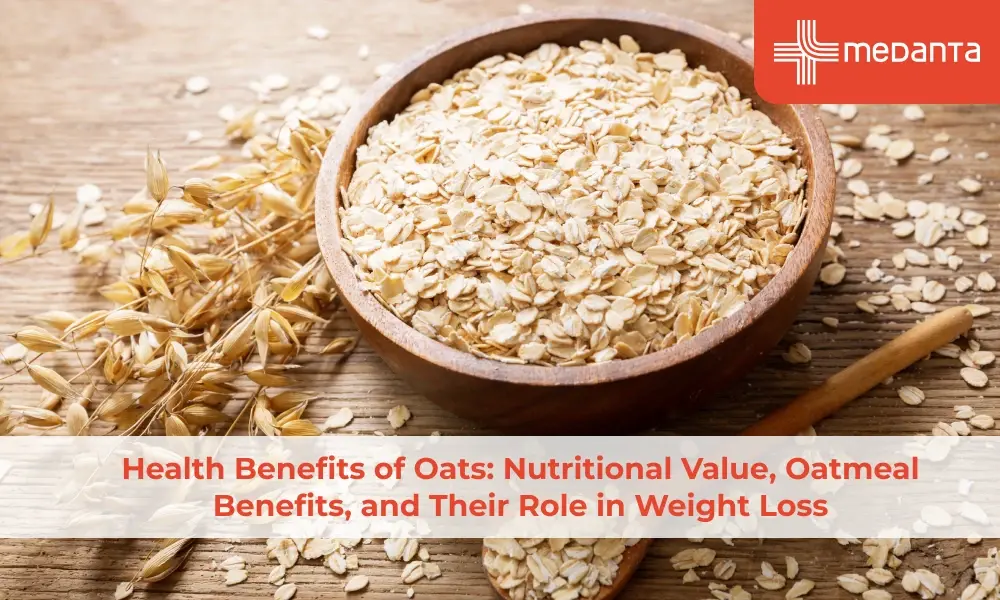
TABLE OF CONTENTS
Patients often come to us asking about oats after seeing it recommended for weight loss, heart disease, or diabetes management. The short answer is that the evidence holds up but the reasons are more specific than most wellness content acknowledges. Oats belong to the Avena sativa species and, unlike refined cereals, retain their bran and germ through processing. That structural integrity is what preserves the fibre fractions, proteins, and micronutrients that make oats clinically relevant rather than merely fashionable.
Oats feature in dietary plans for patients managing metabolic syndrome, elevated cholesterol, insulin resistance, and excess body weight.
Nutritional Value of Oats
A 100g dry serving of rolled oats delivers:
Nutrient | Per 100g (Dry Rolled Oats) |
|---|---|
Calories | ~389 kcal |
Carbohydrates | ~66 g |
Dietary Fibre | ~10 g |
Beta-Glucan | ~4 g (soluble fibre) |
Protein | ~17 g |
Total Fat | ~7 g |
Magnesium | ~177 mg |
Iron | ~4.7 mg |
Zinc | ~3.6 mg |
Thiamine (B1) | ~0.76 mg |
Worth noting separately: the protein quality in oats is higher than in wheat or rice, with a more favourable essential amino acid distribution.
Health Benefits of Eating Oats
Most of its health benefits (cardiovascular, metabolic, and gastrointestinal benefits) trace back to a single compound: beta-glucan, the soluble fibre that gives oatmeal its characteristic texture and drives the majority of its physiological effects.
LDL cholesterol reduction: Beta-glucan dissolves in the gut and forms a gel that traps bile acids before they can be reabsorbed. The liver then draws on circulating LDL to produce replacement bile acids, pulling cholesterol out of the bloodstream in the process. Sustained intake of 3g of beta-glucan daily (the amount in roughly 70g of dry rolled oats) is consistently associated with LDL reductions of 5 to 10% in clinical research.
Post-meal glucose control: The same gel that traps bile acids also slows gastric emptying, meaning glucose from oats enters the bloodstream more gradually. For patients with type 2 diabetes or those managing prediabetes, this attenuation of glycaemic spikes is a clinically practical benefit.
Vascular antioxidant effects: Avenanthramides, phenolic compounds found only in oats, have demonstrated anti-inflammatory activity in controlled research settings.
Innate immune support: Beta-glucan has attracted research interest for its potential to activate macrophage activity and enhance innate immune response. Human trial evidence here is less definitive than for cardiovascular endpoints, and we present it as a promising rather than confirmed benefit.
Stable energy across the morning: Oats have a glycaemic index of approximately 55 or below, depending on preparation method. This moderate GI prevents the rapid glucose-insulin oscillation that underlies post-meal fatigue and mid-morning hunger.
Oats for Weight Loss: Does It Really Help?
Three properties work together to make oats genuinely useful for weight management. First, the fibre delays gastric emptying, keeping the stomach fuller for longer. Second, at approximately 17g of protein per 100g dry weight oats contribute meaningfully to satiety signalling. Third, the low glycaemic index lowers the appetite rebound that follows a glucose spike. The net effect is a reduction in caloric intake across the day, driven by appetite physiology rather than conscious restriction.
Oatmeal Benefits for Heart and Digestion
Of all the health claims associated with oats, cardiovascular protection has the most durable evidence base. According to studies, oat products have heart health benefits, recognising the strength of evidence behind their LDL-lowering effect. That benefit becomes measurable at approximately 3g of beta-glucan daily, which corresponds to around 70g of dry rolled oats - a threshold reliably associated with reduced cardiovascular risk in clinical settings.
Digestive benefits operate through both fibre fractions simultaneously. The soluble portion selectively nourishes Bifidobacterium and Lactobacillus populations - the bacterial strains associated with gut barrier integrity and immune competence. The insoluble fraction adds physical bulk to stool, supporting transit regularity. Patients recovering from antibiotic courses, dealing with chronic constipation, or managing irritable bowel presentations are commonly recommended oats as part of a structured fibre restoration approach.
Best Ways to Include Oats in a Daily Diet
Among the available oat types, steel-cut and rolled oats are the clinically preferable choices. Both retain their beta-glucan content and carry a lower glycaemic index than the more heavily processed instant varieties. How oats are prepared affects their nutritional delivery almost as much as the type selected; water or low-fat milk as a cooking medium is a consistently better option than sugar-laden or high-fat alternatives.
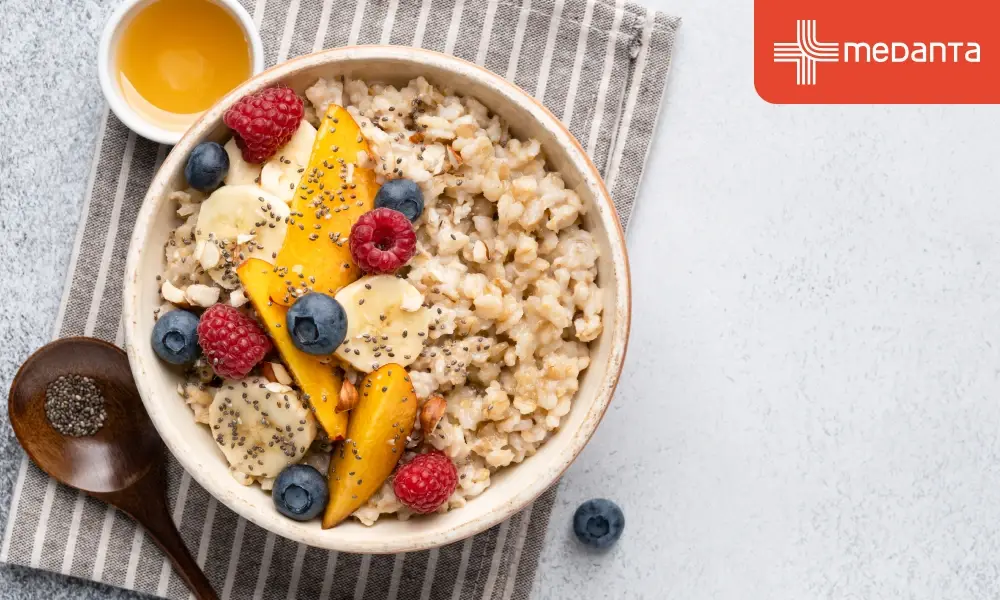
Breakfast porridge: 40 to 50g of rolled oats cooked with water or skimmed milk, topped with fresh fruit or a small quantity of nuts
Overnight oats: Soaking rolled oats in curd or milk overnight preserves beta-glucan integrity and suits patients who prefer a no-cook
Savoury preparations: oats upma or oats khichdi (prepared with vegetables and minimal oil) are well-accepted formats
Smoothie addition: Two tablespoons of raw rolled oats blended into a fruit or vegetable smoothie adds fibre and protein without significantly altering flavour
Baking: substituting a portion of refined flour with oat flour in chapati, chilla, or idli batter increases fibre content without a perceptible change in texture for most patients.
Conclusion
A fair assessment of oats requires one qualification upfront: no dietary staple, however well-studied, functions as a therapeutic agent. Oats do not reverse established cardiovascular disease or correct metabolic dysfunction on their own. What they do provide is a combination of beta-glucan, protein, and micronutrients that supports LDL reduction, glucose moderation, digestive health, and sustained satiety within a caloric range that does not burden weight management.
Incorporating 40 to 70g of rolled or steel-cut oats daily is, for most patients, a low-effort and evidence-backed dietary adjustment with returns that accumulate over time.
FAQs
What are the health benefits of eating oats daily?
The documented benefits of eating oats daily span several systems: lower LDL cholesterol through beta-glucan's bile acid binding mechanism, improved post-meal glucose control through slowed gastric emptying, enhanced gut microbiome diversity through prebiotic fibre, and more sustained satiety compared with most breakfast alternatives.
Are oats good for weight loss?
Satiety is the key mechanism. The fibre and protein in oats slow gastric emptying and prolong the signal of fullness. A 50g cooked serving delivers this at 175 to 190 kcal and, for most patients, sustains appetite suppression for three to four hours. Maintained consistently and without calorie-dense additions, this creates the kind of modest, sustainable caloric deficit that weight management programmes depend on.
How do oats help reduce cholesterol?
Beta-glucan(the soluble fibre in oats) forms a viscous gel in the small intestine that binds bile acids and impairs their reabsorption. The liver compensates by converting circulating LDL cholesterol into new bile acids, effectively reducing serum LDL.
Are oats good for diabetes patients?
Oats have a glycaemic index of approximately 55 (low to moderate range). The beta-glucan content slows glucose absorption and attenuates post-meal glycaemic spikes - a clinically relevant effect for patients managing type 2 diabetes & prediabetes.
Can oats improve digestion?
Digestive benefit comes from both fractions of oats' fibre content acting in different ways. Beta-glucan (the soluble component) is fermented by gut bacteria - selectively feeding populations like Bifidobacterium that support gut barrier function. The insoluble fibre works mechanically, increasing stool bulk and improving transit time. Patients with constipation, post antibiotic microbiome disruption or sluggish gut motility generally see meaningful improvement, provided oats are introduced gradually rather than abruptly.
What is the best time to eat oats?
Breakfast is the most clinically supported timing for most patient groups. Starting the day with oats establishes a low glycaemic baseline, suppresses mid-morning appetite, and reduces the compensatory overeating that often follows a glucose spike from a refined-carbohydrate breakfast.
Are oats good for heart health?
The cardiovascular benefit of oats is among the most thoroughly documented in nutritional science. The mechanism centres on beta-glucan's LDL-lowering effect. Consistent intake of 3g of beta-glucan daily has been associated with 5 to 10% reductions in LDL cholesterol in patients with elevated cardiovascular risk.
Can oats cause any side effects?
Oats are broadly well tolerated, with side effects uncommon at standard dietary quantities. The most frequently reported issue is gastrointestinal like bloating, flatulence, or loose stools. True oat allergy exists but is uncommon.
Which type of oats is the healthiest?
Steel-cut oats are the least processed form and carry the lowest glycaemic index, making them the strongest clinical choice. Rolled oats are a close second, nutritionally comparable, more convenient, and better suited to preparation methods like overnight oats or porridge. Instant oats have undergone additional processing that increases their glycaemic index and reduces preparation time at the cost of some nutritional benefit.
Are oats suitable for children and elderly people?
Oats are appropriate for children from the age of six months onward when introduced as a weaning food, provided they are prepared as a smooth, thin porridge without added salt, sugar, or honey. For school-age children, oats support sustained concentration and energy through the morning. In elderly patients, oats offer specific value: the calcium, magnesium, and phosphorus content supports bone health; the fibre addresses the constipation that commonly affects older adults; and the low glycaemic index assists glucose management in those with age-related insulin resistance.