1068
1068
 Request Call Back
 Contact
 1068
1068
Crooked Teeth: Causes, Health Risks, and the Best Treatment Options Available
Published on: Aug 19, 2026
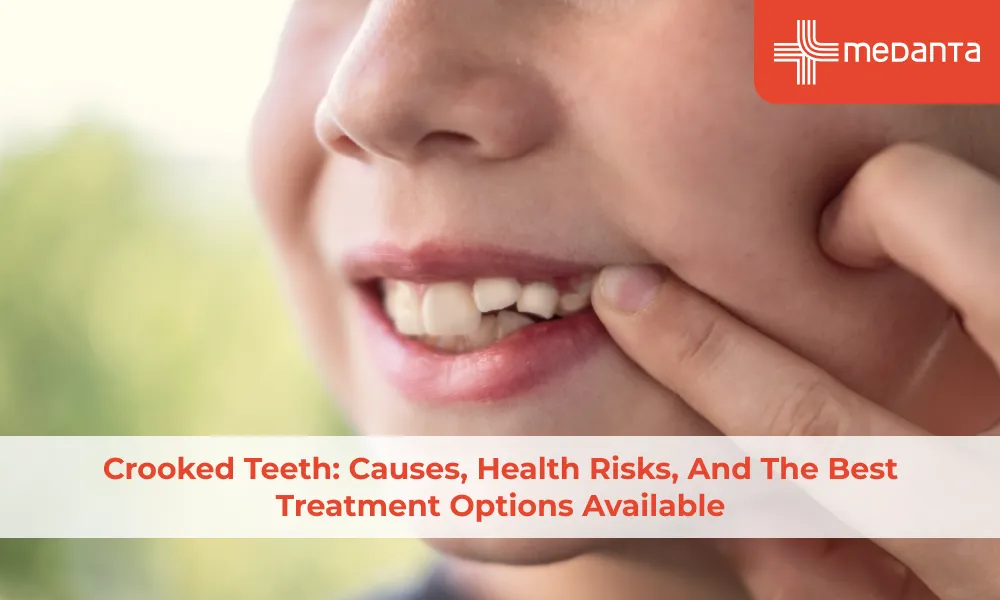
TABLE OF CONTENTS
- Common Causes of Crooked or Misaligned Teeth
- Crooked Teeth in Children vs Adults
- Health Problems That Crooked Teeth Can Cause
- How Dentists Evaluate Teeth Misalignment
- Traditional Braces: How They Work and Who They're For
- Clear Aligners (Invisalign) – An Invisible Alternative
- Other Treatment Options: Retainers, Veneers, Surgery
- Cost of Crooked Teeth Treatment in India
- Preventing Misalignment in Children
- Conclusion + How to Start Your Orthodontic Journey
- FAQs
- References
Crooked teeth (rotated, overlapping, crowded, or sitting outside the normal) arch are among the most common dental findings worldwide. For many people they are primarily cosmetic. For others, misalignment produces real clinical consequences: difficulty cleaning, uneven bite forces wearing down enamel, jaw muscle strain, and speech difficulties. Understanding which category applies determines whether treatment is elective or medically appropriate.
Common Causes of Crooked or Misaligned Teeth
Common causes are:
Genetics: Jaw and tooth size are largely inherited; a small jaw crowding large teeth is the most frequent pattern
Childhood habits: Prolonged thumb-sucking beyond age four, extended dummy use and tongue-thrusting push teeth forward and alter jaw development
Mouth breathing: Changes the resting position of the tongue and jaw muscles, leading to narrow arch development and crowding
Early loss of primary teeth: Losing baby teeth too early through decay or injury allows neighbouring teeth to drift and crowd the space
Untreated decay and gum disease: Bone loss allows teeth to shift; missing teeth create gaps into which adjacent teeth drift
Crooked Teeth in Children vs Adults
Growing jaws make orthodontic intervention more effective and faster in children. Early assessment at age seven is recommended even when treatment won't begin until the early teens. Interceptive orthodontics - expanders or partial appliances - can guide jaw development before all permanent teeth erupt.
In adults, denser jaw bones mean movement takes longer, and some corrections straightforward in children require surgery in adults. Adult orthodontic treatment is fully effective including braces and clear aligners work at any age and discreet options have significantly increased adult uptake in Indian metro cities.
Health Problems That Crooked Teeth Can Cause
Common issues are:
Crooked teeth are harder to clean: Overlapping surfaces create areas toothbrushes and floss cannot reach leading to plaque accumulation, higher caries risk and periodontal disease.
Due to misaligned bites your teeth are exposed to uneven forces accelerating enamel wear which over time may cause fracture.
Malocclusion is associated with TMJ dysfunction: Pain, clicking, and reduced mouth opening from muscles compensating for uneven bite forces.
Speech sounds (sibilants (s, z) and fricatives (f, v)) are affected when tooth position disrupts tongue contact during articulation.
Severe crowding is also associated with increased snoring and mild sleep-disordered breathing.
How Dentists Evaluate Teeth Misalignment
Your orthodontist will examine teeth, bite and jaw position using Angle's classification. OPG provides a full-arch view; cephalometric X-ray measures jaw angles for treatment planning. Complex cases use CBCT for three dimensional imaging.
Traditional Braces: How They Work and Who They're For
Metal braces use brackets bonded to each tooth connected by archwires that move teeth through bone over time. The wire is adjusted every four to eight weeks as teeth move. Ceramic braces use tooth-coloured brackets for reduced visibility. Lingual braces attach to the inner tooth surfaces thus making them invisible from the front.
Traditional braces remain most effective for severe misalignment, significant rotations, large spaces and jaw discrepancies requiring combined correction. Treatment duration is 18 to 36 months.
Clear Aligners (Invisalign) – An Invisible Alternative
Clear aligners are custom fitted removable plastic trays worn for one to two weeks which gradually move teeth toward the planned position. They are nearly invisible and can be removed for eating and oral hygiene. Invisalign is the most widely known brand and many Indian brands including toothsi, makeO and SMILELIGN offer locally manufactured alternatives at lower price points.
Clear aligners suit mild to moderate misalignment and spacing. Severe crowding, complex rotations and higher degrees of bite correction are better managed with conventional braces. Compliance requires wearing trays 20 to 22 hours daily - frequent removal undermines planned results.
Other Treatment Options: Retainers, Veneers, Surgery
Retainers (fixed wire behind the front teeth, or removable Hawley or clear retainers) correct very minor spacing or mild relapse after prior treatment. They are maintenance tools, not primary correction devices for significant misalignment.
Veneers are porcelain or composite shells bonded to teeth to mask crookedness cosmetically but the teeth remain misaligned, with hygiene and bite implications unchanged. Orthognathic surgery corrects severe skeletal jaw discrepancies (underbite or overbite from jaw position) combined with orthodontic treatment before and after.
Cost of Crooked Teeth Treatment in India
The cost of treating crooked teeth in India depends the type of orthodontic treatment chosen, how complex the case is, how long the treatment takes and the orthodontist's level of experience. Metal braces are usually the most budget friendly option. While ceramic braces, lingual braces & clear aligners tend to cost more largely because of their aesthetic appeal and the more advanced technology behind them.
Location plays a role too with metropolitan cities often charging more than smaller towns. Government dental colleges offer orthodontic treatment at substantially reduced rates.
Preventing Misalignment in Children
Effective preventive strategies are:
Discourage thumb sucking and dummy use beyond age three to four - these habits reshape the developing arch
Treat decay in baby teeth promptly rather than extracting early - preserving space for permanent teeth matters
Encourage nasal breathing and address adenoid or tonsil enlargement that forces chronic mouth breathing through paediatric ENT review
First orthodontic assessment at age seven - X-rays reveal developing problems not yet visible
Conclusion + How to Start Your Orthodontic Journey
Crooked teeth range from a minor cosmetic concern to a driver of real dental health problems. A consultation with an orthodontic specialist provides the most complete assessment of options. In India's dental market from government college treatment to premium aligner brands, orthodontic care is accessible across most budgets.
FAQs
Is having crooked teeth a medical problem or just cosmetic?
Both depending on severity. Mild crookedness without bite issues is largely cosmetic. Moderate to severe misalignment makes it difficult for you to clean teeth, causes enamel wear, TMJ strain and sometimes speech or breathing problems.
At what age should crooked teeth be corrected in children?
First orthodontic assessment at age seven identifies developing problems. Active treatment typically begins between 10 and 14. Interceptive treatments like palate expanders & space maintainers begin earlier to guide jaw development.
How long does it take braces to fix crooked teeth?
Most cases take 18 to 36 months. Mild cases may resolve in 12 to 18 months; complex cases may require longer. Clear aligner treatment for mild cases runs 6 to 18 months.
Are clear aligners as effective as traditional braces?
For mild to moderate misalignment, outcomes are comparable. For severe crowding, complex rotations, significant bite correction or vertical movement, traditional braces remain more effective. Case selection is the key variable as a well-selected aligner case produces excellent results.
Can crooked teeth lead to headaches or jaw pain?
Yes. Malocclusion places uneven forces on the jaw muscles and TMJ, producing headaches, jaw clicking, jaw pain and limited mouth opening. Orthodontic correction of the underlying bite often reduces or resolves these symptoms.
Can crooked teeth be fixed without braces in adults?
Clear aligners are an effective brace free option for mild to moderate misalignment. Veneers mask crookedness cosmetically (without moving your teeth). For severe misalignment, braces (including ceramic or lingual) remain the most effective approach.
How much does teeth alignment treatment cost in India?
Metal braces are generally the most affordable option. While ceramic braces, lingual braces and clear aligners tend to cost more. Government dental colleges offer treatment at significantly lower rates.
Do crooked teeth affect the way you speak?
Yes in some cases as sibilants (s, z) and fricatives (f, v, th) can be distorted when tooth position disrupts tongue contact during speech.
Does mouth breathing cause crooked teeth in children?
Yes chronic mouth breathing changes the tongue's resting position, leading to a narrower, higher arch and crowding. Addressing the underlying cause (like enlarged adenoids or nasal obstruction) alongside orthodontic treatment gives better long term results than orthodontics alone.
Will crooked teeth get worse over time if left untreated?
Generally yes. Teeth drift throughout life - the lower front teeth tend to crowd progressively even in those who had straight teeth in their twenties. Untreated misalignment combined with gum disease accelerates drifting considerably.
Do crooked teeth worsen with age?
Yes. Ageing jaw changes and the continued natural forward pressure teeth exert produce progressive crowding particularly of the lower front teeth even without prior misalignment. This is why retainers after orthodontic treatment are recommended indefinitely, not just for a few years.
References
1. Proffit WR, Fields HW, Larson BE, Sarver DM. Contemporary Orthodontics. 6th ed. St Louis: Elsevier; 2018.
https://doi.org/10.1016/C2015-0-00387-3
2. Bishara SE. Textbook of Orthodontics. Philadelphia: Saunders; 2001. Chapter 3: Aetiology of malocclusion.
https://doi.org/10.1016/B978-0-7216-8289-5.X5001-9
3. Petti S. Over two hundred million injuries to anterior teeth attributable to large overjet: a meta-analysis. Dent Traumatol. 2015;31(1):1–8.
https://doi.org/10.1111/edt.12126
4. Lagravère MO, Flores-Mir C. The dental and skeletal effects of Invisalign orthodontic aligners: a systematic review. J Am Dent Assoc. 2005;136(12):1724–9.
https://doi.org/10.14219/jada.archive.2005.0117
5. Thiruvenkatachari B, Harrison JE, Worthington HV, O'Brien KD. Orthodontic treatment for prominent upper front teeth (Class II malocclusion) in children and adolescents. Cochrane Database Syst Rev. 2013;(11):CD003452.