


Critical care medicine and anaesthesiology are disciplines that share a common physiological foundation. The intensivist and the anaesthesiolog...
Critical care medicine and anaesthesiology are disciplines that share a common physiological foundation. The intensivist and the anaesthesiologist both manage airway, ventilation, haemodynamics and organ support - one primarily in the operating theatre, the other in the ICU. At many institutions these functions are performed by the same doctor and the clinical crossover is significant: a surgeon operating on a brain tumour requires an anaesthesiologist who understands neurocritical physiology; a patient recovering from that operation in the ICU requires the same understanding applied to post-operative care. The integration of perioperative and intensive care expertise is particularly valuable in a hospital that manages complex cardiac and neurosurgical cases.
Medanta Indore's Critical Care department is staffed by anaesthesiologists and intensivists whose training spans cardiac anaesthesia, neuro-anaesthesia and neurocritical care, regional anaesthesia, and general ICU management. The team works in direct clinical alignment with the hospital's cardiac surgery and neurosurgery programmes providing the perioperative and critical care infrastructure that complex surgical care requires.
The department covers operative anaesthesia for cardiac, neurosurgical, and high-risk general surgical cases, post-operative critical care management, neurocritical care for patients with neurological emergencies, acute pain management and specialised procedures including bronchoscopy and sleep apnea assessment.
Cardiac Anaesthesia for Complex Cardiac Surgery
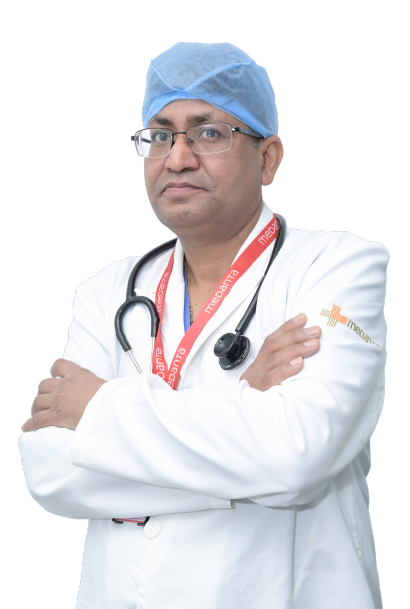
Cardiac surgery including coronary artery bypass grafting, valve replacement and congenital heart disease repair requires anaesthesia management that is materially different from general surgical anaesthesia. The induction, maintenance, and emergence phases must be calibrated to a patient whose cardiac function may already be significantly compromised. Cardiopulmonary bypass management, myocardial protection during aortic cross-clamp, weaning from bypass, and haemodynamic management in the immediate post-operative period all demand specific training and experience in the cardiac operating environment. Dr. Manoj Kumar Gupta provides cardiac anaesthesia for complex cardiac surgical procedures at Medanta Indore working in direct clinical collaboration with the cardiac surgery team.
Neuro-Anaesthesia and Neurocritical Care
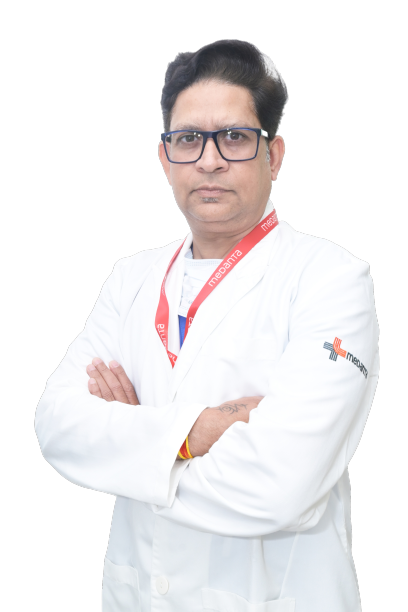
Neuro-anaesthesia requires an understanding of cerebral autoregulation, intracranial pressure physiology and the effects of anaesthetic agents on cerebrovascular haemodynamics - knowledge that significantly influences agent selection, ventilatory management, and positioning throughout a neurosurgical procedure. Dr. Nikhil Swarnkar completed a Fellowship in Neuro-Anaesthesia and Neurocritical Care at Medanta - The Medicity, Gurugram. His clinical scope covers neuro-anaesthesia for brain tumour resections, cerebrovascular surgery including aneurysm clipping, endovascular neuro-interventional procedures, spine surgery anaesthesia, and neurocritical care management for patients with stroke, traumatic brain injury, and neurological emergencies in the ICU.
General ICU Management, High-Risk Surgical Anaesthesia, and Regional Techniques
General ICU management including mechanical ventilation, haemodynamic monitoring and support, management of post-operative complications, and organ support is within the scope of all four members of the department. Anaesthesia for high-risk surgical patients like those with significant cardiac comorbidity, respiratory disease, or complex metabolic conditions requires pre-operative risk assessment, intra-operative monitoring commensurate with the risk level and post-operative critical care planning. Regional anaesthesia techniques (neuraxial blocks & peripheral nerve blocks) provide targeted anaesthesia and analgesia that reduce systemic analgesic requirements and facilitate earlier mobilisation particularly relevant in orthopaedic and abdominal surgical patients. Dr. Akshay Kumar Khairwar manages anaesthesia and critical care with a specific focus on neuro-critical care and cardiac critical care alongside Dr. Gupta and Dr. Swarnkar.
Dr. Manoj Kumar Gupta, Principal Consultant, completed his MD in Anaesthesiology at Mahatma Gandhi Memorial Medical College, Indore and his MBBS at Gajraraja Medical College, Gwalior. His clinical practice covers cardiac anaesthesia for complex cardiac surgical procedures, general anaesthesia and perioperative management, critical care support and ICU management, anaesthesia for high-risk surgical patients, neuro-anaesthesia, and regional anaesthesia techniques.
Dr. Nikhil Swarnkar, Principal Consultant, completed both his MBBS and MD in Anaesthesiology at NSCB Medical College, Jabalpur - a government medical college with broad surgical and anaesthesia training exposure before undertaking a dedicated Fellowship in Neuro-Anaesthesia and Neurocritical Care at Medanta - The Medicity, Gurugram. That fellowship represents structured subspecialty training in one of India's highest-volume neurosurgical environments. His clinical scope specifically covers neuro-anaesthesia for complex neurosurgical and endovascular procedures, neurocritical care, acute pain management, and anaesthesia for brain tumours, stroke, and neurovascular disorders.
Dr. Smita Jain, Consultant, manages critical care, life support, sleep apnea studies, and bronchoscopy - the last two representing diagnostic and procedural capabilities within the department that extend beyond purely operative anaesthesia.
Dr. Akshay Kumar Khairwar, Associate Consultant, holds an MD in Anaesthesiology and Critical Care from Gandhi Medical College, Bhopal, alongside an M.Tech in Bioinformatics from the Indian Institute of Information Technology, Allahabad - an unusual academic combination - and an MBBS from Mahatma Gandhi Memorial Medical College, Indore. His clinical focus covers anaesthesia and critical care, neuro-critical care, and cardiac critical care.
What is neuro-anaesthesia and why does it require specialist training?
Neuro-anaesthesia is the subspecialty of anaesthesia concerned with the management of patients undergoing neurosurgical procedures - brain tumour resections, cerebrovascular surgery, spinal surgery, and endovascular neuro-interventional procedures. The brain is uniquely sensitive to physiological perturbation: fluctuations in carbon dioxide levels alter cerebrovascular tone and intracranial pressure; certain anaesthetic agents have direct effects on cerebral metabolic rate and electrical activity; patient positioning affects venous drainage and perfusion pressure. Managing these variables simultaneously while maintaining adequate anaesthesia depth and haemodynamic stability requires specific training in neurocritical physiology and familiarity with the operative requirements of the neurosurgical team. Not all anaesthesiologists have this subspecialty preparation; Dr. Swarnkar's dedicated neuro-anaesthesia fellowship at Medanta Gurugram reflects exactly this training.
What does post-operative critical care after cardiac surgery involve?
Patients who have undergone open cardiac surgery including bypass grafting, valve replacement, or complex structural repair are managed in the cardiac ICU immediately after the procedure. The immediate post-operative period involves careful management of haemodynamics as the myocardium recovers from the surgical stress and cardiopulmonary bypass, ventilator weaning and extubation when respiratory parameters are adequate, monitoring for arrhythmias, drainage management, renal function monitoring and pain management. Chest tubes drain any accumulated blood or fluid from the pleural and pericardial spaces. Most uncomplicated patients are extubated within six to eight hours of surgery and move out of the ICU within one to two days.
What is endovascular neuro-interventional anaesthesia?
Endovascular neuro-interventional procedures including catheter-based coiling of cerebral aneurysms, mechanical thrombectomy for acute ischaemic stroke, and embolisation of arteriovenous malformations are performed in the angiography suite rather than a conventional operating theatre. They require anaesthesia management in an environment with limited access to the patient and under fluoroscopic imaging. The choice between general anaesthesia and conscious sedation for these procedures is an active area of clinical debate, particularly for stroke thrombectomy; the neuro-anaesthesiologist's role includes optimising cerebral perfusion conditions during the procedure and managing any neurological or haemodynamic complications that arise. Dr. Swarnkar's specific listing of endovascular neuro-interventional anaesthesia reflects experience in this procedural environment at Medanta.


 1068
1068
 Request Call Back
 Contact
 1068
1068