1068
1068
 Request Call Back
 Contact
 1068
1068
Why Do Men Have Nipples? The Science Behind Male Nipples
Published on: Sep 30, 2026
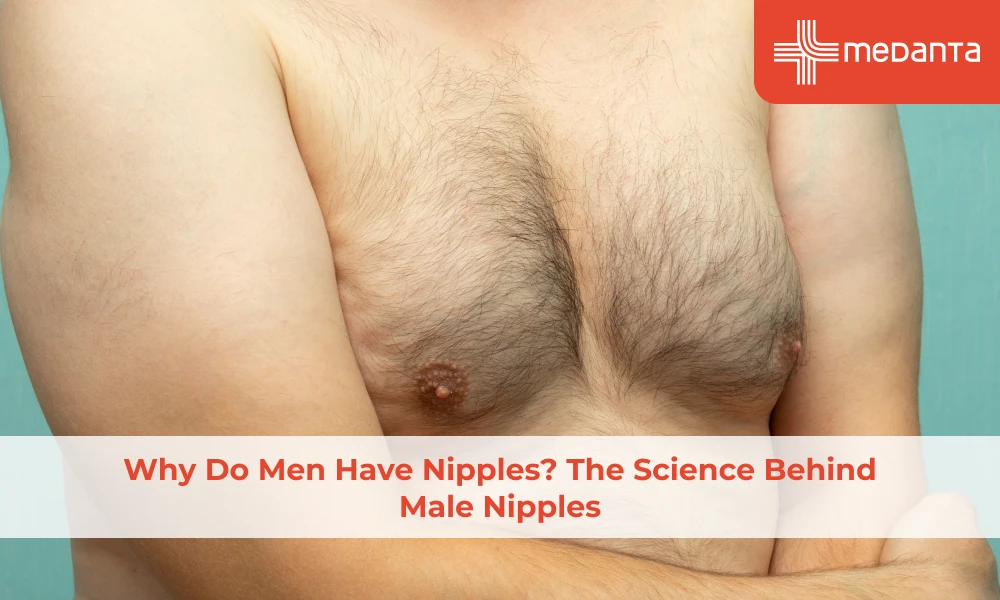
TABLE OF CONTENTS
Male nipples are simply part of normal human development, present because every embryo follows the same basic developmental blueprint in the earliest weeks of pregnancy. Nipples actually form before the embryo has settled into becoming male or female, so both sexes end up with them from the start. As development moves forward, sex hormones step in to shape the reproductive organs along male or female lines, but the nipples remain because they do not interfere with normal male development.
The Biological Reason Men Have Nipples
The short answer is that nipples develop in human embryos before the embryo's sex is determined at the hormonal level. By the time the hormones that differentiate a male body from a female body begin to act, the nipples are already there and there is no biological mechanism that removes them in males.
From an evolutionary perspective, the genetic cost of maintaining nipples in males is negligible and they take minimal developmental resources to build and carry no disadvantage essentially. The simplest and most evolutionarily stable way to ensure nipples are reliably present in females where they are essential for infant survival is to build nipples in all embryos first and then only develop the milk-producing glandular tissue in females under the influence of oestrogen at puberty. Male nipples are therefore a retained ancestral feature, present in males because removing them would require a more complex developmental mechanism than simply leaving them in place.
How Nipples Develop Before Birth
In the first six weeks of embryonic development, human embryos of both genetic sexes (XX and XY) follow an identical developmental pathway. Nipple development begins at approximately four to five weeks of gestation, when two ridges of thickened skin called the mammary ridges or milk lines form along both sides of the embryo's ventral (front) surface, running from the armpits down to the groin. In humans, these ridges mostly regress, leaving only two points of thickened skin tissue in the chest area that will eventually become the nipples and the underlying breast tissue.
At approximately six to seven weeks of gestation, the SRY gene on the Y chromosome of XY embryos triggers testicular development and testosterone production. The hormonal signals that build male genitalia have no instruction to remove the nipples which have already formed and are committed to their developmental pathway. At puberty, oestrogen in females drives the growth of the underlying glandular breast tissue. In males, testosterone suppresses further breast tissue development. The nipple itself, however, remains.
Do Male Nipples Serve Any Purpose?
Male nipples have limited biological function but they are not completely without purpose. They are:
Erogenous sensitivity: Male nipples contain a dense network of sensory nerve endings and are sensitive to touch temperature, and stimulation. Many men report nipple sensitivity as a normal part of sexual response.
Thermoreception: Nipple tissue is responsive to cold temperature, causing nipple erection through contraction of the underlying areolar smooth muscle.
Latent lactation capacity: Male breast tissue retains the structural capacity to produce milk under specific hormonal conditions, demonstrating that the tissue is not entirely dormant.
Can Men Lactate? Separating Myth from Fact
Under certain circumstances, men can produce small amounts of milk-like fluid from their nipples called male galactorrhoea. This is not a normal occurrence and is almost always a sign of an underlying medical condition. These are:
Elevated prolactin (hyperprolactinaemia): When prolactin rises due to a pituitary tumour (prolactinoma), certain medications (including antipsychotic drugs, domperidone, and metoclopramide), hypothyroidism, or chronic kidney disease the residual ductal breast tissue in men can begin producing fluid.
Physiological male lactation: In uncommon situations, severe malnutrition followed by nutritional recovery has been reported to trigger temporary milk production in men.
Any nipple discharge in men should be evaluated by a doctor to identify the underlying cause.
Common Concerns About Male Nipples

Several benign changes in male nipples can cause concern but are usually medically insignificant. These are:
Gynaecomastia: The benign enlargement of male breast glandular tissue is extremely common, affecting many adolescent boys during puberty. It is caused by a relative imbalance between oestrogen and testosterone and typically resolves without treatment within one to two years. Persistent gynaecomastia beyond puberty or gynaecomastia in older men may benefit from medical evaluation.
Inverted nipples: Inverted nipples are a normal anatomical variant caused by shorter-than-usual lactiferous ducts tethering the nipple inward. They are present from birth in most cases and are entirely benign. Medical evaluation is only needed if inversion is newly acquired in adulthood as this can indicate fibrotic change in the breast tissue.
Nipple hair and puffy areola: Hair follicles around the areola are normal in men with no medical significance. A raised or puffy areola in adolescent boys is a common manifestation of pubertal gynaecomastia and typically resolves as puberty progresses.
When Male Nipple Changes Need a Doctor's Attention
Most changes in male nipples are benign and self-limiting. However, the following changes require prompt medical evaluation.
Any spontaneous fluid discharge from a male nipple (milky, clear or bloodstained)
A hard, painless lump beneath the nipple that does not resolve over several weeks
Nipple retraction that develops in adulthood, skin changes over the nipple or areola (redness, scaling, ulceration or a Paget's disease-like eczematous rash) and significant new pain in the nipple or breast tissue all require prompt dermatological or surgical evaluation.
Conclusion
Male nipples exist because human embryos of both sexes build nipples before sex-determining hormones act and there is no developmental instruction to remove them in males. They are a retained ancestral feature that serves minimal but real biological functions including erogenous sensitivity and the latent capacity for lactation under abnormal hormonal conditions.
Most male nipple concerns like gynaecomastia, inverted nipples and areolar puffiness in adolescence are entirely benign and self-limiting. However nipple discharge, hard lumps beneath the nipple or newly acquired nipple retraction or skin changes in adult men should be promptly evaluated to exclude male breast cancer or significant hormonal pathology.
FAQs
Why do men have nipples if they don't breastfeed?
Men have nipples because nipple development in human embryos begins at approximately four to five weeks of gestation before the hormonal signals that differentiate a male body from a female body begin to act. By the time testosterone is produced by the testes of XY embryos, the nipples are already formed. There is no developmental instruction to remove them in males,and since maintaining nipples in males carries almost no evolutionary cost, they are retained.
Do male nipples serve any biological purpose?
Male nipples retain erogenous sensitivity - they contain a dense network of sensory nerve endings and are responsive to touch and stimulation in many men. They also respond to cold temperature by nipple erection through contraction of the underlying areolar smooth muscle. The underlying residual breast tissue retains a latent capacity for milk production under abnormal hormonal conditions such as elevated prolactin levels.
At what stage does the body decide male or female nipples?
Nipples are formed in all embryos between approximately four and five weeks of gestation. The differentiation into a male or female form begins at approximately six to seven weeks of gestation, when the SRY gene triggers testicular development and testosterone production in XY embryos. Since the nipples have already formed by this point, hormonal masculinisation does not remove them. At puberty, oestrogen drives glandular breast tissue development in females. In males, testosterone suppresses this development but the nipple itself is retained.
Can men lactate from their nipples?
Yes men can produce small amounts of milk-like fluid from their nipples under specific abnormal hormonal conditions, called male galactorrhoea. The most common causes are elevated prolactin levels due to a pituitary tumour (prolactinoma), certain medications (including antipsychotic drugs, domperidone, and metoclopramide), hypothyroidism, or chronic kidney disease. Male galactorrhoea should always be investigated to identify and treat the underlying cause.
Why are some men's nipples more sensitive than others?
Nipple sensitivity varies between individuals and is determined by the density and distribution of sensory nerve endings in the nipple and areolar tissue. Genetic variation in nerve density, individual differences in skin thickness, and hormonal influences throughout development all contribute to this variation. There is no medical significance to having very sensitive or very insensitive nipples, provided there are no accompanying changes such as pain, discharge or a new lump.
Is a puffy or swollen male nipple normal?
A puffy or raised appearance of the areola in adolescent boys is a very common and normal manifestation of pubertal gynaecomastia - the benign enlargement of male breast glandular tissue due to a temporary imbalance between oestrogen and testosterone. It typically resolves without treatment within one to two years.
Do all mammals have nipples regardless of gender?
Almost all mammals have nipples in both sexes, for exactly the same developmental reason that applies to humans - nipple development occurs before sex differentiation in mammalian embryos. There are some notable exceptions: male horses (stallions) and male rats lack nipples entirely.
Can male nipples get erect like female nipples?
Yes male nipples can become erect in the same way as female nipples. Nipple erection is mediated by contraction of the areolar smooth muscle beneath the nipple tissue in response to cold temperature, touch or sexual stimulation. This smooth muscle is present in both male and female nipples and functions in the same way regardless of sex.
Why do some men have inverted nipples?
Inverted nipples where the nipple points inward rather than outward are a normal anatomical variant caused by shorter-than-usual lactiferous ducts tethering the nipple inward. They are present from birth in most cases and are entirely benign. Inverted nipples in men require medical evaluation only if newly acquired in adulthood as new inversion can indicate fibrotic change in the breast tissue or rarely a mass pulling the nipple tissue inward.
When should a man see a doctor about nipple changes?
A man should see a doctor if any of the following occur:
Spontaneous nipple discharge (milky, clear or bloodstained) in a man not taking medications
A hard, painless lump beneath the nipple that persists for more than a few weeks
New retraction of a nipple that was previously normal
Skin changes over the nipple or areola including redness, scaling or persistent eczema-like rash
New pain in the nipple or breast tissue not explained by obvious causes.
References
1. Veltri KL, Mooney MP, Siegel MI. Development of the nipple-areolar complex in the human embryo. J Morphol. 1987;192(3):249–57. https://doi.org/10.1002/jmor.1051920303
2. Sadler TW. Langman's Medical Embryology, 15th edition. Wolters Kluwer. 2023. https://www.wolterskluwer.com/en/solutions/lippincott/langmans-medical-embryology
3. Braunstein GD. Gynecomastia. N Engl J Med. 1993;328(7):490–5. https://doi.org/10.1056/NEJM199302183280706
4. Cooke PS, Nanjappa MK, Ko C, Prins GS, Hess RA. Estrogens in male physiology. Physiol Rev. 2017;97(3):995–1043. https://doi.org/10.1152/physrev.00018.2016
5. Fentiman IS. Male breast cancer: a review. Endocr Relat Cancer. 2009;16(4):1129–39. https://doi.org/10.1677/ERC-09-0183