1068
1068
 Request Call Back
 Contact
 1068
1068
When Do Babies Start Walking? A Complete Guide for Parents
Published on: Apr 09, 2026
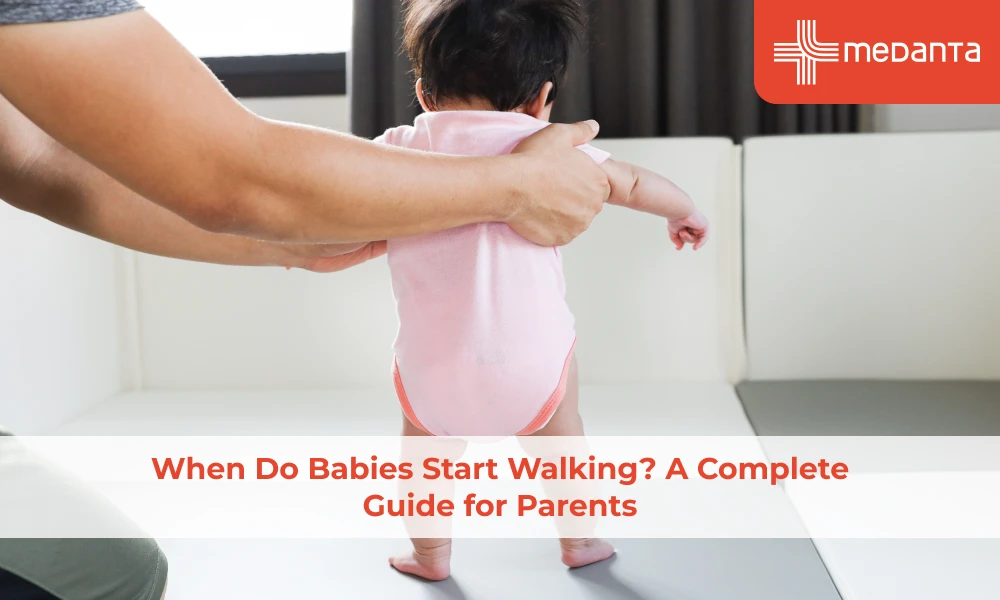
TABLE OF CONTENTS
- Average Age When Babies Start Walking
- Key Developmental Milestones Before Walking
- Signs Your Baby Is Ready to Walk
- Differences Between Early Walkers and Late Walkers
- How Crawling Supports Walking Development
- Common Challenges Babies Face While Learning to Walk
- Role of Muscle Strength and Balance in Walking
- Tips to Encourage Your Baby to Start Walking
- Baby Walkers: Why Most Paediatricians Recommend Avoiding Them
- When to Consult a Doctor for Delayed Walking
- FAQs
Few moments in early parenthood carry the same weight as a baby's first steps. And few things cause as much quiet anxiety as watching another child the same age walk confidently across a room while your baby seems perfectly content to crawl. Understanding what the research actually says about walking, when it happens, what leads up to it, and what genuinely warrants a doctor's attention helps replace that anxiety with a clearer picture.
Average Age When Babies Start Walking
Most babies take their first independent steps between 9 and 12 months, and walking becoming more consistent and confident between 12 and 15 months. The full normal range extends to 18 months, and any child walking independently by that point falls well within expected development. What this means practically is that a baby who starts walking at 9 months and one who starts at 16 months can both be developing entirely normally.
Key Developmental Milestones Before Walking
Walking does not arrive without preparation. In the months leading up to those first steps, babies move through a predictable sequence of motor milestones that build directly on each other.
Rolling over (typically around 4 to 6 months) strengthens the core and gives babies their first experience of controlling their own body in space.
Sitting independently, usually by 6 to 8 months, refines balance and trunk stability.
Pulling up to stand which most babies achieve between 8 and 10 months marks the beginning of weight-bearing on the legs.
Cruising, where a baby moves sideways along furniture while holding on, bridges the gap between standing and walking.
Each stage is both a milestone in itself and preparation for what comes next.
Signs Your Baby Is Ready to Walk
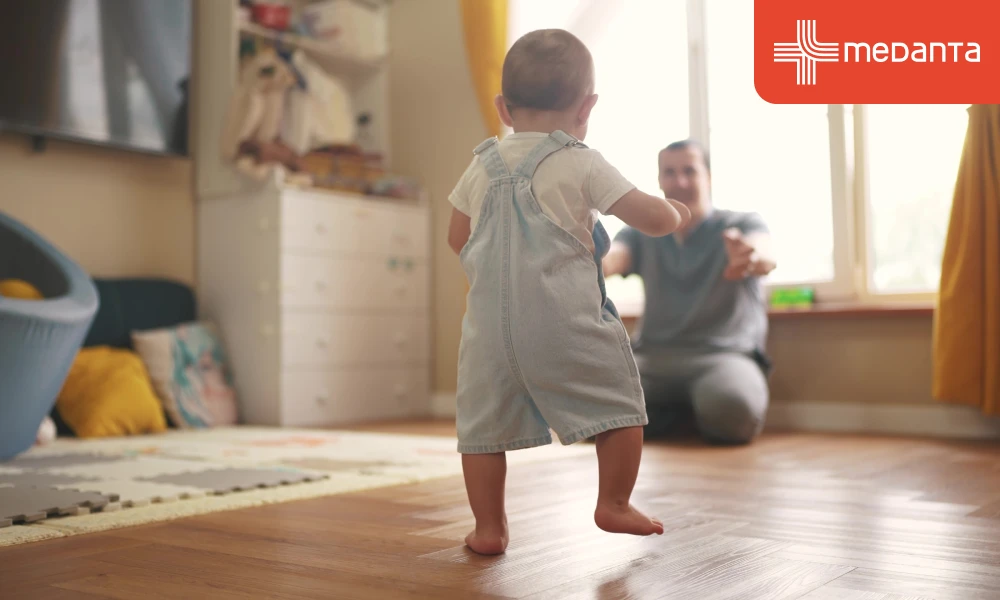
Certain behaviours reliably signal that walking is approaching. A baby who pulls up to standing at every opportunity, who cruises furniture with growing confidence and speed, and who occasionally lets go with one hand to reach for something is physically rehearsing for independent steps. Standing without support even briefly, before dropping back down is one of the clearest signals. Some babies also enter a phase of deliberate practice, repeatedly pulling up, letting go, and sitting back down as though testing their own balance. This kind of motivated, repetitive exploration is exactly what walking preparation looks like.
Differences Between Early Walkers and Late Walkers
The timing of when a baby starts walking varies widely and is influenced by multiple normal factors:
Genetics is the strongest predictor of when a baby walks. Parents who walked early tend to have children who do the same.
Body type plays a role too. Babies with a leaner build often walk earlier, while those with a heavier build may take a little longer to develop the leg strength needed.
Temperament matters as well. Cautious babies may reach the physical readiness for walking but choose to wait until they are confident, while more adventurous children sometimes take off earlier than their coordination is quite ready for.
How Crawling Supports Walking Development
Crawling builds the muscle groups and movement patterns that walking later depends on. Cross-body coordination during crawling develops the same kind of alternating movement that walking requires. Core strength gained through crawling helps with the trunk stability needed to balance upright. Hip and shoulder flexibility developed on all fours translates directly into a more fluid walking gait. Not every baby crawls before walking some bottom-shuffle, some roll, some go straight from pulling up to cruising. But for babies who do crawl, the contribution to walking readiness is significant.
Common Challenges Babies Face While Learning to Walk
Balance is the central challenge, and every new walker is essentially solving a balance problem with each step. Other challenges are:
Frequent falling: Most toddlers fall often but recover quickly
Posture variations: Wide-set stances and bowed legs
Surface changes: Uneven ground, carpets, and steps require gradual adaptation.
Confidence levels: Some babies may delay walking due to fear of falling despite being physically ready.
Role of Muscle Strength and Balance in Walking
Walking requires coordinated development of muscle strength and balance. The core muscles (the abdominals, back extensors, and hip stabilisers) are responsible for keeping the torso upright while the legs move. On the other hand leg muscles (especially the quadriceps and glutes) enable weight-bearing and forward movement. Balance requires the brain, inner ear, and muscles to communicate in real time. All of this develops gradually through the months of floor play, pulling up, and cruising. Babies who spend more time moving freely on the floor typically build these physical foundations more readily.
Tips to Encourage Your Baby to Start Walking
The most effective encouragement is also the simplest:
Give your baby ample floor time on a safe surface, and let them move at their own pace.
Barefoot walking on different textures helps develop foot strength and sensory feedback.
Placing interesting objects just out of reach motivates reaching and stepping.
Holding both hands and walking slowly alongside a baby builds confidence before they are ready to go solo.
Cruising-friendly furniture arrangements a low coffee table, a stable couch give babies a natural circuit to practise on.
Praise and calm encouragement when a baby takes steps matters too.
Baby Walkers: Why Most Paediatricians Recommend Avoiding Them
The evidence here is clear and consistent: baby walkers do not help babies learn to walk, and they carry meaningful safety risks. The American Academy of Paediatrics (AAP) advises against their use. Babies in walkers learn a different movement pattern than walking they push with their toes rather than developing a heel-to-toe gait. Several studies have found that walker use actually delays independent walking by reducing the floor time needed for natural development.
When to Consult a Doctor for Delayed Walking
An 18-month-old who is not yet walking independently deserves paediatric assessment, even in the absence of other symptoms. Other signs that warrant discussion with a doctor include:
Very stiff or very floppy muscle tone
Lack of interest in weight-bearing
A family history of neuromuscular conditions.
FAQs
At what age do most babies start walking?
Most babies take their first independent steps between 9 and 12 months and are walking confidently by 14 to 15 months. The full normal range extends to 18 months.
Is it normal if my baby is not walking by 12 months?
Yes. Twelve months is the average, not the deadline. Many babies who are developing entirely normally walk between 13 and 18 months. If your baby is pulling up, cruising, and showing interest in movement, the walking stage is typically close.
What are the signs that my baby is ready to walk?
Pulling up to stand confidently, cruising along furniture, standing briefly without support, and occasionally letting go with both hands are the clearest signals.
Do all babies crawl before they start walking?
No. Some babies bottom-shuffle or roll instead of crawling, and some move fairly directly from pulling up and cruising to walking. Skipping traditional crawling has not been shown to affect later development negatively.
Can I help my baby learn to walk faster?
You can support the process, but not significantly accelerate it. Providing plenty of floor time, encouraging cruising, letting your baby move barefoot indoors, and offering a steady hand for supported steps all create the right conditions. The timeline itself is largely set by the child's own developmental pace.
Are baby walkers safe for development?
No. Baby walkers have been shown to delay, not support, walking development. They also carry a real injury risk, particularly near stairs. The American Academy of Pediatrics advises against them. Stationary play centres are a safer alternative.
Why do some babies walk earlier than others?
Genetics is the biggest factor. Body type, temperament and the amount of supervised floor time babies get also contribute. Early or late walking within the normal range reflects natural variation.
When should I be concerned about delayed walking?
If your baby is not walking independently by 18 months, a paediatric evaluation is appropriate. Earlier assessment makes sense if the baby shows asymmetrical movement, loses skills already achieved, walks consistently on tiptoes, or has very low or very high muscle tone.
What are common mistakes parents make while teaching walking?
Using baby walkers, keeping babies in bouncers or carriers for long periods instead of allowing floor time, and holding both hands constantly without allowing the baby to practise balance independently are among the most common.
How can I safely support my baby's first steps?
Clear the floor of sharp-edged furniture, use non-slip mats on hard floors, and let your baby move barefoot indoors for better grip and sensory feedback. Offer a hand rather than full arm support so the baby is doing the balance work. Stay close without hovering, and give the baby space to try and fail. Repeated falling and getting back up is exactly how independent walking develops.