1068
1068
 Request Call Back
 Contact
 1068
1068
When Do Babies Start Talking? A Complete Guide for Parents
Published on: Apr 09, 2026
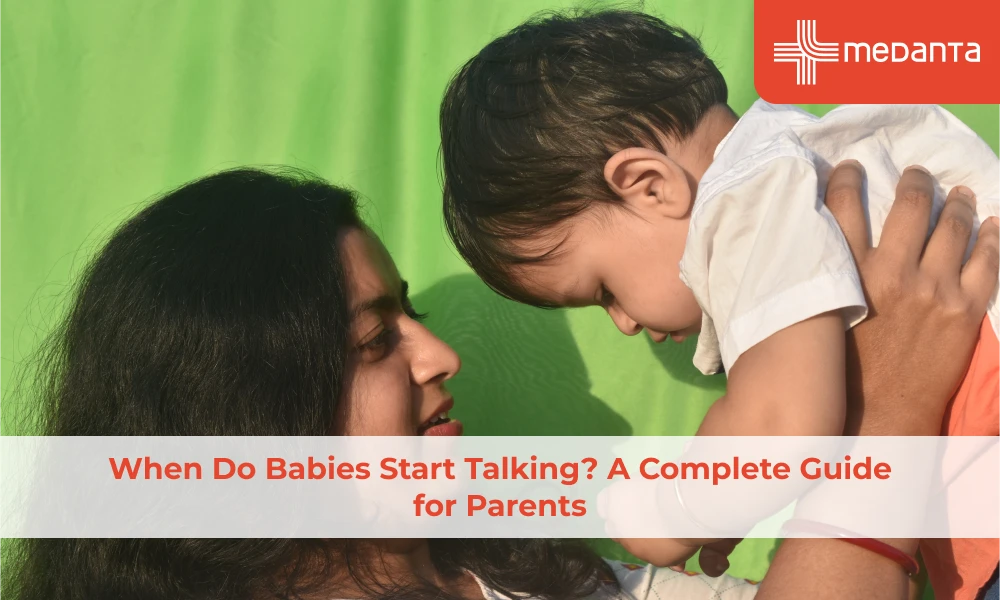
TABLE OF CONTENTS
- Average Age When Babies Start Talking
- Early Communication Milestones: Cooing and Babbling
- First Words: When and What to Expect
- Speech vs Language Development in Babies
- Signs Your Baby Is Ready to Talk
- Factors Affecting Speech Development in Children
- Common Speech Delays and Their Causes
- Tips to Encourage Speech and Language Skills
- Role of Parents and Environment in Language Learning
- When to Consult a Doctor for Speech Delay
- FAQs
Long before a baby says their first word, they are already communicating. The cry that signals discomfort, the wide eyes tracking a familiar face, the slow smile when you speak all of it is language, just not the kind most parents are waiting for. Understanding how speech develops from those earliest sounds through to full sentences makes the whole journey less anxious to watch.
Average Age When Babies Start Talking
Most babies say their first real word between 10 and 14 months, with 12 months being the commonly cited average. By 18 months, a typical vocabulary sits around 10 to 20 words. At 24 months, most children are putting two words together and using roughly 50 words or more. These are averages - a child who speaks their first word at 9 months and one who does so at 15 months can both be developing entirely typically.
Early Communication Milestones: Cooing and Babbling
From around 6 to 8 weeks, babies begin cooing - soft, vowel-like sounds. These represent the earliest deliberate vocalisation. By 4 to 6 months, this gives way to babbling: strings of sounds like "ba-ba-ba" or "da-da-da." Research has shown that babies babble by 6 months in the rhythms of the language spoken most at home. Between 9 and 12 months, babbling grows more complex and intentional, sounding remarkably like a real conversation in a language only the baby knows.
First Words: When and What to Expect
First words rarely arrive as clear announcements. A word counts when a baby uses the same sound consistently to mean the same thing. Common early words include parent or caregiver names, words for food or favourite objects, and social words like "hi" and "no." Words that carry emotional weight tend to come first, which is why many babies name a beloved pet or sibling before they know any body part or colour.
Speech vs Language Development in Babies
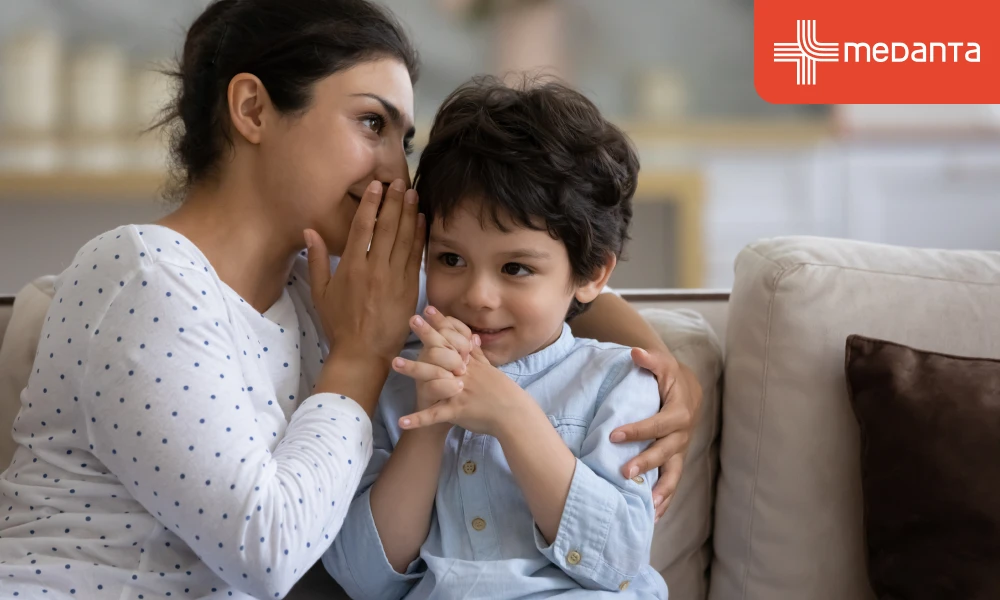
Speech refers to the physical production of sounds and how clearly a child articulates words. Language refers to the broader system: understanding what is said (receptive language) and expressing thoughts and needs (expressive language). A child can have strong language with unclear speech or clear articulation with a limited vocabulary. Paediatricians and speech therapists assess both separately, as delays in one do not necessarily signal delays in the other.
Signs Your Baby Is Ready to Talk
A baby who responds to their name, follows simple one-step instructions, points at things they want, and tries to get a parent's attention through sounds and gestures is building the foundation for speech. Eye contact during vocalisation is another strong signal. Babies who look at a parent while making sounds are practising the turn-taking rhythm that conversation requires. Imitation of sounds and facial expressions is equally telling.
Factors Affecting Speech Development in Children
Hearing is the most critical factor. A baby who cannot hear clearly cannot model their speech on what they hear, which is why newborn hearing screening is standard at birth.
Genetics play a meaningful role, with late talking running in some families. Bilingual exposure, common across India, does not delay language development overall; bilingual children's total communication ability matches that of monolingual peers.
Common Speech Delays and Their Causes
Hearing loss accounts for a significant proportion of speech delays and is the first thing to rule out when a delay is identified. Oral-motor difficulties affect some children's ability to produce sounds correctly. Conditions including autism spectrum disorder, Down syndrome, and cerebral palsy all have associated language patterns that differ from the typical timeline. In some children, no structural cause is identified and the delay resolves over time but early assessment always improves outcomes regardless of the cause.
Tips to Encourage Speech and Language Skills
Narrating daily activities gives babies thousands of words in meaningful context like describing what you are doing while you do it is one of the most effective strategies available. Reading aloud builds familiarity with how language sounds and flows. Responding to babbles as though they are real conversations teaches the structure of communication. Limiting passive screen time under the age of two preserves the face-to-face interaction that language development depends on most.
Role of Parents and Environment in Language Learning
The number of words a baby hears each day, and the quality of interaction around those words, are among the strongest predictors of vocabulary at age three and reading ability at school entry. Babies learn language through live, contingent interaction with people who respond to them not from background television or audio recordings. Talking during feeds, nappy changes, and play, singing, and pointing things out on walks all contribute more than most parents realise.
When to Consult a Doctor for Speech Delay
By 12 months, a baby should be babbling, pointing, and responding to their name. By 18 months, at least 10-20 words. By 24 months, two-word combinations. Any loss of language skills already acquired (a baby who was babbling and then stops) is a red flag at any age and needs immediate review. A referral to a speech-language therapist does not mean a lifelong diagnosis; it means earlier, targeted support rather than months of unnecessary waiting.
FAQs
At what age do babies usually start talking?
Most babies say their first word between 10 and 14 months, with consistent two-word phrases following between 18 and 24 months. The normal range is wide a child talking at 9 months and one talking at 15 months can both be developing entirely typically.
What are the first words babies typically say?
First words are usually what matter most to the baby like names for parents or caregivers, words for food or the names of favourite objects. "Mama" and "dada" are common early words as the sounds are easy to produce & parents respond enthusiastically.
Is it normal if my baby is not talking by 1 year?
Yes. Twelve months is an average, not a deadline. At this age, babbling, pointing, responding to their name, and making eye contact during communication are stronger indicators of on-track development than first words alone.
What is the difference between babbling and talking?
Babbling is the repetition of sounds without consistent meaning attached. Talking begins when a child uses a sound or word consistently to refer to a specific thing or person. The line between the two can be blurry which is why parents often debate whether something counts as a real word.
How can I encourage my baby to speak early?
Talk constantly, narrate your daily routine, read aloud, sing songs with repetition, and respond to babbles as real conversation. Limiting screen time under the age of two and maintaining face-to-face interaction are more effective than any app or programme designed to teach language.
Do boys and girls develop speech at different rates?
On average, girls develop spoken language slightly earlier than boys, but the variation within each group is far larger than the average difference between them. Gender alone is not a sufficient explanation for a significant or persistent speech delay.
When should I worry about speech delay in my child?
Speak to your paediatrician if your child is not babbling by 12 months, not using 10 words by 18 months, not combining two words by 24 months, or if they lose language skills previously acquired at any age.
Can screen time affect my baby's speech development?
Yes. Passive screen time displaces face-to-face conversation, which is the primary driver of language development. Most paediatric organisations recommend avoiding screens entirely for children under 18 to 24 months, apart from video calls with family members.
Should I consult a doctor if my baby is not speaking yet?
If your baby has no clear words by 18 months, or no two-word combinations by 24 months, paediatric assessment is appropriate. Early assessment identifies causes, rules out hearing problems, and connects families with the right support without unnecessary delay.
What activities help improve a baby's language skills?
Reading picture books and naming what you see, singing nursery rhymes, narrating daily routines, and playing back-and-forth games like peekaboo all build language naturally. The common thread is a responsive, engaged adult. Activities with real interaction are consistently more effective than any educational toy or app.