1068
1068
 Request Call Back
 Contact
 1068
1068
Raynaud's Disease: Symptoms, Triggers, Causes, and Treatment Options
Published on: Aug 17, 2026
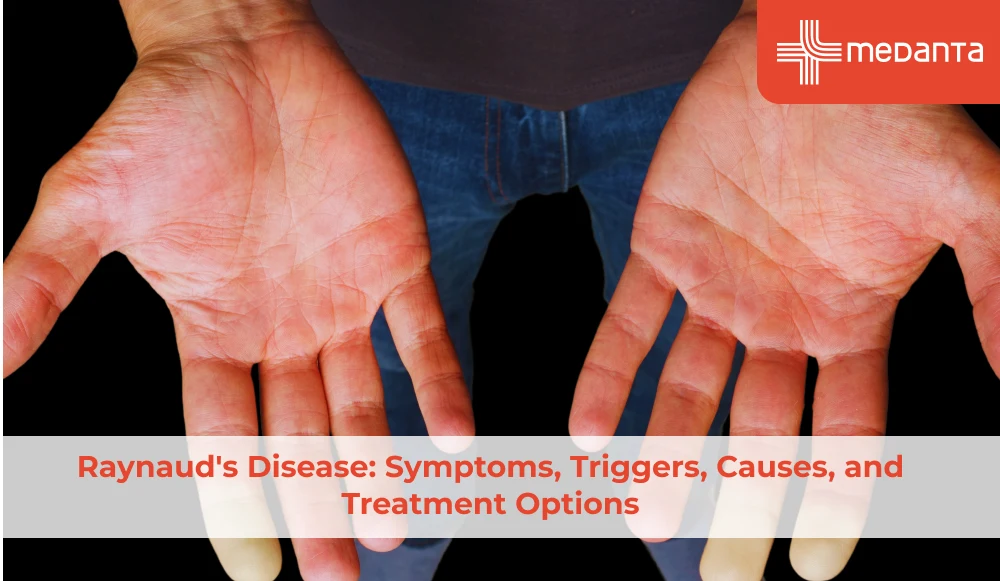
TABLE OF CONTENTS
- Primary vs Secondary Raynaud's – Key Differences
- What Causes Raynaud's Phenomenon?
- Recognising the Colour Changes – White, Blue, Red
- Which Body Parts Are Affected?
- How Is Raynaud's Disease Diagnosed?
- Treatment Options for Raynaud's Disease
- Living With Raynaud's – Daily Tips and Precautions
- Conclusion + When to Seek Specialist Care
- FAQs
- References
Introduction – What Is Raynaud's Disease?
Raynaud's is a condition in which blood vessels in the fingers, toes, ears, nose and lips overreact to cold or stress by going into spasm, temporarily cutting off blood flow. The characteristic colour sequence (white as blood drains, blue from deoxygenation, red as blood returns) is its hallmark. For most people it is manageable and inconvenient rather than dangerous, though severe secondary cases can cause tissue damage.
Primary vs Secondary Raynaud's – Key Differences
Primary Raynaud's occurs without an associated condition. It is more common, tends to be milder, usually begins in young women and rarely causes tissue damage. The vasospasm is exaggerated but blood vessels are structurally normal.
Secondary Raynaud's (or Raynaud's phenomenon) is associated with an underlying condition, most commonly scleroderma or lupus. It typically begins later in life, is more severe, may affect one hand differently, and carries a higher risk of digital ischaemia and tissue complications. Any Raynaud's beginning after age 40 or presenting with asymmetric involvement requires investigation for an underlying cause.
What Causes Raynaud's Phenomenon?
In primary Raynaud's, digital arteries react disproportionately to cold or stress causing constriction which reduces blood flow, where in most people only mild vasoconstriction would occur. Genetic factors, oestrogen effects on vascular tone and variation in sympathetic calibration all influence individual susceptibility.
Secondary Raynaud's involves structural vessel changes like wall thickening, immune inflammation and impaired endothelial function making vessels more susceptible to spasm and slower to recover. Occupational vibration, beta-blockers, ergotamine and smoking are recognised secondary causes.
Common triggers are:
Cold exposure: Reaching into a freezer, handling cold water, or air-conditioned environments; even a mild temperature drop can trigger an episode in sensitive individuals
Emotional stress: Anxiety or sudden fright activates the sympathetic nervous system, triggering vasospasm through the same pathway as cold
Vibration: Power tools, repetitive hand-arm vibration in occupational settings, or extended typing
Smoking: Nicotine directly causes peripheral vasoconstriction and impairs endothelial vasodilator function
Caffeine in excess, pseudoephedrine decongestants, and beta-blockers can all worsen vasospasm.
Recognising the Colour Changes – White, Blue, Red
The triphasic colour change is Raynaud's clinical hallmark. White (pallor) appears first as arterial spasm cuts off blood supply. Blue (cyanosis) follows as residual capillary blood deoxygenates. Red (rubor) appears as the spasm resolves and reactive hyperaemia gives rise to flushing. The white-to-red transition may bring throbbing, tingling, and burning discomfort.
Not all episodes complete the full three-phase sequence as some may produce only pallor and rubor, or pallor alone. Well-demarcated pallor in response to cold or stress is the diagnostic key, not the completeness of the colour sequence.
Which Body Parts Are Affected?
Fingers are affected in the vast majority of cases, usually the middle three more than the thumb or little finger, and typically both hands. Toes are the second most common site. The ears, nose, lips and nipples are less common but well recognised. In severe secondary Raynaud's, persistent digital ischaemia causes digital ulcers - painful, slow-healing fingertip wounds requiring specialist management.
How Is Raynaud's Disease Diagnosed?
Diagnosis is primarily clinical. Cold or stress-triggered colour changes in a characteristic distribution is a classical sign for primary Raynaud's. Investigations are:
Nailfold capillaroscopy or viewing fingernail-base capillaries under magnification is the most sensitive test for distinguishing primary from secondary disease.
ANA, anti-topoisomerase, anti-centromere antibody, and inflammatory markers screen for connective tissue diseases.
Full blood count, thyroid function, and ESR complete the workup.
Treatment Options for Raynaud's Disease
Most primary Raynaud's is managed with trigger avoidance and hand-warming without medication. Secondary Raynaud's more commonly requires pharmacological treatment given its severity and risk of digital complications.
Medications Used to Treat Raynaud's
Calcium channel blockers - nifedipine and amlodipine are first-line; they relax blood vessel smooth muscle and reduce vasospasm frequency and severity
Phosphodiesterase-5 inhibitors - sildenafil and tadalafil for severe or refractory Raynaud's particularly in scleroderma-related disease
Topical nitrates - glyceryl trinitrate cream or patches applied locally to the affected digits produce direct vasodilation
Bosentan - an endothelin receptor antagonist for prevention of digital ulcers in scleroderma-related Raynaud's
Intravenous iloprost - a prostacyclin analogue used in specialist centres for severe ischaemic episodes with digital ulceration
Lifestyle Changes That Help Reduce Episodes
Dress in layers covering the core as well as the extremities - vasoconstriction is partly a response to core temperature drop, so keeping the torso warm reduces it
Use battery-heated gloves or hand warmers in cold environments
Avoid sudden temperature changes as transitions between hot and cold environments trigger more episodes than sustained cold exposure
Stop smoking as nicotine produces sustained peripheral vasoconstriction and stopping reduces episode frequency within weeks
Manage stress with regular physical activity and structured relaxation both reduce sympathetic tone measurably
Living With Raynaud's – Daily Tips and Precautions
Practical management centres on anticipating triggers:
Check weather and air conditioning settings before leaving the house.
Use a thermal underlayer as it maintains core temperature through the day.
Keep gloves in the bag.
In Indian metro offices, a shawl or cardigan at the desk prevents the cold-warm transitions that trigger episodes.
Avoid handling cold drinks directly.
Conclusion + When to Seek Specialist Care
Primary Raynaud's is manageable with lifestyle adjustment and calcium channel blockers when needed. The priority is distinguishing primary from secondary disease as this determines monitoring and treatment intensity. Seek specialist review when episodes are severe, asymmetric, new onset above age 40, associated with joint pain or skin changes or producing non-healing fingertip wounds.
FAQs
Why do my fingers turn white or blue in cold weather?
Cold triggers arterial spasm, cutting off blood flow and causing pallor. As residual capillary blood deoxygenates your digit turns blue. When the spasm resolves and blood rushes back, the area flushes red. This is Raynaud's classic triphasic colour change or an exaggerated cold response in sensitive digital vasculature.
Is Raynaud's disease dangerous or life-threatening?
Primary Raynaud's is not dangerous. Secondary Raynaud's, particularly in scleroderma, can lead to digital ulcers and rarely digital loss if poorly managed. The underlying conditions like scleroderma or lupus may carry significant systemic risk, making the secondary form clinically more serious.
Can Raynaud's disease be cured permanently?
Primary Raynaud's cannot be cured but is well-controlled with trigger avoidance and medication. Some patients find episodes reduce with age or in warmer climates. Secondary Raynaud's follows the underlying disease. Treating it improves Raynaud's but does not eliminate it.
What is the difference between Raynaud's disease and phenomenon?
Raynaud's disease is the primary form, occurring without any associated condition. Raynaud's phenomenon is secondary and is associated with scleroderma, lupus or an occupational cause. The distinction determines investigation, monitoring, and treatment required.
Does Raynaud's disease always affect fingers and toes?
Fingers are affected in almost all cases. Toes are commonly involved. The ears, nose, lips and nipples are less common sites. The pattern is usually consistent - if only the fingers are typically involved, the toes rarely become affected without a change in disease severity.
Can Raynaud's disease be a sign of an autoimmune condition?
Yes as secondary Raynaud's is associated with scleroderma, lupus, Sjögren's syndrome, rheumatoid arthritis and mixed connective tissue disease. Raynaud's appearing after age 40 with asymmetric involvement, joint pain, skin changes or fatigue warrants autoimmune screening.
What clothing or gloves help with Raynaud's symptoms?
Thermal-lined gloves (there are battery-heated ones for severe cases) are the most practical protection. Layered clothing covering the core maintains body temperature that prevents peripheral vasoconstriction. Merino wool or thermal underlayers are effective and unobtrusive. In Indian office environments, a lightweight shawl addresses air conditioning triggered episodes.
Are there natural remedies that reduce Raynaud's episodes?
Regular aerobic exercise improves peripheral circulation and reduces sympathetic tone. Fish oil has modest evidence for reducing episode frequency. None replaces trigger avoidance and medication where indicated but exercise has the most consistent evidence and additional cardiovascular benefit.
Can stress alone trigger a Raynaud's attack?
Yes. Emotional stress activates the sympathetic nervous system producing the same peripheral vasoconstriction as cold. Stress episodes can be harder to manage than cold ones because the trigger cannot easily be removed. Physical activity, controlled breathing and sleep hygiene reduce sympathetic baseline tone and episode frequency.
Is Raynaud's more common in women or men?
Significantly more common in women as primary Raynaud's has a female-to-male ratio of approximately 9:1. Oestrogen effects on vascular tone and sympathetic reactivity are thought to contribute. Secondary Raynaud's also predominantly affects women, reflecting the gender distribution of associated connective tissue diseases.
References
1. Wigley FM, Flavahan NA. Raynaud's phenomenon. N Engl J Med. 2016;375(6):556–65. https://doi.org/10.1056/NEJMra1507638
2. Garner R, Kumari R, Lanyon P, Doherty M, Zhang W. Prevalence, risk factors and associations of primary Raynaud's phenomenon: systematic review and meta-analysis of observational studies. BMJ Open. 2015;5(3):e006389. https://doi.org/10.1136/bmjopen-2014-006389
3. Herrick AL. The pathogenesis, diagnosis and treatment of Raynaud phenomenon. Nat Rev Rheumatol. 2012;8(8):469–79. https://doi.org/10.1038/nrrheum.2012.96
4. Kowal-Bielecka O, Fransen J, Avouac J, et al. Update of EULAR recommendations for the treatment of systemic sclerosis. Ann Rheum Dis. 2017;76(8):1327–39. https://doi.org/10.1136/annrheumdis-2016-209909
5. Pauling JD, Hughes M, Pope JE. Raynaud's phenomenon - an update on diagnosis, classification and management. Clin Rheumatol. 2019;38(12):3317–30. https://doi.org/10.1007/s10067-019-04745-5