1068
1068
 Request Call Back
 Contact
 1068
1068
Molar Teeth: Function, Types and Why They Matter for Your Bite
Published on: Sep 30, 2026
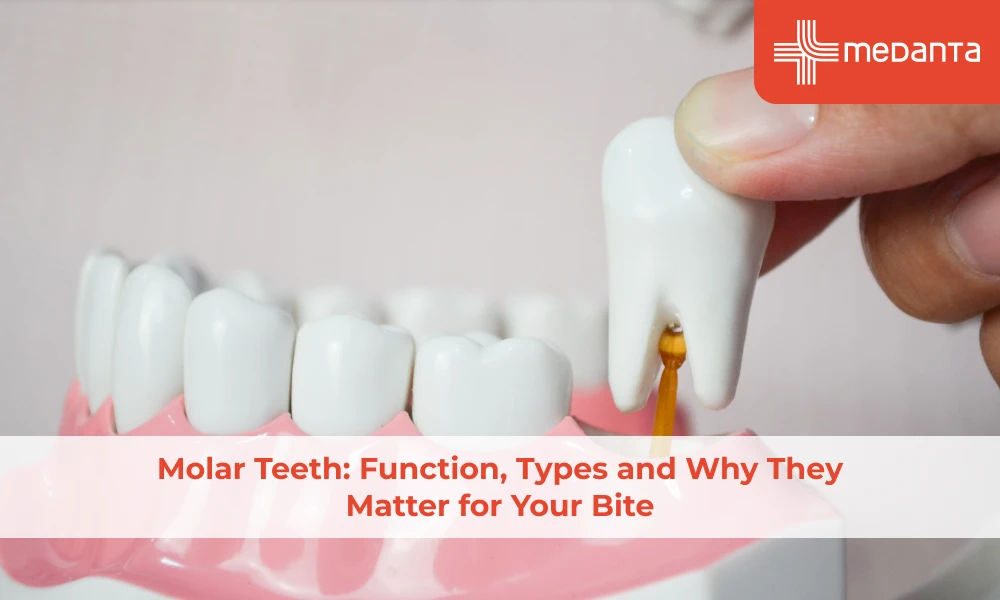
TABLE OF CONTENTS
Molars are the large, flat crowned teeth at the back of your mouth beyond your premolars on both sides of the upper & lower jaws. They are so strong that they can withstand the heavy grinding forces required to break down tough, fibrous and hard foods before swallowing. Without healthy molars you cannot chew properly; thus your digestion suffers and the alignment of the entire bite can shift over time.
Adults typically have twelve molars in total, arranged three per quadrant of the mouth. Understanding what molars are, how they function and how to protect them supports long-term oral and digestive health.
What Are Molars
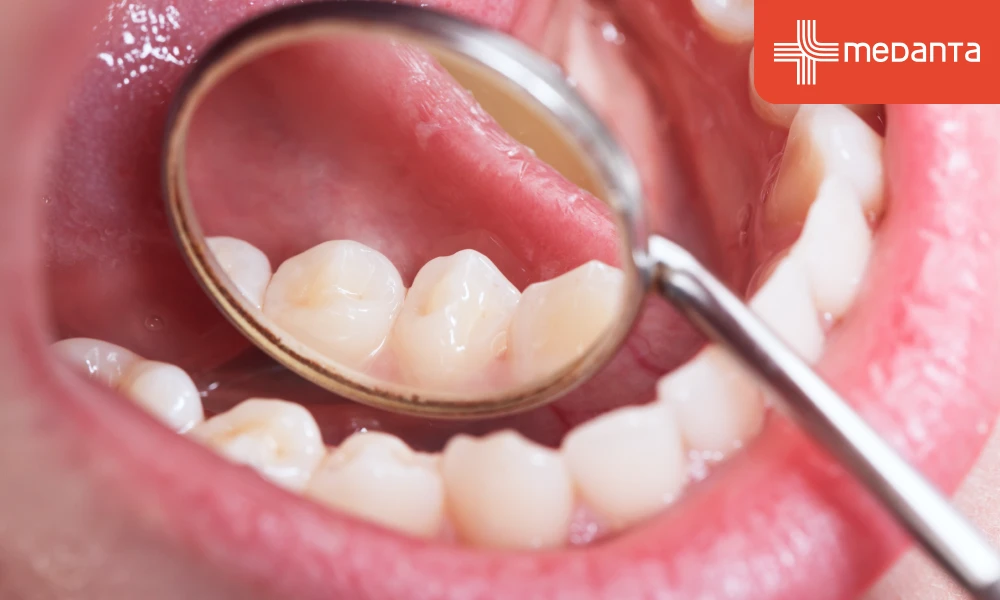
Molars are the posterior (back) teeth situated at the rear of the dental arch on both sides of the upper & lower jaws just behind your premolars (bicuspids). You can identify them by their large size, broad flat biting surface and multiple cusps (raised projections).
Molars have multiple roots anchoring them firmly in the jawbone providing structural stability (all this is needed to handle substantial occlusal forces).
Types of Molar Teeth
In a complete adult dentition, there are three types of molars in each quadrant of the mouth, distinguished by their position, eruption timing and size.
First molars (6-year molars): Erupting at approximately age six, first molars are the largest and most anatomically complex of the three molar types. They maintain the vertical dimension of the bite.
Second molars (12 year molars): Erupting at approximately age twelve second molars are slightly smaller than the first molars but have a similar multi cusp occlusal surface working in close coordination with the first molars to distribute chewing loads across the posterior teeth.
Third molars (wisdom teeth): Erupting last, typically between ages 17 and 25, wisdom teeth are the most variable teeth in the human dentition.
Children have two primary molars per quadrant, erupting between 12 and 33 months of age and eventually shed to make way for the permanent premolars.
Function of Molars in Chewing and Digestion
Molars serve several critical functions in the process of eating and digestion, each made possible by their distinctive anatomy.
Grinding and crushing food: The biggest function of molars is mastication. The broad, multi cusped occlusal surface grinds food into small & soft particles which you can safely swallow and efficiently digest.
Maintaining bite alignment and vertical dimension: The molars are the primary load-bearing teeth in the dental arch. Loss of a molar causes the remaining teeth to gradually shift and tilt altering the bite alignment and potentially causing temporomandibular joint (TMJ) problems and increased wear on the remaining teeth.
Supporting adjacent and opposing teeth: Molars keep adjacent and opposing teeth in their correct position (all this for preventing unwanted forward shifting or overeruption after tooth loss).
Upper Molar vs Lower Molar: Key Differences
Upper (maxillary) and lower (mandibular) molars differ in several anatomical respects.
Root number and crown shape: Upper molars typically have three roots (mesiobuccal, distobuccal and palatal) providing a tripod like base of anchoring. Lower molars typically have 2 roots (mesial and distal). Upper first molars have four or five cusps in a rhomboidal crown pattern. Lower first molars have five cusps in a more rectangular crown.
Proximity to anatomical structures: The roots of upper molars lie in proximity to the maxillary sinus, meaning that infections at upper molar root tips can cause dental sinusitis. The roots of lower molars lie in proximity to the inferior alveolar nerve canal, a consideration in extractions and implant placement.
Are Wisdom Teeth Considered Molars?
Wisdom teeth are the third molars and are anatomically classified as molars. When fully erupted and in correct alignment, they contribute to the grinding function of the posterior teeth in the same way as the first and second molars.
Wisdom teeth erupt when the jaw has already completed most of its growth and the dental arch is often fully occupied, leaving insufficient space for correct alignment. Impaction is common and is the most frequent reason for wisdom tooth extraction in India and globally.
Common Molar Problems
They are:
Dental caries (tooth decay): Molars are most susceptible to caries because their deep pits and fissures trap food particles and bacteria and are difficult to clean effectively.
Cracked tooth syndrome: Large occlusal forces, bruxism (teeth grinding), chewing hard objects or the presence of large fillings that weaken tooth structure can cause cracks in the enamel and dentine.
Gum disease (periodontitis): The lower second and third molars are the most commonly affected teeth in severe periodontitis because they are the most difficult to clean.
Impacted wisdom teeth and bruxism: Impacted third molars cause pain, infection, cysts and damage to adjacent second molars. Bruxism causes progressive wearing down of the molar cusps, sensitivity, and jaw pain.
How to Take Care of Your Molars
Effective care tips are:
Brushing technique: Use a soft-bristled toothbrush with a small head, positioning the bristles at a 45-degree angle to the gumline and using short back-and-forth strokes across the occlusal surface of each molar.
Flossing and interdental cleaning: You should clean the side surfaces of molars with dental floss, interdental brushes or a water flosser daily
Pit and fissure sealants: Dental sealants are thin plastic coatings applied to the occlusal surfaces of molars, filling in the deep pits and fissures that trap bacteria. Sealants are most effective when applied to children's first and second molars (shortly after eruption).
Diet and limiting sugar: Reducing the frequency of sugary and acidic food and drink consumption is the most effective dietary measure for preventing molar caries. Consuming these foods with meals and rinsing the mouth with water afterwards reduces their cariogenic impact.
Regular dental check-ups: Attending a dentist every six months allows early detection and treatment of caries, cracks and gum disease.
Molar Treatment Options
The treatment for molar problems depends on the extent and nature of the damage.
Composite or amalgam fillings: For small to moderate caries, decayed tooth structure is removed and replaced with a composite resin or silver amalgam filling
Dental crowns: When a molar has large caries, significant tooth structure loss, cracks or has undergone root canal treatment a dental crown restores full function and prevents fracture. Crowns can be made from metal, porcelain-fused-to-metal or all-ceramic materials.
Root canal treatment: RCT is the standard method for saving a severely decayed or infected molar.
Tooth extraction and replacement: When a molar cannot be saved replacement options include a dental implant, a fixed dental bridge or a removable partial denture.
Conclusion
Molars are the structural and functional foundation of the human dentition. Their large, multi-cusped crowns and multi-rooted anchoring handle the grinding forces of mastication, support the vertical dimension of the bite and maintain the alignment of the entire dental arch.
Preventing molar problems through twice-daily brushing with correct technique, daily interdental cleaning, pit and fissure sealants in children, dietary sugar control and regular dental check-ups is far more cost-effective than treating molar caries, periodontitis or extraction and replacement. In India, where preventive dental awareness is limited, understanding the importance of molars and the simple habits that protect them is foundational to long-term oral health.
FAQs
What are molars and what are they used for?
Molars are the large, flat crowned posterior teeth located at the back of the mouth.
What is the function of molar teeth?
The primary function of molar teeth is mastication. They grind food into small, soft particles so that you can swallow and digest them easily. Beyond chewing, molars maintain the vertical dimension of occlusion, prevent mesial (forward) drifting of posterior teeth, prevent overeruption of opposing teeth into gaps and provide structural support for the posterior dental arch.
How many molars does an adult have?
An adult with a complete dentition has twelve molar teeth in total: three molars per quadrant of the mouth. These comprise four first molars (erupting at approximately age six), four second molars (erupting at approximately age twelve) and four third molars or wisdom teeth (erupting between ages seventeen and twenty five).
Are wisdom teeth considered molars?
Yes wisdom teeth are the third molars and are anatomically classified as molars. When fully erupted and in correct alignment they contribute to grinding in the same way as the first and second molars.
What is the difference between upper and lower molars?
Upper (maxillary) molars typically have three roots and a rhomboidal crown shape with four or five cusps. Lower (mandibular) molars typically have two roots and a more rectangular crown with five cusps. The roots of upper molars lie in proximity to the maxillary sinus whereas the roots of lower molars lie in proximity to the inferior alveolar nerve canal.
What is the last molar tooth called?
The last molar tooth is called the third molar, commonly known as the wisdom tooth. It is the rearmost tooth in the dental arch, positioned behind the second molar in each of the four quadrants of the mouth. The 3rd molar erupts between the ages of 17 and 25 years.
Why do molars get cavities more often?
Molars are more susceptible to dental caries than other teeth because their occlusal surfaces are covered with deep pits, fissures and grooves that trap food particles and bacteria and are extremely difficult to clean effectively with a toothbrush. They are also the hardest teeth to reach with a toothbrush particularly the second and third molars.
What is the second molar tooth used for?
The second molar works in close coordination with the first molar to distribute chewing loads across the posterior teeth. It erupts at approximately age twelve and has a broad multi-cusped occlusal surface designed for grinding food. The second molar also serves as an important anchor tooth in the posterior dental arch, maintaining spacing and bite alignment and is frequently used as an anchorage point in orthodontic treatment.
How can I take better care of my molars?
To better care for your molars:
Brush with a soft-bristled toothbrush with correct technique
Clean between molars with dental floss, interdental brushes or a water flosser daily
Ask your dentist about pit and fissure sealants for children shortly after molar eruption
Reduce the frequency of sugary and acidic food and drink consumption, particularly between meals
Wear a nightguard if you grind your teeth
Attend dental check-ups every six months.
What happens if a molar tooth is lost?
Losing a molar causes the opposing molar to overerupt into the space and adjacent teeth to shift toward the gap, creating new misalignment throughout the dental arch. Chewing efficiency is reduced, bite load is redistributed onto the remaining teeth and TMJ problems may develop. Long-term molar loss also leads to bone resorption in the jaw at the extraction site.
References
1. Ash MM, Nelson SJ. Wheeler's Dental Anatomy, Physiology and Occlusion, 9th ed. Saunders Elsevier. 2010. https://www.elsevier.com/books/wheelers-dental-anatomy-physiology-and-occlusion/ash/978-1-4160-4608-3
2. Kassebaum NJ, Bernabe E, Dahiya M, et al. Global burden of untreated caries: a systematic review and metaregression. J Dent Res. 2015;94(5):650–8. https://doi.org/10.1177/0022034515573272
3. Torabinejad M, Walton RE. Endodontics: Principles and Practice, 4th ed. Saunders Elsevier. 2009. https://www.elsevier.com/books/endodontics/torabinejad/978-1-4160-3410-3
4. Friedman JW. The prophylactic extraction of third molars: a public health hazard. Am J Public Health. 2007;97(9):1554–9. https://doi.org/10.2105/AJPH.2006.100271
5. Petersen PE. The World Oral Health Report 2003: continuous improvement of oral health in the 21st century. Community Dent Oral Epidemiol. 2003;31(Suppl 1):3–23. https://doi.org/10.1046/j.2003.com122.x