1068
1068
 Request Call Back
 Contact
 1068
1068
Does Exercise Really Increase Breast Size?
Published on: Jun 01, 2026
TABLE OF CONTENTS
Introduction
Few questions in women’s fitness generate as much conflicting advice as this one. Social media tutorials promise that the right chest workout will lift, firm, and enlarge the bust. The answer, from an anatomical standpoint, is more specific than most of these claims allow for. Exercise cannot increase glandular breast tissue volume. What it can do is develop the pectoralis major and minor muscles that sit beneath the breast, altering the shape, projection, and perceived size of the bust without changing its actual tissue composition. Understanding where that line falls is what this article addresses.
Understanding Breast Anatomy
Breast tissue sits anterior to the pectoralis major muscle, separated from it by loose connective tissue. The breast is composed of glandular tissue (lobules and ducts), adipose tissue, and Cooper's ligaments - fibrous strands that suspend the breast from the overlying skin and underlying fascia. Glandular-to-fat ratio varies between individuals and shifts with hormonal status, body weight, age, and pregnancy. The pectoralis major is a skeletal muscle. It attaches from the clavicle, sternum, and ribs and inserts into the humerus, lying entirely beneath the breast, not within it. Skeletal muscle responds to resistance training by hypertrophy. Adipose and glandular tissue do not; they respond to hormonal signals and energy balance.
Can Exercise Change Breast Size?
Not in the way most people mean. No exercise programme increases glandular breast tissue. Progressive chest resistance training hypertrophies the pectoralis major, creating a broader muscular base that lifts and projects the overlying tissue. The breast looks larger and sits higher but the actual volume of glandular and adipose tissue within it has not changed. This effect is most visible in women with moderate breast size; in those with larger, heavier breasts the muscular contribution to apparent projection is often masked by tissue mass.
Exercises That Strengthen Chest Muscles
The following targets the pectoralis major and minor across the clavicular (upper), sternal (middle), and costal (lower) heads:
Flat bench press: A classic strength exercise that builds overall chest muscle size and strength. Gradually increasing weight or repetitions helps improve muscle growth.
Incline press at 30-45 degrees: This focuses more on the upper chest muscles and improves upper chest definition.
Cable or dumbbell flyes: Helps stretch and strengthen the pectoralis through a wide range of movement
Push ups: A simple bodyweight exercise that strengthens the chest, shoulders and arms. Variations can make the exercise more challenging as strength improves.
Chest dips: An advanced exercise that targets the lower and middle chest muscles while also engaging the shoulders and arms.
Which exercises to do and which to avoid
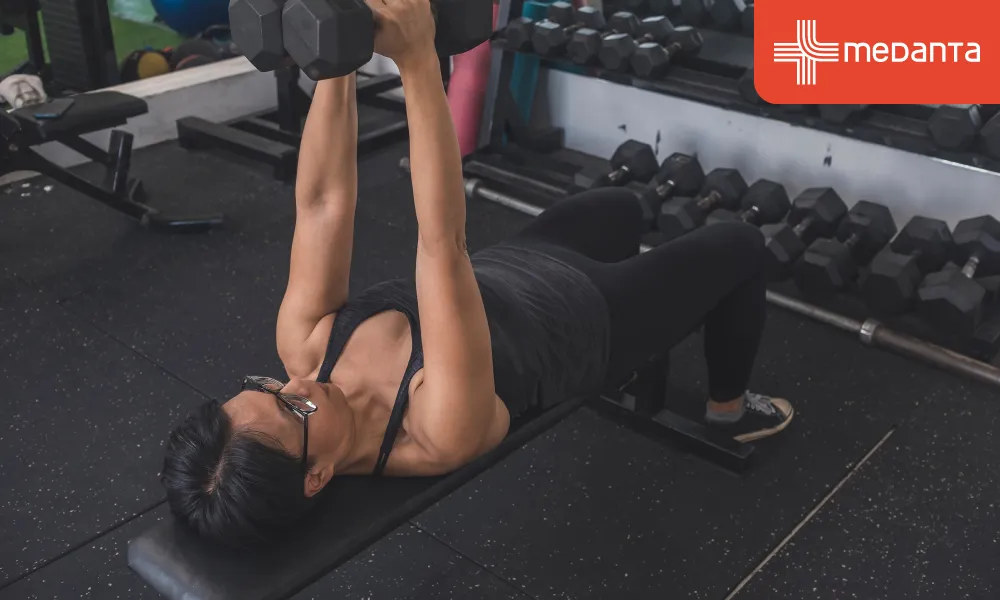
Resistance training hypertrophies the pectoralis major improving chest wall definition and elevating the breast. It also indirectly supports Cooper's ligaments by improving postural muscle tone in the upper back and chest, reducing gravitational pull on the fibres that suspend the breast.
Exercise to avoid glandular tissue growth, increase breast adipose volume, or alter cup size. High-intensity cardio, particularly long-duration running, often causes fat loss from breast tissue, reducing volume. Women who notice breast reduction with exercise have typically lost subcutaneous fat from the thoracic region, not muscle.
Other Factors That Affect Breast Size
Genetics: The ratio of glandular to adipose tissue and where the body stores and loses fat (including breast fat) follows hereditary distribution patterns
Hormonal fluctuations: Oestrogen drives glandular development at puberty; cyclical progesterone causes premenstrual swelling through ductal fluid retention; menopause-related oestrogen decline reduces glandular density
Pregnancy and lactation: Prolactin-driven lobular hyperplasia substantially increases glandular volume; post-weaning involution returns much of it
Body weight: Since breast volume is partly adipose, weight gain increases and weight loss decreases breast size at a rate determined by individual fat partitioning genetics
Age: Cooper's ligament elasticity declines with repeated gravitational loading; combined with skin collagen reduction of approximately 1% per year after age 25, this produces progressive ptosis rather than volume change.
Natural Ways to Improve Breast Shape
Exercise: Progressive chest resistance training 2–3 times per week with consistent overload over 8–12 weeks is the minimum required for measurable pectoralis development beneath the breast
Posture correction: Thoracic kyphosis and forward head posture collapse the anterior chest and reduce breast projection. Strengthening the lower trapezius, rhomboids and serratus anterior opens the chest and improves breast presentation without any direct chest work
Stable body weight: Repeated significant weight cycles stretch Cooper's ligaments and skin beyond their elastic capacity, accelerating ptosis
Supportive bras during high-impact exercise: Adequate support reduces superior-inferior breast displacement during running and jumping, limiting mechanical stretch on Cooper's ligaments over time.
Myths and Facts About Breast Size
Myth: Push-ups enlarge breasts.
Fact: They develop the pectoralis major beneath the breast, improving projection and firmness, but cannot add glandular or adipose tissue.
Myth: Foods or supplements increase breast size.
Fact: No food or OTC supplement has clinical evidence for increasing breast tissue volume. Phytoestrogens in soy and flaxseed exert weak oestrogenic activity but not at levels sufficient for glandular growth.
Myth: Massage increases breast size.
Fact: It improves local circulation temporarily but has no mechanism for increasing tissue volume.
Myth: Exercise can reduce breast size.
Facts: Cardio combined with caloric deficit causes adipose loss from breast tissue often one of the first visible areas of fat loss in women with breast-forward fat distribution.
Myth: Strength training improves breast shape.
Fact: A developed pectoralis major lifts and firms the overlying breast, particularly when combined with upper back posture correction.
Conclusion
Exercise does not increase breast size in the clinical sense as it does not stimulate glandular tissue growth or increase adipose volume within the breast. What a well-designed resistance training programme targeting the pectoralis major does produce is a firmer muscular base beneath the breast, improved projection, better postural alignment, and reduced gravitational strain on Cooper's ligaments over time. For women seeking to improve breast shape and firmness without surgical intervention, progressive chest training combined with posture work and appropriate support during exercise is the most evidence-grounded approach available.
FAQs
Can exercise increase breast size naturally?
Not in terms of tissue volume. No exercise increases glandular or adipose breast tissue. Chest resistance training develops the pectoralis major beneath the breast, which lifts and projects the overlying tissue creating the appearance of a larger, higher bust without changing cup size.
Which exercises help improve breast shape and firmness?
Flat bench press, incline press at 30–45 degrees, cable flyes, and push-ups are the core exercises. Incline press specifically develops the clavicular pectoralis head, contributing most to upper pole fullness. Two to three sessions per week with progressive overload over 8–12 weeks is the minimum effective dose.
Do chest exercises make breasts look bigger?
Often yes, but through muscular and postural change rather than volumetric increase. A hypertrophied pectoralis major pushes breast tissue forward and upward; improved upper back posture opens the chest further, making the effect on apparent size and position visible even without any change in actual breast tissue.
Can push-ups increase breast size?
Push-ups hypertrophy the pectoralis major with progressive overload, improving the structural base beneath the breast. They do not add glandular or adipose tissue, so cup size does not change but shape and projection typically improve with consistent training.
Why does exercise sometimes reduce breast size?
High-intensity cardio with caloric deficit causes systemic fat loss; breast adipose is often among the first depots to reduce in women with breast-forward fat distribution. The glandular component remains unchanged and only the surrounding fat reduces. This is a normal metabolic response.
Can strength training improve breast appearance?
Through two mechanisms: pectoralis major hypertrophy creates a firmer elevated platform beneath the breast, and strengthening the rhomboids, lower trapezius, and serratus anterior corrects thoracic kyphosis, opening the chest and improving how the breast sits and projects at rest.
How long does it take to see changes from breast exercises?
Pectoralis hypertrophy becomes visible at 8–12 weeks of consistent training two to three times per week. Postural improvements from upper back work can appear faster (within four to six weeks).
Does weight gain or loss affect breast size?
Significantly. A large proportion of breast volume is adipose, so weight gain generally increases and weight loss reduces breast size. The degree depends on individual genetic fat distribution. Repeated large weight cycles progressively stretch Cooper’s ligaments and accelerate ptosis.
Are there natural ways to increase breast size?
No intervention short of surgery reliably increases glandular breast tissue volume. Pregnancy and lactation increase it temporarily; weight gain increases adipose tissue within the breast. For shape and firmness without volumetric change, progressive chest and posture training is the most evidence-grounded natural approach.
Do workouts help tighten sagging breasts?
Cooper's ligament laxity and skin elastin loss are not reversible through exercise. Indirectly, developing the pectoralis major provides a firmer base that reduces apparent ptosis and improves shape. Postural correction additionally changes the angle at which the breast sits on the chest wall further improving appearance.