1068
1068
 Request Call Back
 Contact
 1068
1068
Skin Tags: What Causes Them, How to Remove Them and How Can You Prevent Them
Published on: Jul 30, 2026
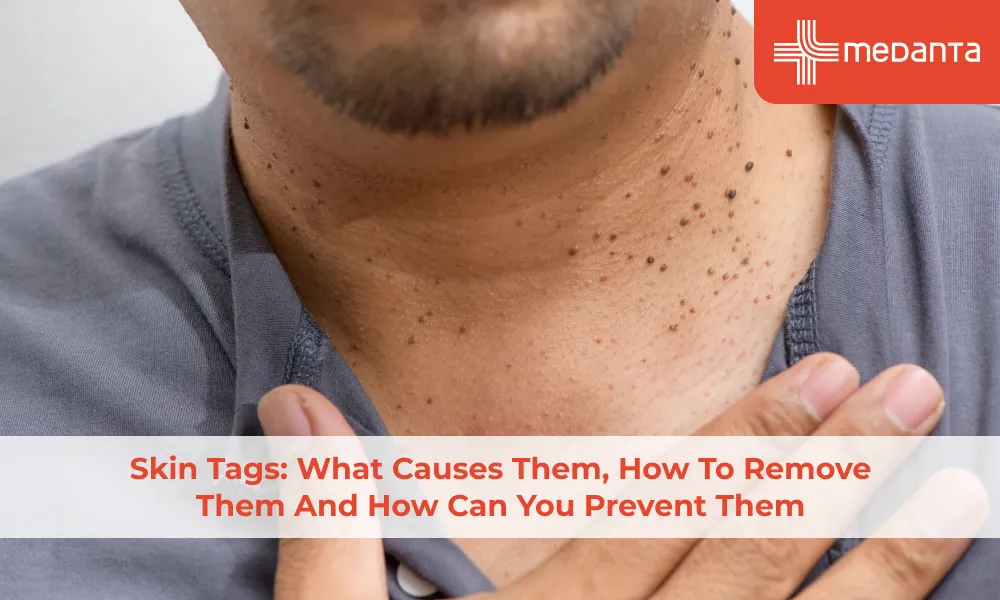
TABLE OF CONTENTS
- Where Do Skin Tags Commonly Appear on the Body?
- What Actually Causes Skin Tags to Form?
- Are Skin Tags Dangerous or Just Cosmetic?
- Who Is More Likely to Get Skin Tags?
- Safe Medical Methods to Remove Skin Tags
- Home Remedies: What Works and What Doesn't
- What Not to Do: Risks of Self-Removal
- Will Skin Tags Grow Back After Removal?
- How to Reduce Your Risk of Getting New Skin Tags
- Myths vs Facts About Skin Tags
- When Should You See a Doctor?
- Conclusion & Dermatologist Tips
- FAQs
Skin tags are small, soft, flesh-coloured growths that hang from the skin on a narrow stalk. They are benign in every medical sense, yet a frequent source of frustration when they appear in visible or irritating locations. They affect roughly half the global adult population at some point, and the questions around them like what causes them, whether they signal something else, and how to remove them are worth answering clearly.
Where Do Skin Tags Commonly Appear on the Body?
The neck is one of the most common sites, where friction from clothing and jewellery concentrates
Armpits have warm, moist skin-on-skin contact, creating ideal conditions
In the groin and inner thighs, skin fold areas where movement generates friction
Under the breasts, where they are linked to bra strap friction and skin fold moisture
Eyelids have smaller tags here, occasionally interfering with vision in larger cases
Any body fold or area of repeated skin friction can develop tags. The face, back, and waistband areas are less common but not excluded.
What Actually Causes Skin Tags to Form?
Repeated friction between skin surfaces or between skin and clothing is the most consistent trigger which is why folds and creases dominate the site list. Histologically, a skin tag is collagen fibre and tissue components trapped inside a thickened skin layer. Hormonal changes (pregnancy especially) accelerate their appearance, which is why women often notice a cluster forming during the second or third trimester.
Insulin resistance and type 2 diabetes are consistently associated with skin tag development as elevated insulin appears to stimulate fibroblast growth factor pathways. Multiple tags appearing simultaneously around the neck and armpits are a recognised sign worth screening for underlying insulin resistance.
Are Skin Tags Dangerous or Just Cosmetic?
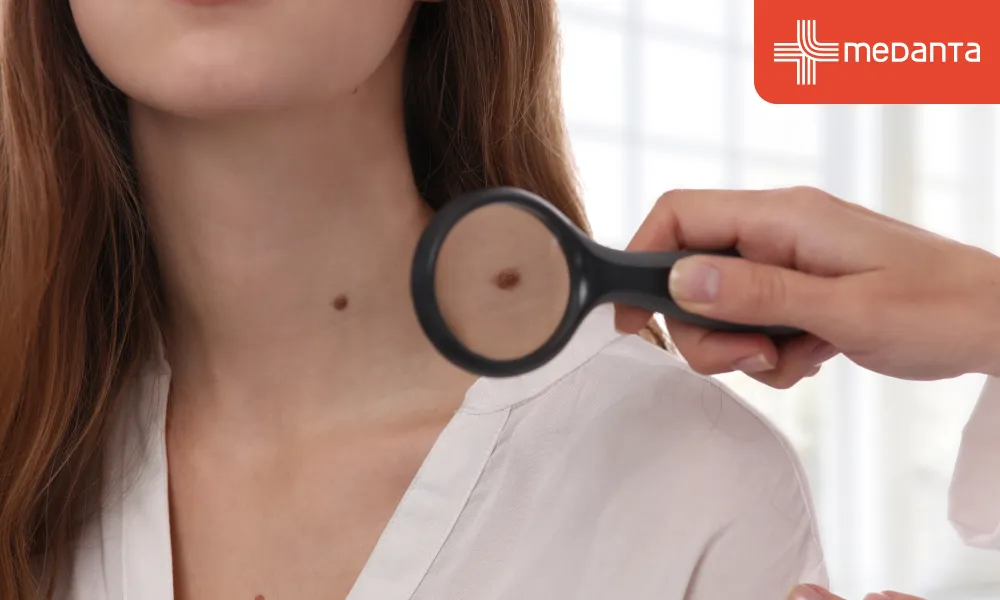
Skin tags are benign. They do not become cancerous, spread or cause systemic harm. The clinical concern is that warts, dermatofibromas, pigmented naevi and occasionally early melanocytic lesions can mimic a skin tag. Any tag that bleeds spontaneously, changes colour or grows rapidly needs dermatological evaluation rather than self-removal.
Who Is More Likely to Get Skin Tags?
Adults over 40 - incidence increases with age as skin elasticity changes and tissue folds deepen
Overweight or obese individuals - more pronounced skin folds create more friction surfaces
Pregnant women - hormonal and metabolic changes during pregnancy trigger formation in many women
People with insulin resistance, metabolic syndrome, or type 2 diabetes which is a well-documented association
Individuals with a family history of skin tags - genetic predisposition plays a role
Safe Medical Methods to Remove Skin Tags
Several techniques remove skin tags safely when performed by a trained practitioner:
Cryotherapy: Liquid nitrogen freezes the tag causing it to die and fall off within one to two weeks; minimal scarring
Electrocautery: An electric current burns the tag at its base; clean removal with low recurrence at the same site
Surgical excision: Scissors or scalpel cuts the tag at its stalk under local anaesthesia; immediate removal and allows histological confirmation if needed
Ligation: The stalk is tied with a fine thread to cut off the blood supply; the tag falls off within days
Laser removal is available at specialist centres and works well for multiple tags or eyelid tags where precision matters.
Home Remedies: What Works and What Doesn't
Tea tree oil, apple cider vinegar and banana peel have no meaningful clinical evidence for efficacy. OTC skin tag products containing salicylic acid or cold spray have mixed evidence and work more reliably on smaller tags.
Tying dental floss tightly around the stalk at home replicates clinical ligation and does sometimes work for small pedunculated tags away from the face and eyes. The risk of infection and incorrect application makes it a second-best option to clinical removal.
What Not to Do: Risks of Self-Removal
Do not cut or snip a skin tag with nail scissors or any non-sterile instrument. Infection, excessive bleeding, and incomplete removal are all common outcomes
Do not apply concentrated acids, essential oils, or any caustic substance to tags near the eyes, face or genitals
Do not attempt removal of any tag that bleeds unprovoked, is multicoloured or has changed size rapidly. It needs evaluation first
The pain, bleeding, and infection risk of amateur removal frequently exceeds the problem the tag itself was causing.
Will Skin Tags Grow Back After Removal?
Removal at the base of the stalk permanently removes that specific tag as the same site does not regenerate it. The conditions creating skin tags including friction, insulin resistance and hormonal change, continue producing new ones elsewhere, which is why patients who have a cluster removed often notice new ones forming nearby over subsequent months, misinterpreted as regrowth.
How to Reduce Your Risk of Getting New Skin Tags
Weight management reduces skin fold friction and the insulin resistance-related hormonal causes of tag formation
Loose, breathable clothing minimises friction at neck, armpits, and waistband. Silk or cotton fabrics cause less irritation than synthetic materials
Keeping skin fold areas dry reduces maceration, which may contribute to tag formation in prone areas
Addressing insulin resistance through diet and exercise reduces one of the most consistent metabolic drivers of new tag formation.
Myths vs Facts About Skin Tags
Myth | Fact |
|---|---|
Skin tags are contagious | They are not - they cannot transfer between people or to different sites through contact |
Skin tags always indicate diabetes | They are associated with insulin resistance, but many people with tags have completely normal metabolic tests |
Cutting a skin tag will make more grow | Removal of one tag does not cause others to form - new tags reflect ongoing systemic or friction factors |
Skin tags are a type of wart | Warts are caused by HPV and have a distinct appearance; skin tags are benign fibrovascular growths with no viral cause |
Skin tags are cancerous or become cancer | They are entirely benign and have no malignant potential |
When Should You See a Doctor?
Spontaneous bleeding, rapid size change, irregular borders or colour variation within a lesion all warrant dermatological review before any removal attempt. Eyelid tags should always be removed professionally. Any skin change in a person with a history of skin cancer needs evaluation rather than assumption.
Conclusion & Dermatologist Tips
The dermatologist's consistent advice: leave tags causing no problems alone; have symptomatic or visible ones removed properly; and address the metabolic and lifestyle factors driving new formation. If multiple tags are appearing simultaneously, check HOMA-IR and fasting insulin as your skin may be signalling a metabolic shift worth acting on.
FAQs
Are skin tags a sign of diabetes or any other disease?
They are associated with insulin resistance and diabetes. Multiple tags appearing simultaneously is worth investigating metabolically. Many people with skin tags have completely normal metabolic tests.
Can I remove a skin tag at home safely?
Small pedunculated tags on the body (not the face or eyes) can be ligated at home with sterile thread but clinical removal by a dermatologist is safer and avoids infection risk.
Do skin tags hurt or bleed?
Uncomplicated skin tags are painless. They can become irritated or bleed if caught on clothing or rubbed. Spontaneous bleeding without trauma warrants evaluation.
Why do skin tags appear around the neck and armpits?
These areas combine skin-on-skin friction, warmth and moisture (the conditions most associated with tag formation). Collar friction adds to neck involvement.
Is there a cream that removes skin tags?
No cream has robust evidence for removing established skin tags. OTC products with salicylic acid or cold spray show partial effectiveness for small tags only.
Can children get skin tags?
Skin tags are uncommon in children with small skin growths are more likely to be molluscum contagiosum or warts. A paediatrician or dermatologist should assess any such growth rather than it being assumed a skin tag.
Do skin tags disappear on their own?
Occasionally a tag twists on its stalk, cuts off its blood supply and falls off spontaneously. Most skin tags persist indefinitely without active removal.
Does health insurance cover skin tag removal?
Cosmetic skin tag removal is generally not covered in India. Medically justified removal like tags that bleed repeatedly, interfere with function or need histological evaluation, may have coverage depending on the policy.
What happens if you cut off a skin tag yourself?
Pain, bleeding and infection are the immediate consequences. Incomplete removal leaves a residual nub that can become inflamed. Near the face or eyes, scarring risk makes self-cutting inadvisable.
Can losing weight help reduce skin tags?
Weight loss reduces skin fold friction and insulin resistance which are the primary drivers of new tag formation. It doesn't remove existing tags but reduces the rate of new ones forming.