1068
1068
 Request Call Back
 Contact
 1068
1068
Baby Vaccination Schedule in India: A Complete Guide for Parents (0-5 Years)
Published on: Apr 09, 2026
TABLE OF CONTENTS
- Overview of the Baby Vaccination Schedule in India (0–5 Years)
- Vaccines Given at Birth: BCG, OPV, and Hepatitis B
- Vaccination Schedule for Infants: 6, 10, and 14 Weeks
- Importance of Booster Doses in Early Childhood
- Optional vs. Mandatory Vaccines in India
- Government (UIP) vs. Private Vaccination Schedules
- Combination Vaccines and Their Benefits
- Side Effects of Common Childhood Vaccines
- What to Do If a Vaccine Dose Is Missed
- Tips for Parents to Keep Track of Vaccination Schedules
- FAQs
Vaccination gives children a strong start in life and helps protect them as they grow. Immunisation has eliminated smallpox, brought polio to the edge of eradication, and reduced childhood mortality from diseases such as measles and diphtheria. In India where the Universal Immunisation Programme (UIP) reaches over 26 million newborns annually, knowing which vaccines your child needs and when is the foundation of responsible early care.
Let's explore the complete vaccination schedule from birth to five years and the differences between government & private programmes.
Overview of the Baby Vaccination Schedule in India (0–5 Years)
Two systems shape how Indian children get vaccinated. The first is the Universal Immunisation Programme (UIP), a government-run initiative that delivers core vaccines free of charge at public health centres across the country. The second is the schedule published by the Indian Academy of Pediatrics (IAP), which expands on the UIP with additional vaccines available at private facilities. Between them, these two frameworks address preventable illness from the first hours of life through to school entry.
Vaccines Given at Birth: BCG, OPV, and Hepatitis B
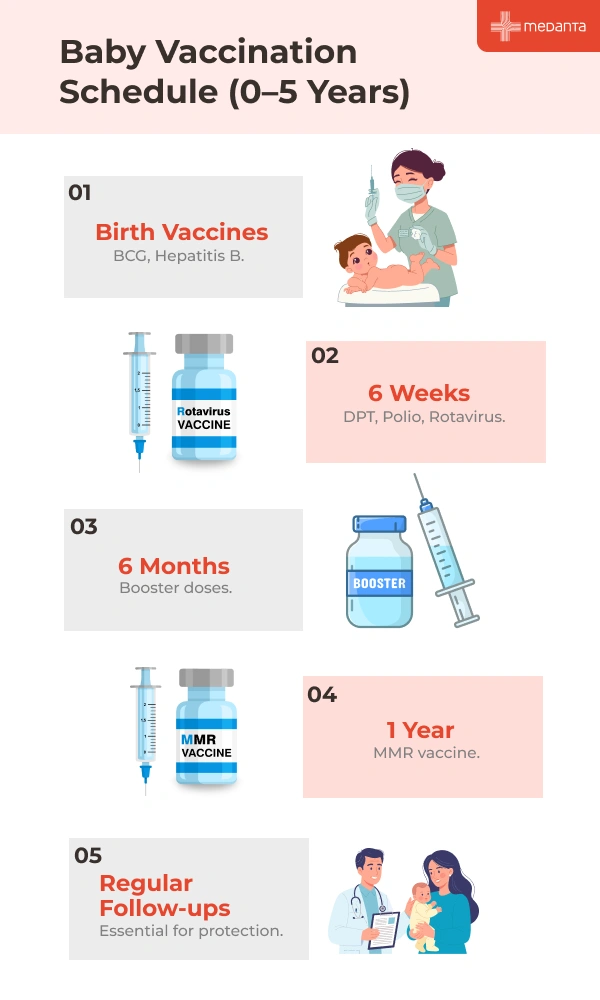
The following three are given within the first 24 hours of life ideally before the baby leaves the delivery ward.
BCG (Bacillus Calmette Guérin): Protects children against severe forms of tuberculosis (tuberculous meningitis and miliary TB)
OPV (Oral Polio Vaccine - Zero Dose): Doctors give this at birth to protect against poliovirus. India achieved polio-free status in 2014 but ongoing immunisation is what sustains it.
Hepatitis B (first dose): Administered at birth to prevent mother-to-child transmission.
Vaccination Schedule for Infants: 6, 10, and 14 Weeks
The 6–10–14 week timeframe focuses on diseases that pose the highest risk in early infancy, before natural immunity develops.
At 6 weeks:
DTwP/DTaP (diphtheria, tetanus, pertussis)
IPV (inactivated polio vaccine)
Hib (Haemophilus influenzae type b)
Hepatitis B (second dose)
PCV (pneumococcal conjugate vaccine)
Rotavirus (first dose).
At 10 weeks and 14 weeks:
Repeat doses of DTwP/DTaP, IPV, Hib, PCV, and Rotavirus
Hepatitis B third dose is given at 14 weeks.
These three visits form the backbone of protection against the diseases most likely to cause serious illness and hospitalisation in the first year of life.
Importance of Booster Doses in Early Childhood

A primary vaccine series builds immunity. Booster doses sustain it. By 15 to 18 months, immunity from several of the early vaccines begins to wane, and a second round of DTwP or DTaP, MMR, and varicella is needed to maintain protection. A further DTP booster is recommended between the ages of 4 and 6 years, before the child enters school.
Skipping boosters is one of the most common mistakes parents make, often because the child appears healthy and the follow-up visit seems unnecessary. Immunity without a booster is genuinely incomplete for several key vaccines.
Optional vs. Mandatory Vaccines in India
Vaccines on the UIP schedule including BCG, Hepatitis B, OPV, DPT, IPV, Hib, MMR, PCV, and Rotavirus are part of the national programme and available free of cost. These cover the diseases with the highest burden and mortality risk in the Indian context.
Vaccines classified as optional under the IAP schedule include Hepatitis A, Varicella (chickenpox), Typhoid conjugate vaccine, Influenza, and Meningococcal vaccine.
Government (UIP) vs. Private Vaccination Schedules
The UIP provides essential vaccines free at government health facilities, making immunisation accessible regardless of income. The IAP private schedule expands on this with additional vaccines and, in some cases, combination formulations that reduce the number of injections required.
One practical difference: government facilities often use DTwP (whole-cell pertussis), while private clinics offer DTaP (acellular pertussis), which tends to cause fewer side effects such as fever and local redness. Both are effective against whooping cough, but parents choosing private vaccination should discuss the options with their paediatrician.
Combination Vaccines and Their Benefits
Combination vaccines simplify immunisation by protecting against multiple diseases in a single shot. A pentavalent vaccine covers diphtheria, tetanus, pertussis, Hepatitis B, and Hib in a single shot. Add IPV and you have a hexavalent formulation. For an infant, fewer injections per visit means considerably less distress. For parents, a simpler schedule means fewer appointments to track and fewer chances to fall behind.
Side Effects of Common Childhood Vaccines
Most children experience mild, temporary reactions after vaccination like a low-grade fever for a day or two, redness or swelling at the injection site, and general fussiness. These are signs of an immune response, not cause for alarm.
Serious reactions are uncommon. A fever climbing above 103°F, breathing difficulty, a rash spreading beyond the injection site, or a child who seems markedly unwell in the 24 to 48 hours after vaccination need immediate medical assistance.
What to Do If a Vaccine Dose Is Missed
A missed dose does not mean starting the schedule over. The IAP follows a "catch-up" approach most vaccines can be resumed from where they were left off, with adjusted intervals depending on the child's age at the time. The key is to speak to a paediatrician as soon as possible rather than waiting for the next scheduled visit. Delays in resuming immunisation leave the child unprotected during the gap.
Tips for Parents to Keep Track of Vaccination Schedules
At birth, every family receives a Mother and Child Protection (MCP) card the official record of every vaccine administered. Misplacing it creates gaps that are genuinely hard to reconstruct, so keeping it with other important documents is worth treating as a priority. Several hospital systems and standalone apps now support digital immunisation tracking, making it much easier to set advance reminders before each scheduled visit. For parents who are unsure which doses have been completed and which are still pending, a paediatrician can review the child's history and map out exactly what comes next.
FAQs
What is the recommended vaccination schedule for babies in India?
The Government of India's Universal Immunisation Programme covers all essential vaccines from birth to five years at no cost. The Indian Academy of Pediatrics recommends an expanded private schedule that adds vaccines such as Hepatitis A, Varicella, and Typhoid. Your paediatrician will guide you on which schedule is appropriate for your child.
Which vaccines are given to newborns at birth?
Three vaccines are given at birth:
BCG (for tuberculosis)
The zero dose of OPV (oral polio vaccine)
The first dose of Hepatitis B.
Are all vaccines in India mandatory for babies?
Vaccines on the UIP schedule are strongly recommended and provided free by the government, but vaccination in India is not legally mandatory. From a medical standpoint, all scheduled vaccines (government and private) serve an important protective function.
What is the difference between government and private vaccines?
The government UIP schedule provides core vaccines free of charge, while the private IAP schedule includes additional vaccines and sometimes alternative formulations with fewer side effects. Both schedules are medically sound; the choice often depends on accessibility and cost.
Is it safe to give multiple vaccines at the same time?
Yes giving vaccines together does not reduce how well they work, and does not increase the risk of adverse reactions.
What are the common side effects after vaccination?
Common complications are:
A mild fever
A red or sore spot at the injection site
A fussier-than-usual baby for a day or two.
Severe reactions like high fever above 103°F, breathing difficulty, or a widespread rash are rare, but a doctor should be contacted promptly if any of them appear.
What should I do if my baby misses a vaccine dose?
Contact your paediatrician as soon as you realise a dose has been missed. Most vaccines can be caught up without restarting the full schedule, using adjusted intervals based on the child's current age. Delaying a missed dose further increases the window of vulnerability.
Are optional vaccines necessary for my child?
The word "optional" here refers to programme availability and cost not to whether the vaccine is medically worthwhile. Hepatitis A, Varicella, Typhoid, and Influenza all protect against infections that circulate widely in India, and most paediatricians recommend them.
How can I keep track of my baby's vaccination schedule?
The Mother and Child Protection (MCP) card, issued at birth, is the official record of all vaccines given. Keep it safe and present it at every hospital visit. Many clinics and paediatric apps also provide digital tracking and reminder systems that can help you stay on schedule.
When do booster doses start for children?
The first significant booster doses are due at 15 to 18 months, covering DTwP or DTaP, MMR, Varicella, and Hepatitis A. A further DTP and OPV booster follows between 4 and 6 years of age.