1068
1068
 Request Call Back
 Contact
 1068
1068
7 Surprising Health Benefits of Eating Coconut You Didn't Know About
Published on: Aug 17, 2026
TABLE OF CONTENTS
- Nutritional Profile of Raw Coconut
- Top 7 Health Benefits of Eating Coconut Regularly
- Coconut for Men – Specific Benefits You Should Know
- Coconut During Pregnancy – Is It Safe?
- Tender Coconut Water vs Raw Coconut – Which Is Healthier?
- Coconut Oil, Coconut Milk and Coconut Flesh – Which Form Is Best?
- How Much Coconut Should You Eat Daily?
- Side Effects of Eating Too Much Coconut
- Best Ways to Include Coconut in Your Daily Diet
- Coconut and Cholesterol – Clearing the Confusion
- Conclusion
- FAQs
- References
Introduction – Why Coconut Is Called a Superfood
Coconut has sustained populations across coastal India, Sri Lanka, and Southeast Asia for centuries. It is valued for its unique nutritional profile including medium-chain triglycerides (MCTs), dense dietary fibre, a notable micronutrient profile and antimicrobial compounds with real clinical relevance. While coconut was once criticised for its saturated fat content, recent research suggests that its health effects are more complex than previously believed. This article explains the nutritional benefits of coconut, the latest scientific evidence and how you can include it as part of a balanced diet.
Nutritional Profile of Raw Coconut
One cup (80g) of raw coconut flesh provides:
Energy: Approximately 283 calories
Carbohydrate: 12g
Fibre: 7.2g
Protein: 2.7g
Fat: 26.8g (of which 23.8g is saturated).
Micronutrients include manganese (75% of daily needs), copper (22%), selenium (14%), as well as phosphorus, iron, folate and B vitamins. The insoluble fibre content is notably high for this energy density.
Top 7 Health Benefits of Eating Coconut Regularly
1. Heart Health
Coconut's saturated fat is predominantly lauric acid, raising both LDL and HDL so the net LDL:HDL ratio change is more neutral than animal source saturated fat.
2. Digestion and Gut Health
Raw coconut's insoluble fibre supports transit regularity and colonic fermentation. Lauric acid has antimicrobial activity against Helicobacter pylori and Candida species.
3. Skin and Hair
Lauric acid, copper and manganese support collagen and elastin production, skin barrier integrity and hair follicle health from within. Selenium deficiency is associated with hair thinning and coconut provides a significant dietary source.
4. Immunity
Lauric acid and its derivative monolaurin disrupt lipid membranes of enveloped viruses, bacteria (including Staphylococcus aureus) and fungi. Clinically measurable immune enhancement from dietary coconut is less clear than for concentrated preparations.
5. Weight Management
Coconut's fibre supports satiety. MCTs are metabolised more directly than long-chain fats but whole coconut's dominant MCT is lauric acid (C12), which behaves like a long-chain fatty acid metabolically. Dramatic weight loss effects are not supported.
6. Brain Health
Brain health claims relate to MCT-derived ketone production that is relevant in early Alzheimer's disease. Small trials with concentrated MCT preparations showed modest cognitive benefits. Selenium & copper have neuroprotective antioxidant roles in general neurological health.
7. Bone Health
Manganese (coconut provides 75% of daily needs per cup) activates enzymes building the organic matrix of bone and cartilage. Copper contributes to collagen cross-linking in bone - coconut's simplest and most well-evidenced structural health contribution.
Coconut for Men – Specific Benefits You Should Know
Selenium in coconut supports male reproductive health and sperm motility; deficiency is associated with reduced sperm quality. The micronutrient contribution from dietary coconut is real but modest.
Coconut's fibre and MCT content support satiety and provide readily oxidised fuel. Lauric acid's antimicrobial properties may support gut health in those with high training loads.
Coconut During Pregnancy – Is It Safe?
Both are safe during pregnancy. Tender coconut water provides natural electrolytes, supports hydration and manages fluid retention common in the second and third trimesters - a traditional morning sickness remedy.
Raw coconut flesh provides folate, manganese and fibre. No adverse effects from dietary coconut during pregnancy are documented.
Tender Coconut Water vs Raw Coconut – Which Is Healthier?
Tender coconut water is low in fat (approximately 46 calories per cup) and electrolyte-rich including potassium (600mg), sodium (252mg) and magnesium. It provides minimal fibre and none of the MCTs or lauric acid of the flesh. Raw flesh is calorie-dense, high in fat and fibre, with coconut's full micronutrient profile.
They serve different functions: coconut water for hydration and electrolyte replacement; raw flesh for fibre, satiety, and micronutrient density.
Coconut Oil, Coconut Milk and Coconut Flesh – Which Form Is Best?
Raw coconut flesh retains all fibre, the full micronutrient matrix and the fat making it the most nutritionally complete form. Coconut milk retains fat but loses most fibre; useful as a culinary base but not equivalent to eating the flesh.
Coconut oil is pure fat - lauric acid with no fibre, protein or micronutrients. Its role is as a cooking medium, not in the same health category as whole coconut.
How Much Coconut Should You Eat Daily?
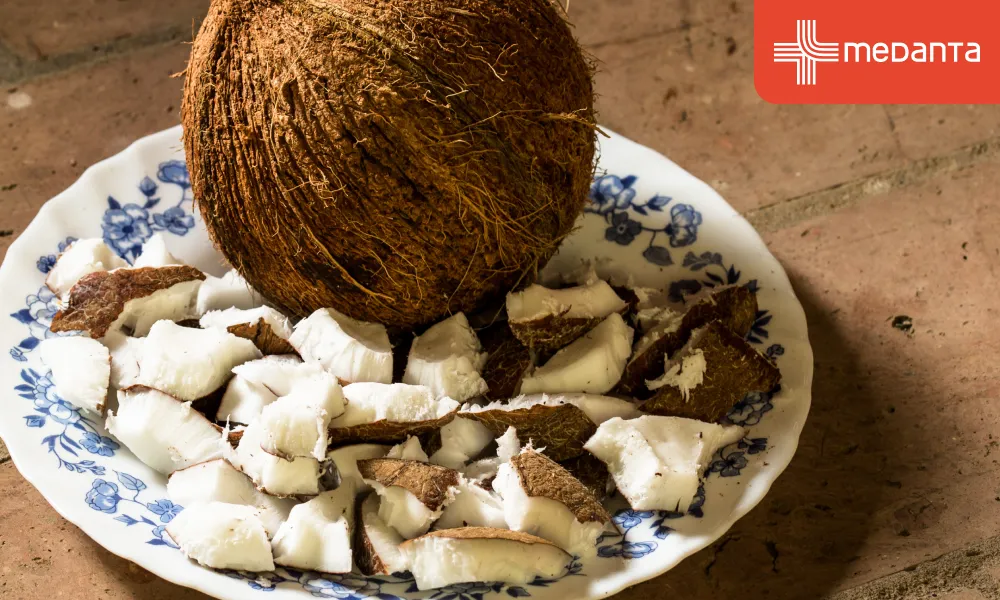
Two to four tablespoons (20 to 40g) of freshly grated coconut daily delivers fibre, micronutrients and MCT benefit within saturated fat and calorie budgets. Larger quantities suit traditional South Indian diets where coconut is a primary cooking base.
Side Effects of Eating Too Much Coconut
Common adverse effects are:
High calorie density: 283 calories per cup; large portions are significant for those managing weight
Excess saturated fat: Very high daily intake elevates LDL in some individuals particularly those with genetic dyslipidaemia or existing cardiovascular disease
Digestive overload: Sudden large amounts of insoluble fibre can cause bloating, gas and loose stools in those unaccustomed to high-fibre diets
Drug interactions: Coconut water's potassium (600mg per cup) is relevant for those on potassium-sparing diuretics or ACE inhibitors; large daily consumption should be discussed with the doctor.
Best Ways to Include Coconut in Your Daily Diet
You can include coconut as:
Freshly grated coconut in chutney alongside idli, dosa or upma
Coconut in dal tadka or sambar adds texture, fibre, and flavour
Tender coconut water as a morning drink or post-exercise rehydration instead of commercial sports drinks
Raw coconut slices as a mid-morning snack - naturally sweet, high in fibre and sustaining.
Coconut and Cholesterol – Clearing the Confusion
The guidance that all saturated fat raises cardiovascular risk has been revised. Coconut contains lauric acid, a type of saturated fat that can increase LDL (bad) cholesterol but it also raises HDL (good) cholesterol. As a result its overall effect on heart health may differ from that of other saturated fats such as palmitic acid, which is commonly found in processed foods and fatty meats. Siri-Tarino et al.'s 2010 meta-analysis found no significant association between saturated fat intake and cardiovascular events.
Coconut as part of a balanced diet does not carry the cardiovascular risk implied by earlier total-saturated-fat models. For people with high LDL, familial hypercholesterolaemia or cardiovascular disease, coconut quantities should be discussed with the cardiologist
Conclusion
Coconut has well-supported benefits in fibre, manganese, lauric acid's antimicrobial properties and electrolyte content. The saturated fat concern has been substantially revised by research accounting for specific fatty acid type and food matrix. In moderate quantities coconut supports health as part of a whole-food diet. Caution is appropriate for those with cardiovascular disease or genetic dyslipidaemia.
FAQs
Is eating raw coconut every day good for health?
Yes two to four tablespoons of freshly grated coconut daily provides useful fibre, manganese and lauric acid. Traditional South Indian dietary patterns with daily coconut are not associated with worse health outcomes.
Does coconut raise or lower cholesterol?
Coconut raises both LDL and HDL via lauric acid - a less adverse net LDL:HDL change than animal-source saturated fat. Those with dyslipidaemia or familial hypercholesterolaemia should discuss coconut intake with a cardiologist.
Is coconut good for weight loss or does it cause weight gain?
Coconut's fibre and fat support satiety but its calorie density (283 calories per cup) means large amounts contribute to weight gain.
What is the difference between coconut water and coconut milk?
Coconut water is from a tender coconut that is low in fat, electrolyte-rich and approximately 46 calories per cup. Coconut milk is blended mature coconut flesh that is high in fat and no active fibre. A cooking base. Nutritionally distinct.
Can diabetics eat coconut safely?
Yes in moderate amounts. Raw coconut's low GI and high fibre slow glucose absorption. Tender coconut water has low to moderate glycaemic impact; diabetics should moderate coconut milk given its calorie density.
Is tender coconut safe to drink during pregnancy?
Yes safe and beneficial. It provides natural electrolytes, supports hydration and is gentle during morning sickness. It does not replace prescribed prenatal supplements.
Do coconut oil and raw coconut have the same benefits?
Raw coconut flesh provides fibre, protein, manganese, copper, selenium, and lauric acid. Coconut oil provides only fat, no fibre, protein, or micronutrients. The fibre and micronutrient benefits of whole coconut are absent from oil.
How many pieces of coconut should you eat per day?
Two to four tablespoons (20 to 40g) daily is appropriate for most healthy adults but those monitoring saturated fat or with cardiovascular risk factors should keep to the lower end.
Is coconut good for the skin and hair when eaten?
Yes. Manganese and copper support collagen and elastin synthesis. Selenium supports hair follicle health; its deficiency is associated with thinning. These dietary contributions are distinct from topical coconut oil.
Can people with thyroid issues eat coconut?
Yes moderate coconut consumption does not harm thyroid function. Claims that coconut oil supports hypothyroidism are not established by clinical trials. Follow your endocrinologist's dietary guidance rather than using coconut as a thyroid remedy.
Is fresh coconut healthier than dried coconut?
Yes fresh coconut retains more moisture, heat-sensitive vitamins and no added sugar. Commercial desiccated coconut is often sweetened; unsweetened desiccated coconut is a reasonable substitute with similar fibre and minerals.
References
1. Siri-Tarino PW, Sun Q, Hu FB, Krauss RM. Meta-analysis of prospective cohort studies evaluating the association of saturated fat with cardiovascular disease. Am J Clin Nutr. 2010;91(3):535–46. https://doi.org/10.3945/ajcn.2009.27725
2. Eyres L, Eyres MF, Chisholm A, Brown RC. Coconut oil consumption and cardiovascular risk factors in humans. Nutr Rev. 2016;74(4):267–80. https://doi.org/10.1093/nutrit/nuw002
3. Liau KM, Lee YY, Chen CK, Rasool AH. An open-label pilot study to assess the efficacy and safety of virgin coconut oil in reducing visceral adiposity. ISRN Pharmacol. 2011;2011:949686. https://doi.org/10.5402/2011/949686
4. Kabara JJ, Swieczkowski DM, Conley AJ, Truant JP. Fatty acids and derivatives as antimicrobial agents. Antimicrob Agents Chemother. 1972;2(1):23–8. https://doi.org/10.1128/AAC.2.1.23
5. Intahphuak S, Khonsung P, Panthong A. Anti-inflammatory, analgesic, and antipyretic activities of virgin coconut oil. Pharm Biol. 2010;48(2):151–7. https://doi.org/10.3109/1388020090306261413