1068
1068
 Request Call Back
 Contact
 1068
1068
What is a Good AMH Level to Get Pregnant: Understanding Fertility and Ovarian Reserve
Published on: Jan 02, 2026
TABLE OF CONTENTS
- What is AMH (Anti-Müllerian Hormone)?
- Normal AMH Levels for Women of Different Ages
- AMH Levels and Fertility: What They Indicate
- Good AMH Levels to Increase Chances of Pregnancy
- Factors Affecting AMH Levels
- How to Improve AMH Levels Naturally
- AMH Testing: When and How to Get Tested
- Lifestyle and Diet Tips to Support Ovarian Health
- Conclusion: Optimising Fertility with Healthy AMH Levels
- FAQs
Women who want to get pregnant often ask about good AMH levels. AMH (Anti-Müllerian Hormone) tells us how many eggs remain in a woman's ovaries. This hormone level naturally goes down with age and substantially affects the chances of getting pregnant.
AMH ranges differ based on age groups. The best ovarian reserve for conception typically shows AMH levels between 1.0-3.0 ng/mL.
This article explains what AMH is, its effect on women's fertility and natural ways to improve AMH levels.
What is AMH (Anti-Müllerian Hormone)?
Your ovaries' granulosa cells in small follicles produce AMH (a glycoprotein hormone). This hormone belongs to the transforming growth factor-beta superfamily. Your AMH levels show how many primordial follicles remain in your ovaries throughout your reproductive years. AMH stands out from other fertility hormones because its levels stay steady during your menstrual cycle, which makes it a reliable way to check ovarian reserve.
Normal AMH Levels for Women of Different Ages
Women's AMH levels reach their peak around age 25 and slowly drop after that. Research reveals these AMH values by age:
Age 20-25: 3.0-5.0 ng/mL
Age 26-30: 2.5-4.0 ng/mL
Age 31-35: 1.5-3.5 ng/mL
Age 36-40: 1.0-3.0 ng/mL
Age 41-45: 0.5-2.0 ng/mL
Age 46-50: less than 1.0 ng/mL
AMH Levels and Fertility: What They Indicate
AMH tells us about egg quantity, not quality. Higher AMH suggests more eggs in reserve, while lower levels might mean fewer eggs remain. Doctors use AMH to predict how well the ovaries might respond to fertility treatments. Women with low AMH can still get pregnant naturally because AMH is just one piece of the fertility puzzle.
A woman's age is a vital factor in fertility outcomes, even with similar AMH readings. Women under 35 achieve better pregnancy rates than older women, despite having comparable AMH measurements. The numbers show that young women with low AMH can still conceive naturally. Those aged 20-25 with reduced AMH levels have a 65% chance of natural pregnancy if their menstrual cycles remain regular. But women in their early 30s with low AMH should try to conceive earlier rather than later.
Good AMH Levels to Increase Chances of Pregnancy

Women trying to get pregnant should aim for AMH levels between 1.0-3.0 ng/mL. Age matters too - you want above 3.0 ng/mL at 25, above 2.5 ng/mL at 30, above 1.5 ng/mL at 35, above 1.0 ng/mL at 40, and above 0.5 ng/mL at 45.
Very high AMH (over 3.0 ng/mL) might point to PCOS, even though higher levels usually mean better fertility.
Factors Affecting AMH Levels
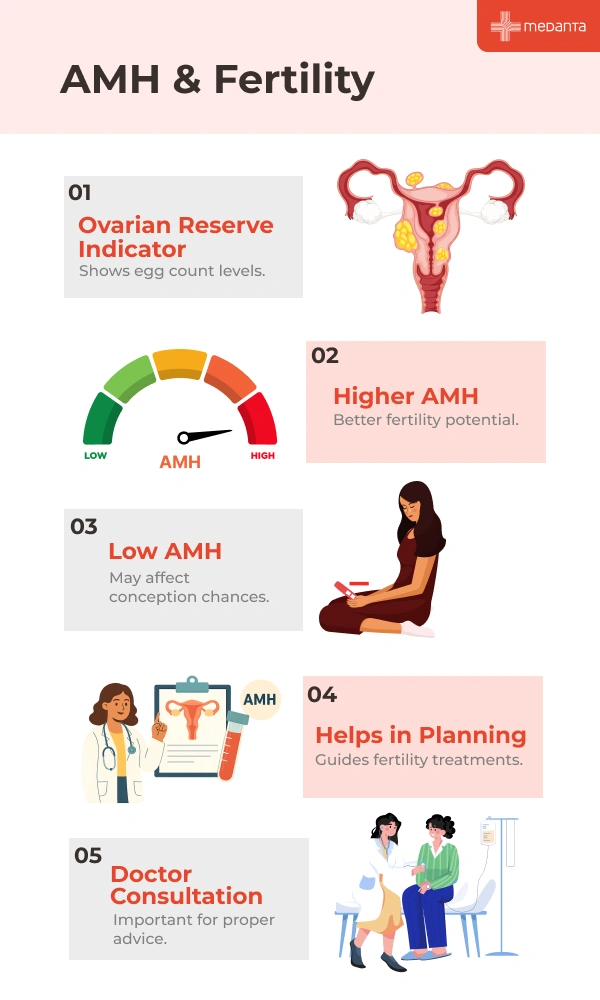
Several factors affect your AMH levels including but not limited to:
Age - the biggest factor (a sharp drop after 35)
PCOS - often leads to higher AMH
Genetics - early menopause in your family might affect your levels
Medical treatments - chemotherapy, radiation, or ovarian surgery affect AMH levels
Smoking - speeds up ovarian ageing and lowers AMH
How to Improve AMH Levels Naturally
You can't dramatically boost AMH levels, but you can support your ovarian health.
Eat foods rich in antioxidants, healthy fats, and proteins to keep your hormones balanced.
Regular exercise helps hormone health, but don't overdo it.
Stress management through yoga, meditation, or mindfulness can help your reproductive hormones.
Some supplements like CoQ10, DHEA (with doctor's approval), and Vitamin D might help your ovaries work better.
AMH Testing: When and How to Get Tested
Aspect | Details |
Test Type | Simple blood test |
Timing | Any day of the menstrual cycle works |
Preparation | No special prep needed |
Who Should Test | Women over 30 planning pregnancy, those worried about fertility, women with early menopause in their family |
Frequency | Yearly checks if trying for a baby after 30 |
Result Format | Shown in ng/mL or pmol/L |
Lifestyle and Diet Tips to Support Ovarian Health
Your ovarian health can improve substantially by adopting healthy habits. The choices you make each day will impact your fertility experience.
Mediterranean-style eating should include vegetables, fruits, whole grains, olive oil, fish, and low-fat dairy. This eating pattern will give a boost to insulin sensitivity and reduce metabolic problems that affect fertility.
Fill your plate with fertility superfoods like berries (rich in antioxidants that protect eggs), leafy greens (high in folate), fatty fish (omega-3 source), and nuts/seeds (vitamin E for egg health).
Move regularly but moderately. You should do 30 minutes of gentle exercise most days. High-intensity workouts can disrupt your hormonal balance, while moderate exercise supports it.
Maintain a healthy weight because being underweight or overweight can disrupt ovulation and hormone production.
Quality sleep matters (getting seven to nine hours each night balance your reproductive hormones).
Cut back on harmful habits (avoid smoking, limit alcohol and keeping caffeine under 200mg daily i.e. about one coffee).
Reduce environmental toxins with BPA-free containers, natural cleaning products, and organic foods when possible.
Manage stress effectively through yoga, meditation, or activities you enjoy. Your hormone balance and ovulation might suffer from chronic stress.
Stay hydrated because proper water intake helps your body detoxify and delivers nutrients to your ovaries.
Conclusion: Optimising Fertility with Healthy AMH Levels
Your AMH levels offer valuable insights into your fertility experience. These numbers matter, but AMH shows just one part of your reproductive story. It tells you about egg quantity, not quality. The best AMH range to get pregnant usually falls between 1.0-3.0 ng/mL, though age affects this range. Young women with low AMH often achieve natural pregnancies as long as their cycles remain regular.
A simple blood test measures your AMH levels on any day of your cycle. This makes it easy to track your ovarian reserve, especially after turning 30 or if you have concerns about fertility.
Everyone's path to fertility looks different. While AMH levels don't change much, focusing on your overall health creates the best chance for conception. Think of AMH as just one of many tools that help you plan your reproductive timeline and options.
FAQs
What's a normal AMH level?
AMH levels usually fall between 1.0-3.0 ng/mL. Your age affects these numbers. Readings under 1.0 ng/mL point to low ovarian reserve.
What AMH level gives the best chance of pregnancy?
The sweet spot for conception lies between 1.5-4.0 ng/mL. Women seeking IVF treatment show good response with levels between 1.0-3.5 ng/mL. Those with normal AMH (2.2-6.8 ng/mL) respond well to ovulation treatments.
Can you boost your AMH levels naturally?
We can't substantially increase AMH levels. However, you can support your ovarian health through regular exercise, stress management, and a nutrient-rich diet.
How do AMH levels change with age?
AMH reaches its highest point around age 25 before starting to drop. The decline speeds up after 35. The median AMH decreases by 0.2 ng/mL each year until age 35, then slows to 0.1 ng/mL yearly afterwards.
Can you get pregnant with low AMH?
Absolutely! Low AMH doesn't rule out pregnancy. Women under 35 with low AMH still have about 65% chance of natural conception with regular cycles.
How often should you check AMH levels?
A yearly test works well for women over 30 who want to conceive. Many doctors suggest waiting at least three months between tests.
What lifestyle changes help protect ovarian reserve?
These changes make a difference:
Keep a healthy weight
Cut back on caffeine and alcohol, quit smoking
Eat foods rich in antioxidants
Get a full 8 hours of sleep each night