1068
1068
 Request Call Back
 Contact
 1068
1068
Ocular Brachytherapy for Uveal Melanoma: Clinical Efficacy and Patient Outcomes
Published on: Jan 23, 2026
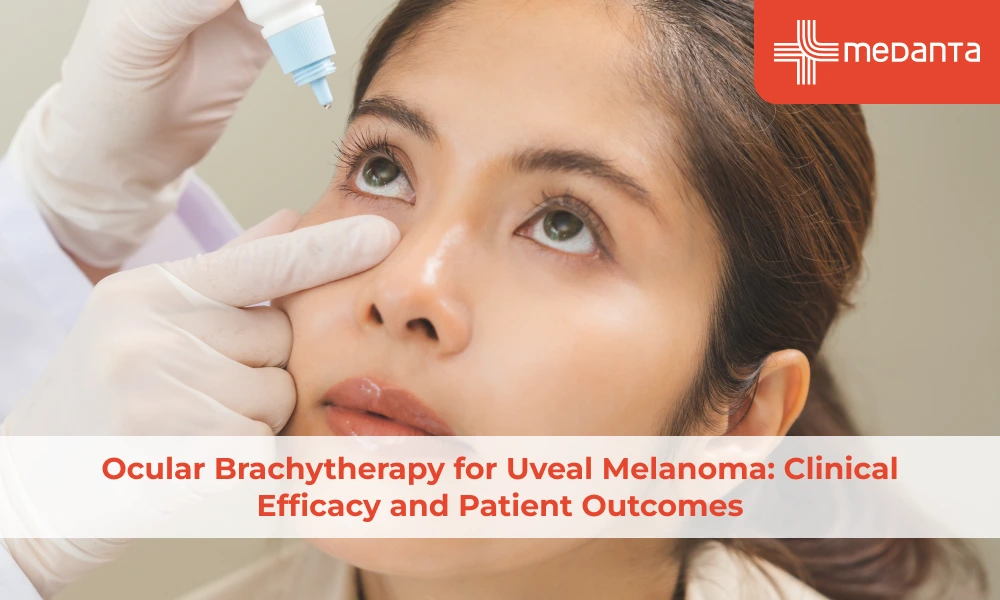
TABLE OF CONTENTS
Uveal melanoma represents the most prevalent primary intraocular malignancy in the adult population. Prompt clinical intervention is vital for optimizing survival rates and maximizing the potential for vision preservation. Modern radiotherapy, specifically ocular brachytherapy, serves as a cornerstone of eye-conserving management, offering high rates of local tumor control while mitigating the need for radical surgery.
Pathophysiology and Presentation
Uveal melanoma arises from the malignant proliferation of melanocytes within the uveal tract.
Anatomical Distribution: Approximately 90–95% of cases involve the choroid or ciliary body, with the remainder occurring in the iris.
Clinical Paradigm Shift: Historical management favored enucleation (surgical removal of the eye). However, contemporary oncology emphasizes globe-preserving treatments that deliver equivalent survival outcomes while maintaining the patient’s quality of life and aesthetic appearance.
The Mechanism of Ocular Brachytherapy
Ocular brachytherapy utilizes a localized, high-dose radiation delivery system. The procedure is characterized by the following phases:
Plaque Implantation: A custom-sized gold carrier (plaque) containing radioactive isotopes (typically Iodine-125 or Ruthenium-106) is sutured to the sclera, precisely overlying the tumor base.
Radiation Delivery: The plaque remains in situ for 2 to 7 days. The gold alloy acts as a directional shield, focusing radiation toward the malignancy while attenuating the dose to surrounding healthy ocular and orbital tissues.
Explanation: Following the delivery of the calculated therapeutic dose, the plaque is surgically removed.
Efficacy and Local Control
Clinical data confirms that brachytherapy is highly effective for small-to-medium sized intraocular tumors.
Comparative Survival: The Collaborative Ocular Melanoma Study (COMS) demonstrated that the five-year survival rates for brachytherapy are statistically equivalent to those of enucleation.
Success Rates: Ocular brachytherapy achieves local tumor control in approximately 93% of cases at the five-year follow-up. Long-term longitudinal
studies indicate a 10-year survival rate of approximately 55%, depending on the genetic profile and size of the tumor.
Visual Prognosis and Retention

Functional vision outcomes are primarily dictated by the tumor's proximity to the fovea and optic nerve.
Visual Acuity: A significant majority of patients retain "useful vision" (defined as $\ge$ 20/200) three years post-treatment.
Prognostic Factors: Tumors located in the ciliary body generally carry a more favorable visual prognosis. Conversely, tumors involving the macula or optic disc are associated with a higher incidence of secondary radiation induced vision loss.
Complications and Risk Management
While effective, ionizing radiation may lead to delayed ocular sequelae, including:
Radiation Retinopathy and Maculopathy: Vascular changes in the retina that can lead to edema or ischemia.
Radiation-Induced Cataract: Progressive opacification of the crystalline lens.
Neovascular Glaucoma: Secondary elevation of intraocular pressure.
Optic Neuropathy: Radiation damage to the optic nerve head.
Post-Operative Recovery and Surveillance
Physical recovery from the surgical procedure typically occurs within 2 to 4 weeks. However, long-term oncological surveillance is mandatory:
Short-term: Initial reassessment at 4–6 weeks to monitor surgical healing. ∙ Long-term: Dilated fundus exams and ocular ultrasonography every 6 months for the first 5 years.
Systemic Monitoring: Periodic liver function tests or radiographic imaging (e.g., MRI or CT) are required to monitor for potential metastatic spread, most commonly to the liver.
FAQs
What is the definitive success rate of brachytherapy?
The treatment demonstrates a 90% local cure rate for appropriately selected small and medium-sized tumors. It is recognized as a definitive primary treatment for uveal melanoma.
How does brachytherapy compare to enucleation regarding patient quality of life?
Patients treated with brachytherapy often report higher satisfaction regarding body image and better functional outcomes in tasks requiring peripheral vision and depth perception. However, the requirement for lifelong monitoring of the eye can contribute to increased psychological "cancer-related anxiety" compared to enucleation.
Can vision be preserved in all cases?
While the eye is preserved, vision retention varies. Approximately 50% of patients may experience a degree of visual decline within three years due to radiation induced changes. Early intervention with anti-VEGF therapy or laser photocoagulation may help manage these side effects.