1068
1068
 Request Call Back
 Contact
 1068
1068
Linear Accelerator (Linac): How It Works, Uses, and Benefits in Cancer Treatment
Published on: Dec 26, 2025
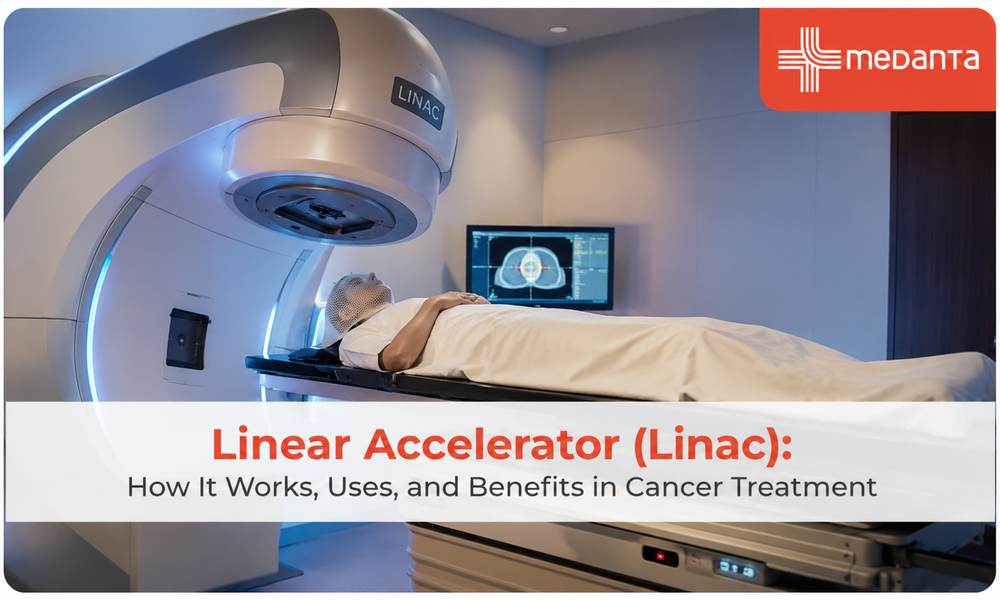
TABLE OF CONTENTS
Linear accelerators deliver high energy X-rays straight to tumour cells thus protecting surrounding healthy tissue (making them essential tools in modern cancer treatment). These powerful devices (also known as Linacs) create precisely targeted radiation beams that destroy cancer cells with remarkable accuracy. Radiation therapy serves as the cornerstone of cancer management. More than half of all cancer patients receive radiation therapy during their treatment. The linear accelerator adapts radiation to match a tumour's shape eliminating malignant cells while safeguarding normal tissue. Advanced Linacs come equipped with built-in checking systems that verify treatment requirements before activation.
This article explains how linear accelerator radiation therapy works, the types of cancer it treats and its benefits for patients.
What Is a Linear Accelerator (Linac)?
The medical linear accelerator stands as the cornerstone of radiation oncology. This advanced machine generates high-energy x-rays or electrons that match a tumour's exact shape. It destroys cancer cells while safeguarding the healthy tissue around it.
The machine's simple design begins with a heated filament that generates electrons. An electric field between the filament (cathode) and a thin metal window (anode) accelerates these electrons. The machine uses an Accelerating Waveguide to achieve proper acceleration over a reasonable distance for clinical applications.
Linacs use microwave technology (as with radar) to accelerate electrons in the 'wave guide' component. The electrons strike a heavy metal target and produce high-energy X-rays that conform precisely to the patient's tumour.
The core components include:
A gantry that rotates around the patient to deliver radiation from multiple angles
A movable treatment couch that ensures proper positioning
A multileaf collimator in the machine head that shapes the beam
This technology makes advanced treatments possible, including Intensity-Modulated Radiation Therapy (IMRT), Volumetric Modulated Arc Therapy (VMAT), Image-Guided Radiation Therapy (IGRT), and Stereotactic treatments. The Linac treats cancer with remarkable precision in almost any part of the body.
How Does a Linac Work?
A linear accelerator starts with electrons released from a heated tungsten filament. These particles move through a waveguide tube where microwave technology pushes them close to light speed. The beam stays focused thanks to magnets along the path, and treatment can follow two different routes.
When used for photon therapy, electrons hit a heavy metal target and create high-energy X-rays. These X-rays leave the machine in shapes that match the patient's tumour perfectly. The process works differently for electron therapy which treats surface tumours. Here, the electron beam spreads wider as it passes through metallic foils.
A multileaf collimator shapes the radiation beam with its independently moving thin metal blocks. This advanced technology directs radiation only to the treatment area.
The system works exceptionally well because:
The machine head (gantry) can rotate completely around the patient and deliver treatment from any angle
Patient positioning reaches millimetre accuracy with laser guidance
Patients can be moved in all directions on the treatment couch (up, down, left, right, in, out)
Advanced software matches radiation beams to each tumour's unique shape
Radiation dose stays monitored through built-in ionisation chambers
The patient lies still on the couch while the machine delivers exact radiation doses to the tumour from carefully chosen angles.
Types of Cancer Treated with Linac
Linear accelerators effectively treat many types of cancer throughout the body. These machines deliver precise radiation that destroys malignant cells while protecting healthy tissue nearby.
Cancer Type | Treatment | Effectiveness |
Brain and Spine | Used for both primary and metastatic tumours | SRS techniques provide high precision |
Head & Neck | Preserves vital functions (speech, swallowing) | Precise treatment reduces the average dosage to the parotid gland and DARS (dysphagia and aspiration related strucutures) |
Breast | Post-surgery radiation to prevent recurrence | MR-Linac provides improved tissue monitoring |
Lung | Effective for small and non-small cell types | 88% 1-year survival rate with SBRT in early stage lung cancers |
Prostate | Precision targeting near sensitive structures | Zero Grade 3+ toxicity reported in MR-Linac studies |
Gynecologic | Treats cervix, uterus, endometrial cancers | For majority of cervical cancer patients, radiation plays a crucial role in curing the disease. Brachytherapy is often complementary |
Digestive System | Treats the pancreas, liver, oesophagus and stomach | Lower toxicity levels with high locating ability to intricate anatomically compromised organs |
Rectum or Colon | MR-Linac is especially beneficial | Allows daily monitoring of tumour changes. |
Bladder | External beam radiation common | Your doctor may often combine it with chemotherapy specially in cases where its called as bladder preservation protocol. |
Blood/Lymphatic | Highly radiosensitive cancers | Quick regression/remission even after low doses of radiation |
Testicular | Excellent candidate for radiation | Located away from major organs |
Linac machines provide extra benefits through advanced techniques like IMRT, VMAT, IGRT and SRS/SBRT.
Advanced Techniques Using Linac
Advanced techniques in modern linear accelerators boost precision and effectiveness in cancer treatment. These improvements help doctors target tumours with greater accuracy. The radiation damage to healthy tissues remains minimal.
Image-Guided Radiation Therapy (IGRT) captures images before and during treatment sessions allowing your doctors to redirect radiation beams instantly (when needed). The technique is a great way to treat mobile tumours in the lungs, prostate, and abdomen.
Volumetric Modulated Arc Therapy (VMAT) delivers radiation as the machine rotates around the patient. This increases beam coverage and reduces high-dose exposure to normal tissues.
MR-Linac technology stands as the most remarkable advancement that combines a linear accelerator with magnetic resonance imaging. This hybrid system provides up-to-the-minute tumour visualisation during treatment, enabling:
Precise tracking of tumours that move during breathing
Daily adaptation based on changes in tumour size or position
Most important reduction in side effects
MR-Linac makes a big difference in prostate cancer patients' quality of life by reducing the radiation's effect on urinary and intestinal function.
Benefits of Linac Treatment
Linear accelerator therapy offers many health advantages beyond cancer treatment.
Patient satisfaction is high. Patients find the treatment surprisingly comfortable. Most patients describe their experience as positive or neutral, even while lying on the treatment bed. The excellent tolerance level explains why most patients would choose this therapy again.
Cancer patients prioritise their quality of life. Linear accelerator treatments deliver remarkable results:
The majority of patients report expected or better symptom control
Patients manage to keep their daily activities and social life
Healthy tissue around the tumour sustains less damage
Protection of organs shows better results than conventional radiotherapy
Patients need no hospitalisation
These machines' precision creates real health benefits. Rectal cancer patients see treatment margins reduced by one-third compared to conventional techniques, which protects surrounding tissues better. This accuracy leads to less toxicity, greater comfort and better health outcomes.
Safety of Linac Machines
Safety leads linear accelerator design and operation. These machines use multiple protection layers to ensure patients get exactly the prescribed radiation dose—nothing more, nothing less.
Radiation therapists under the supervision of radiation physicists/radiation safety officer check the linac accelerator's safety features each morning. They verify radiation output, beam-shaping mechanisms, and positioning features. The team runs more tests weekly, monthly, and quarterly to confirm consistent performance. Manufacturer guidelines require quarterly maintenance from engineers.
These machines come with several built-in safeguards:
Systems that shut down automatically when performance changes from specifications
Record and verify systems that block treatment unless it matches the exact plan
Bar-coding systems that ensure accurate patient identification
Systems that track and verify radiation beam consistency
The treatment rooms have thick lead and concrete walls that contain high-energy X-rays. This protects the core team and people outside. Therapists watch patients through closed-circuit television and stay connected through microphones during each session.
The International Electrotechnical Commission created strict safety standards. These standards cover electrical, mechanical, and radiation aspects of these machines.
Patient Experience During Linac Treatment
Understanding what happens during each linear accelerator treatment session helps patients prepare better. Most patients feel relieved when they learn these treatments are painless - just like getting an X-ray.
The process starts when you check in and change into a gown if needed. Your radiation therapist will help position you on the treatment table using lasers, immobilisation devices, and small tattoos marked during your simulation. Your perfect stillness will give accurate radiation delivery.
Treatment sessions usually last 15-30 minutes, though actual radiation delivery takes just a few minutes. Your therapists watch you through closed-circuit television and stay in touch via microphones. You might hear buzzing or clicking sounds while the machine rotates around you.
Your care team might use these techniques for tumours that move when you breathe:
Respiratory gating techniques
Deep inspiratory breath hold (DIBH) for breast cancer
Abdominal compression devices
Patients can maintain their normal routines during treatment courses that typically run five days weekly for several weeks. Here's how to prepare:
Eat lightly a few hours before
Stay well-hydrated
Wear comfortable clothing
Avoid skin products on the treatment area
Fatigue is the most common side effect, but many patients continue working and enjoy their regular activities throughout their treatment.
Conclusion
Linear accelerators have changed cancer care through their exceptional way to target tumours while protecting healthy tissue. These machines deliver high-energy radiation with perfect accuracy. They are vital tools to treat cancer types throughout the body.
The precision of Linac therapy works better than conventional approaches as you may have fewer side effects and better symptom control. They maintain their quality of life during treatment.
Modern techniques like IMRT, VMAT, and MR-Linac technology expand what doctors can do in radiation therapy. Immediate imaging helps doctors track moving tumours. They can adapt treatment daily based on changes. This makes the treatment more effective (and reduces complications).
Cancer diagnoses bring fear and uncertainty but Linac therapy gives hope through proven results in many cancer types. Treatment's non-invasive nature lets people keep their daily routines with minimal disruption while getting powerful cancer-fighting therapy. Technology keeps moving forward and these amazing machines will become more precise, effective and comfortable for patients. They give countless cancer patients a fighting chance without sacrificing their wellbeing.
FAQs
What is a linear accelerator (Linac) used for?
A linear accelerator delivers external beam radiation treatments to cancer patients. The device creates high-energy X-rays that target tumours and minimise damage to surrounding healthy tissue.
How does a Linac kill cancer cells?
Linac radiation damages cancer cell DNA to prevent growth and division. Cancer cells multiply faster than normal cells, which makes them especially vulnerable to radiation effects.
Is radiation therapy using Linac safe?
The treatment is remarkably safe. Linacs come with multiple built-in protective measures that prevent excess dose delivery. The staff performs daily safety checks along with monthly and annual inspections to ensure proper operation.
Which cancers can be treated with a Linac?
The device can treat almost any cancer in the body. Doctors commonly use it for brain, head, neck, breast, lung, prostate, gynecologic, and digestive system cancers.
What is the difference between Linac and Gamma Knife?
Linac generates X-rays through electrons while the Gamma Knife uses Cobalt-60 gamma rays.
How long does a typical Linac treatment session take?
Treatment sessions last 15-30 minutes, and the actual radiation delivery takes just minutes. MR-Linac treatments need 20-45 minutes.
Are there side effects from Linac radiation therapy?
Patients might experience fatigue, skin irritation, mild nausea, and swelling at the treatment site. These effects usually go away with time.
How is Linac treatment planned for each patient?
The radiation oncologist collaborates with a dosimetrist and medical physicist to create personalised treatment plans. These plans include the right delivery method, schedule and exact dosage.
Can Linac be treated on both adults and children?
Yes. Hospitals offer detailed support programmes for young patients and often use videos, cartoons and role-playing to explain the process.
How effective is Linac compared to other radiation therapy methods?
Linac shows excellent results. Studies reveal similar local control rates between Linac and other methods like Gamma Knife.