1068
1068
 Request Call Back
 Contact
 1068
1068
Laser Hair Removal: How It Works, Benefits, Side Effects and Cost
Published on: Aug 27, 2026
TABLE OF CONTENTS
- How Does the Laser Actually Work on Hair Follicles
- Which Body Areas Can Be Treated?
- Who Is the Best Candidate for Laser Hair Removal?
- Step-by-Step: What Happens During a Session
- Benefits of Laser Hair Removal Over Waxing/Shaving
- Side Effects and Skin Reactions to Be Aware Of
- Pre-Treatment and Post-Treatment Care Tips
- Is Laser Hair Removal Permanent?
- Cost Breakdown - What to Expect in India
- Conclusion & Questions to Ask Before Booking
- FAQs
- References
Laser hair removal uses concentrated light energy to damage hair follicles, reducing or eliminating future hair growth. Device refinement for darker skin tones has made it significantly more accessible across Indian skin types over the past decade, and for many people it represents a genuine long-term alternative to repeated waxing, threading or shaving. It can be performed on areas such as the face, arms, legs, underarms, bikini line, chest, and back. It is suitable for both men and women.
How Does the Laser Actually Work on Hair Follicles
Hair pigment (melanin) absorbs the laser's light energy and converts it to heat. That heat travels down the hair shaft to the follicle, damaging the structures responsible for regrowth. Thermal damage is targeted because melanin is far more concentrated in hair than in surrounding skin. Sufficient damage to the follicular stem cells and the dermal papilla interrupts the growth cycle.
The process only affects hairs in the anagen (active growth) phase, which explains why multiple sessions are necessary - at any given time only a portion of hairs in a treated area are in anagen.
Which Body Areas Can Be Treated?
Face: Upper lip, chin, sideburns, full face; these are among the most requested areas for laser treatment
Underarms: One of the fastest responding areas given the relatively small size and coarse hair
Legs, arms, and back: Large areas that benefit most from the time efficiency advantage over repeated waxing
Bikini line and Brazilian: Commonly requested; requires precise technique given the sensitivity of the area
Stomach, chest, and shoulders: Commonly treated in men alongside the back
Virtually any area where unwanted hair grows can be treated, with the exception of the eyelid area, where proximity to the eye makes laser treatment unsafe.
Who Is the Best Candidate for Laser Hair Removal?
Ideal candidates have dark hair and relatively lighter skin - the contrast allows precise follicular targeting. This applies to much of the Indian population, though the wide range of skin tones makes device selection critical. Fitzpatrick type V and VI skin requires the Nd:YAG 1064nm laser, which penetrates deeper and is less absorbed by surface melanin, reducing burn risk.
Poor candidates include those with grey, red, or very light hair - insufficient melanin means the laser has no target. Active infections, tanned skin or photosensitising medications require treatment to be deferred.
Step-by-Step: What Happens During a Session
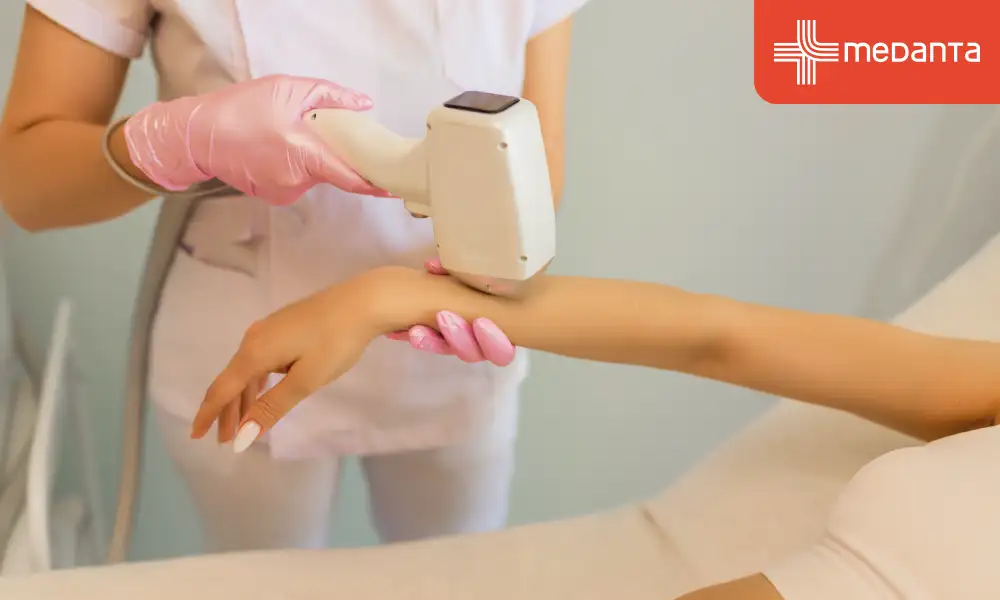
The area is shaved the day before to ensure energy reaches the follicle rather than surface hair. Numbing cream is applied 30 to 60 minutes before at sensitive sites. The skin is cooled through the handpiece or gel while the practitioner systematically delivers pulses across the treatment area.
Sessions run from 10 minutes for the upper lip to 60 to 90 minutes for full legs. The area looks red and feels warm for 12 to 24 hours afterwards.
Benefits of Laser Hair Removal Over Waxing/Shaving
Key advantages are:
Cost over time: The upfront investment usually becomes cost effective within two to three years compared to ongoing waxing expenses.
Time savings: Eliminating or significantly reducing repeated waxing appointments adds up considerably over years.
Reduced ingrown hairs: Laser treated follicles stop producing hair that could curl back into the skin (a common problem with waxing and shaving on the bikini line & underarms).
Precision: Areas like the upper lip, chin, or between the eyebrows can be treated with a level of accuracy that threading simply can't match.
Skin texture in treated areas often improves as repeated waxing and shaving inflammation is eliminated.
Side Effects and Skin Reactions to Be Aware Of
Temporary redness and swelling resolves within 24 hours. Pigmentation changes (hyperpigmentation and hypopigmentation) are the most clinically significant risks in darker skin tones. Both reduce substantially with appropriate laser selection and sun avoidance before and after sessions.
Burns and scarring are uncommon in experienced hands but represent the consequences of wrong device selection for a given skin type.
Pre-Treatment and Post-Treatment Care Tips
Care tips are:
Avoid sun exposure, self-tanning products and tanning beds for four weeks before treatment as tanned skin raises pigmentation risk
Shave the area the day before each session; do not wax, thread, or use depilatory creams as these remove the hair shaft the laser needs
After treatment, apply a cool compress and SPF 30 or higher to treated areas and avoid heat sources including hot showers, steam and exercise for 24 to 48 hours
Use broad-spectrum sunscreen consistently throughout treatment. Sun exposure between sessions raises post-inflammatory pigmentation risk particularly relevant in India's climate.
Cost Breakdown - What to Expect in India
The cost of laser hair removal isn't fixed, it varies based on a number of factors: the area being treated, how many sessions you'll need, the type of laser technology involved, the clinic's level of expertise and even which city you're in. Smaller areas like the upper lip or underarms typically cost less than larger ones like the legs or back, simply because there's less surface area to cover.
Many clinics also offer package deals whether for multiple sessions or full-body treatments, which can bring the overall cost down considerably. If you want an accurate estimate tailored to your specific needs, consultation with a qualified dermatologist or aesthetic specialist.
Conclusion & Questions to Ask Before Booking
Before committing to a clinic, ask which laser device is used and whether it suits your skin tone, how many sessions are recommended for your hair type, the protocol if complications occur and whether a patch test is performed first. A clinic that answers clearly and offers a patch test demonstrates the standard of care this procedure requires.
FAQs
Does laser hair removal hurt?
Most describe it as a snapping or stinging sensation, like a rubber band flicking the skin. The upper lip, bikini line and underarms are more sensitive than the legs or back. Numbing cream significantly reduces discomfort at sensitive sites.
How many sessions does it take to see permanent results?
Six to eight sessions typically achieve the majority permanent hair reduction. Noticeable thinning appears after two to three sessions with more significant reduction by four to five.
Is laser hair removal safe for dark skin tones?
Yes with the correct laser. The Nd:YAG 1064nm is the safe standard for Fitzpatrick types V and VI. Using lasers designed for lighter skin on dark skin significantly raises burn and hypopigmentation risk.
Can laser hair removal be done on the face and upper lip?
Yes and among the most commonly treated areas. Facial hair responds after fewer sessions given the faster growth cycle. Hormonal facial hair in women with PCOS may require more sessions and maintenance.
What happens if you go in the sun after laser treatment?
UV exposure after treatment increases the risk of hyperpigmentation and dark patches forming over treated areas. Avoiding direct sun for at least two weeks after each session and applying SPF consistently is non-negotiable.
Is laser hair removal safe during pregnancy?
Generally avoided during pregnancy due to insufficient safety data. Most clinics decline to treat pregnant patients and hormone driven hair changes make results less predictable during this period.
Can laser hair removal cause cancer?
Laser hair removal uses non-ionising radiation in the visible to near-infrared spectrum, which cannot cause the DNA damage associated with cancer. No evidence links it to any malignancy.
What is the difference between laser hair removal and IPL?
Laser uses a single concentrated wavelength whereas IPL uses a broad spectrum. Laser is more precise particularly for darker skin and requires fewer sessions. IPL is less consistent across different skin and hair combinations.
How long do the results of laser hair removal last?
Sufficiently damaged follicles produce no further hair long term. One or two maintenance sessions per year manage minor regrowth. Hormonal changes can trigger new growth in previously treated areas.
Can laser hair removal be done on grey or white hair?
No. Grey and white hair lack melanin - without it, the laser has no follicular target. Electrolysis is the alternative for unpigmented hair.
Can I shave between sessions?
Yes shaving between sessions doesn't interfere with results. Waxing, threading, or epilating should be avoided as removing the hair shaft disrupts the laser's follicular target at the next session.
References
1. Goldberg DJ. Laser hair removal. Dermatol Clin. 2002;20(3):561–567. DOI: 10.1016/s0733-8635(02)00012-4
https://doi.org/10.1016/s0733-8635(02)00012-4
2. Battle EF Jr, Hobbs LM. Laser-assisted hair removal for darker skin types. Dermatol Ther. 2004;17(2):177–183. DOI: 10.1111/j.1396-0296.2004.04017.x