1068
1068
 Request Call Back
 Contact
 1068
1068
Banana Nutrition Facts: Calories, Protein and Fibre Per Banana
Published on: Sep 29, 2026
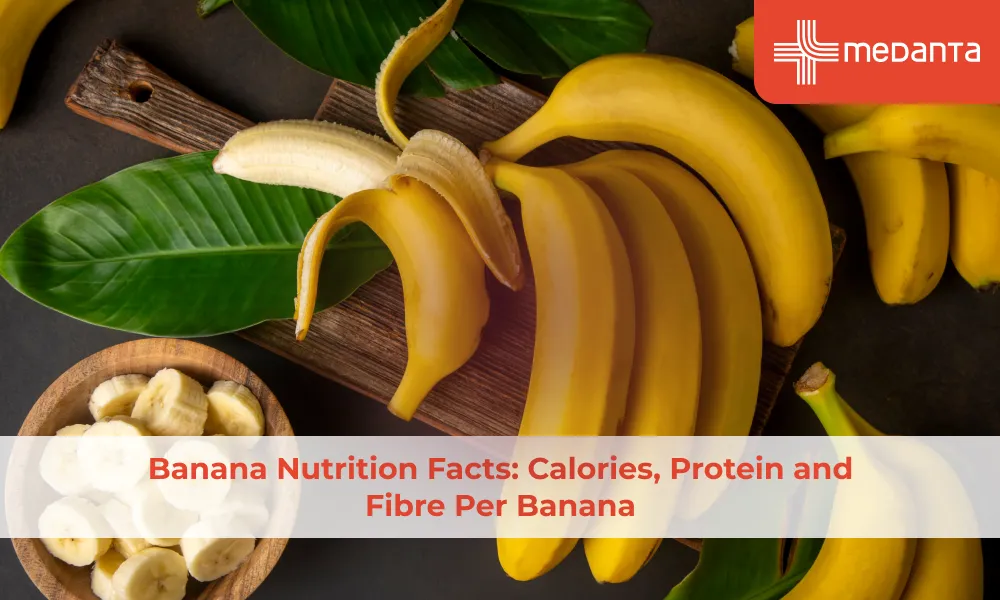
TABLE OF CONTENTS
- Banana Nutrition Facts Per 1 Banana and Per 100g
- How Many Calories Are in 1 and 2 Bananas?
- Does Banana Have Protein? How Much Exactly
- Banana Fibre Content and Digestive Benefits
- Banana Energy: Why Athletes Eat It Before Workouts
- Health Benefits of Eating Banana Daily
- Best Time to Eat Banana
- Conclusion
- FAQs
- References
The banana is one of the most widely eaten fruits globally. Available year-round across every region of the country at a cost accessible to nearly all income groups, it requires no preparation. In India, bananas appear at the breakfast table, in temple offerings, at construction sites, in hospital wards and in the hands of cricketers at drinks breaks. The appeal is not just cultural: bananas provide meaningful amounts of carbohydrates, potassium, vitamin B6, vitamin C and fibre in a single affordable fruit.
Yet banana nutrition is frequently misunderstood. The fruit is avoided by some people trying to lose weight because of its perceived high sugar content, and overestimated by others as a protein source. This article explains what a banana actually contains and when it is best eaten.
Banana Nutrition Facts Per 1 Banana and Per 100g
Nutritional values vary by banana size. The values below are based on USDA data for a medium banana (approximately 100g edible weight).
Nutrient | Per 100g | Per medium banana (approx. 118g with peel / 100g edible) |
Calories | 89 kcal | 89 to 105 kcal |
Carbohydrates | 23g | 23 to 27g |
Total sugars | 12g | 12 to 14g |
Dietary fibre | 2.6g | 2.6 to 3.1g |
Protein | 1.1g | 1.1 to 1.3g |
Total fat | 0.3g | 0.3g |
Potassium | 358mg | 358 to 422mg |
Vitamin B6 | 0.37mg (22% RDI) | 0.37 to 0.43mg |
8.7mg (10% RDI) | 8.7 to 10.3mg | |
Magnesium | 27mg | 27 to 32mg |
Folate | 20mcg | 20 to 24mcg |
How Many Calories Are in 1 and 2 Bananas?
A medium banana provides approximately 89 to 105 kilocalories, almost entirely from carbohydrates. For practical reference:
1 small banana (approximately 80g edible): around 72 kcal.
1 medium banana (approximately 100g edible): around 89 to 105 kcal.
1 large banana (approximately 136g edible): around 121 kcal.
2 medium bananas: approximately 178 to 210 kcal.
89 to 105 kcal from a medium banana is comparable to a small serving of puffed rice (muri or murmura) or a digestive biscuit, and far lower than most commercially available snacks. Banana's caloric density is moderate, not high, and its fibre and water content contribute to satiety.
Does Banana Have Protein? How Much Exactly
A medium banana contains approximately 1.1g of protein. This is real but modest: it represents roughly 2% of the recommended daily protein intake for an average 60kg adult requiring 0.8g of protein per kilogram of body weight (approximately 48g per day).
Banana is not a meaningful protein source and should not be relied upon to meet protein requirements. The amino acid profile is incomplete, with low concentrations of several essential amino acids. For athletes or those with high protein needs, bananas work best as an energy source along with a protein-rich food such as curd (dahi) or peanut butter rather than as a protein source in its own right.
Banana Fibre Content and Digestive Benefits
A medium banana contains approximately 2.6g of dietary fibre (representing around 9 to 10% of the adult daily fibre requirement). This fibre content is meaningful for a single fruit serving.
Banana fibre is composed of both soluble and insoluble fibre. The most nutritionally significant component is resistant starch particularly in less ripe bananas, which functions as a prebiotic.
Ripe bananas have a mild binding effect on the bowel and are a traditional remedy for loose stools across India. Less ripe bananas are good for regular bowel movements and gut bacteria.
Banana Energy: Why Athletes Eat It Before Workouts
Bananas are among the most widely used pre-workout foods for athletes worldwide, including Indian cricketers, badminton players and marathon runners.
Rapidly available carbohydrate: The simple sugars in a ripe banana are absorbed into the bloodstream within 30 to 60 minutes of consumption providing glycogen for working muscles during exercise.
Sustained energy release: The moderate fibre content slows glucose absorption compared to pure sugar or sports drinks; therefore it gives energy release without the sharp blood sugar spike and subsequent crash that highly refined carbohydrates produce.
Potassium and electrolyte support: A medium banana provides approximately 358 to 422 mg of potassium (which is lost in sweat during exercise). With adequate potassium intake you can experience reduced muscle cramping and it supports normal muscle contraction during prolonged exercise.
Portable and practical: Bananas require no preparation, packaging or refrigeration making them one of the most convenient pre-workout foods available.
Health Benefits of Eating Banana Daily
They are:
Heart health: The potassium in bananas supports normal blood pressure by opposing the vasoconstrictive effects of sodium. Diets high in potassium are associated with reduced risk of hypertension and stroke and a medium banana provides 10% of the adult daily potassium requirement.
Mood and sleep support: A banana provides 22% of the adult daily vitamin B6 requirement per medium fruit. Vitamin B6 helps in the synthesis of serotonin, dopamine and melatonin (that is why with regular banana consumption you get improved mood and sleep quality).
Digestive health: Resistant starch in less ripe bananas acts as a prebiotic, supporting beneficial gut bacteria. The fibre content of ripe bananas gives you better bowel movements and reduces constipation which is prevalent among Indian populations consuming low fibre diets.
Blood sugar management: Despite containing natural sugars, banana has a moderate glycaemic index (52 to 62 for ripe banana) and its fibre content moderates the blood glucose response. People with diabetes should include banana in a balanced meal (for them less ripe bananas are good due to better blood glucose control).
Bone support: Banana contains fructooligosaccharides that make calcium absorption better from the gut giving you bone mineral density maintenance along with adequate dietary calcium intake.
Best Time to Eat Banana
Before exercise: A medium banana consumed 30 to 60 minutes before physical activity provides rapidly available carbohydrate energy, potassium for muscle function and vitamin B6 for energy metabolism.
At breakfast: Combining banana with a protein-rich food such as curd (dahi), peanut butter or eggs improves satiety and slows glucose absorption further.
As a mid-morning or afternoon snack: A banana between meals provides a satisfying low preparation snack lower in calories than most packaged Indian snack foods.
After exercise: Consuming a banana after exercise helps replenish muscle glycogen, provides potassium to replace electrolytes lost in sweat and supports protein metabolism during the recovery period.
Conclusion
A medium-sized banana packs a real nutritional punch. It's a natural source of carbohydrates for energy, along with dietary fibre, potassium, vitamin B6, vitamin C and magnesium. It is not a significant protein source, but it is an excellent source of energy, potassium, vitamin B6, and prebiotic fibre, particularly when consumed in a less ripe state.
For most Indian adults, including one or two bananas daily is a practical and evidence-supported way to support energy, digestive health, heart function and mood. People managing blood sugar should prefer less ripe bananas and consume them within a balanced meal.
FAQs
How many calories are in one banana?
A medium banana (approximately 100g edible weight) contains approximately 89 to 105 kilocalories. A small banana contains around 72 kcal and a large banana around 121 kcal with the calorie content coming almost entirely from carbohydrates.
How much protein is in a banana?
A medium banana contains approximately 1.1g of protein representing around 2% of the daily protein requirement for a sixty kg adult. Bananas are not a meaningful protein source (but contribute to total daily protein intake alongside other foods).
Do bananas contain fibre?
Yes. A medium banana contains approximately 2.6g of dietary fibre (soluble fibre, insoluble fibre and resistant starch). Resistant starch is a prebiotic and is abundant in less ripe bananas.
What is the nutritional value of one banana?
A medium banana provides 89 to 105 kcal, 23g of carbohydrate, 12g of natural sugars, 2.6g of fibre, 1.1g of protein, 358mg of potassium, 0.37mg of vitamin B6 (22% RDI), 8.7mg of vitamin C (10% RDI), 27mg of magnesium and 20mcg of folate.
How many calories are in two bananas?
Two medium bananas provide approximately 178 to 210 kilocalories. Two large bananas provide approximately 240 to 250 kilocalories. The calorie content varies with banana size but two medium bananas represent a moderate, nutritious snack or meal component rather than a high-calorie food.
Is banana a good source of energy before exercise?
Yes as a ripe banana consumed 30 to 60 minutes before exercise gives you rapidly available carbohydrate fuel, potassium for muscle function and vitamin B6 for energy metabolism. Research has shown that banana consumption during endurance exercise yields performance outcomes comparable to commercial carbohydrate sports drinks with additional micronutrient benefits.
What is the best time to eat a banana?
The most evidence supported timing is before exercise (for energy and potassium) and at breakfast (combined with a protein source for sustained satiety). Banana also works well as a mid morning or afternoon snack and after exercise for glycogen replenishment.
Is banana good for weight loss or weight gain?
Banana is neutral in the context of weight management: it supports weight loss when it replaces higher-calorie snacks and is consumed as part of a calorie-controlled diet and it can support weight gain when added to a calorie-surplus diet.
How much fibre content does a banana have?
A medium banana contains approximately 2.6g of dietary fibre per 100g of edible fruit. A large banana contains approximately 3.1g. The fibre content includes soluble fibre (good for gut bacteria and supports blood glucose regulation), insoluble fibre (which promotes bowel regularity) and resistant starch (which acts as a powerful prebiotic particularly in unripe bananas).
Do bananas have enough protein to count as a protein source?
With approximately 1.1g of protein per medium banana, bananas do not meet the threshold to be considered a protein source. A meaningful protein source typically provides at least 5 to 10 g of protein per serving. Banana should be paired with high-protein foods such as curd (dahi), dal, eggs or nuts to meet protein requirements.
References
1. USDA Agricultural Research Service. FoodData Central: Bananas, raw. USDA. 2024. https://fdc.nal.usda.gov/fdc-app.html#/food-details/1102653/nutrients
2. Nieman DC, Gillitt ND, Henson DA, et al. Bananas as an energy source during exercise: a metabolomics approach. PLOS ONE. 2012;7(5):e37479. https://doi.org/10.1371/journal.pone.0037479
3. Champ MM. Physiological aspects of resistant starch and in vivo measurements. J AOAC Int. 2004;87(3):749–55. https://pubmed.ncbi.nlm.nih.gov/15287676
4. Indian Council of Medical Research. Nutrient requirements for Indians: recommended dietary allowances and estimated average requirements. ICMR-NIN. 2020. https://www.nin.res.in/RDA_2020.html
5. Slavin JL, Lloyd B. Health benefits of fruits and vegetables. Adv Nutr. 2012;3(4):506–16. https://doi.org/10.3945/an.112.002154