1068
1068
 Request Call Back
 Contact
 1068
1068
Oral Cancer in Young Adults: Causes, Symptoms and Trends
Published on: Jul 23, 2026

TABLE OF CONTENTS
- Is Oral Cancer Increasing Among Young Adults?
- How Oral Cancer in Young Adults Differs from Older Adults
- Common Causes and Risk Factors in Younger Age Groups
- The Role of Tobacco, Vaping and Areca Nut Use
- Can HPV Infection Increase the Risk of Oral Cancer?
- Early Warning Signs and Symptoms to Watch For
- Why Oral Cancer Is Often Diagnosed Late in Young Adults
- Diagnosis and Staging of Oral Cancer
- Treatment Options and Recovery Outcomes
- Prevention Strategies and Lifestyle Changes for Risk Reduction
- FAQs
- References
Oral cancer has long been associated with older age, heavy smoking, and decades of alcohol use - a profile that made it easy to dismiss as irrelevant under 40. That profile has been shifting. Younger patients are appearing in oncology clinics with oral malignancies, some without classic risk factors.
India already carries one of the highest oral cancer burdens globally, driven substantially by smokeless tobacco products reaching adolescents and young adults well before any smoking habit develops. Understanding the specific risks for younger age groups and the early signs is essential.
Is Oral Cancer Increasing Among Young Adults?
Globally, oropharyngeal cancers particularly tonsil and base of tongue have risen in adults under 50, with HPV infection as the primary cause. In India, oral cavity cancers from tobacco and areca nut use dominate and these are appearing at younger ages as gutka and pan masala consumption has spread among teenagers and those in their twenties.
Lip and oral cavity cancers are among the top five cancers in Indian men, with age of presentation trending younger as smokeless tobacco use patterns have changed.
How Oral Cancer in Young Adults Differs from Older Adults
Younger patients present more commonly with tongue and oropharyngeal cancers rather than floor-of-mouth or lip cancers, which predominate in older smokers. HPV-positive oropharyngeal cancers carry considerably better prognosis than their HPV-negative counterparts. However presentation often runs later in young adults because cancer is less readily considered at 28 than at 60, by the patient and sometimes by the treating doctor.
The Role of Tobacco, Vaping and Areca Nut Use
Gutka including areca nut, tobacco, and slaked lime is used by adolescents and young adults at rates that concern oncologists tracking oral submucous fibrosis in patients in their twenties. Areca nut alone, without tobacco, is independently carcinogenic less widely understood than its tobacco association. [3]
Vaping lacks the same established link to oral cancer as combustible tobacco but its aerosol delivers irritants and potentially carcinogenic aldehydes to the oral mucosa. Long-term evidence is still accumulating, and calling vaping safe for oral health is not supported by current data.
Can HPV Infection Increase the Risk of Oral Cancer?
Yes HPV types 16 and 18 are recognised carcinogens in the oropharynx, affecting younger adults who may have no tobacco or alcohol history. The mechanism involves HPV integrating into squamous cell DNA and inactivating tumour suppressor genes. The HPV vaccine included in India's Universal Immunisation Programme for adolescent girls provides protection against these high-risk strains.
Early Warning Signs and Symptoms to Watch For
A mouth ulcer or sore that has been present for more than two to three weeks without healing is the single most important sign to act on. Other warning signs are:
A red patch (erythroplakia) or white patch (leukoplakia) on the gum, tongue, inner cheek, or floor of the mouth that doesn't rub off
A painless lump or thickening anywhere in the mouth, lip, throat, or neck
Difficulty swallowing, chewing, or moving the tongue or jaw and persisting for weeks without explanation
Unexplained numbness of the lip, tongue, or chin
A persistent sore throat or a voice change that doesn't resolve over a few weeks.
Why Oral Cancer Is Often Diagnosed Late in Young Adults
Young adults don't expect cancer. A sore in the mouth is often attributed to a dental problem, a vitamin deficiency or spicy food - explanations that are usually correct, which makes the rare exception harder to catch. The absence of pain in early oral cancer compounds this: a painless ulcer doesn't alarm the way pain would so patients tolerate it for weeks before seeking attention. By then, local spread has often already occurred.
Diagnosis and Staging of Oral Cancer
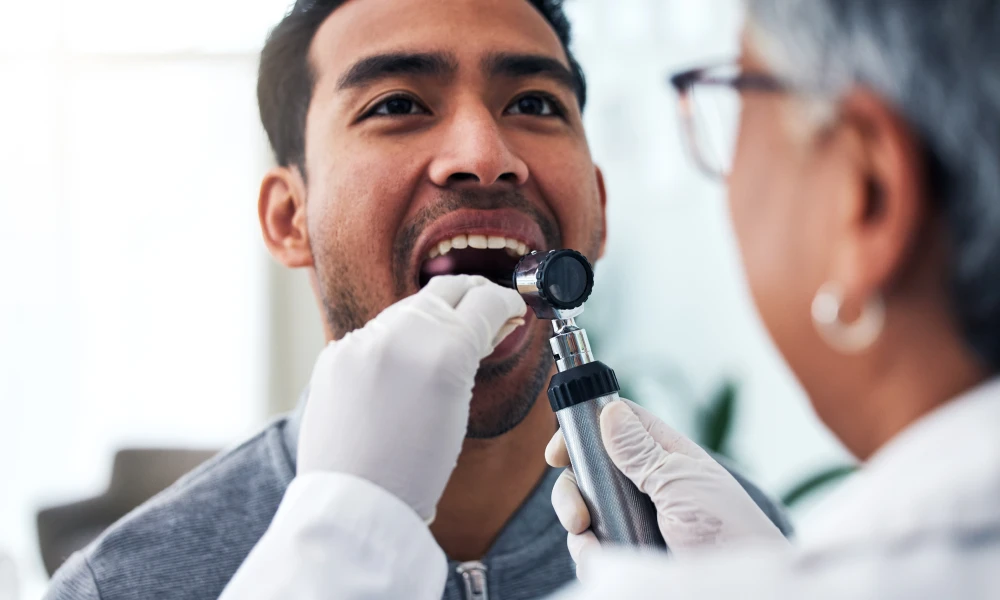
Visual examination of the full oral cavity including under the tongue and soft palate is the first step, sometimes supplemented with toluidine blue staining to highlight suspicious mucosa. Biopsy confirms histological diagnosis. CT or MRI assesses local spread and lymph node involvement; PET-CT evaluates distant metastasis in higher-stage disease.
Treatment Options and Recovery Outcomes
Early-stage oral cancer confined to the primary site is treated with surgery or radiation alone with high cure rates. Advanced disease requires combined modality treatment including surgery with radiation, or concurrent chemoradiation. Functional outcomes like swallowing, speech & jaw movement are a priority in planning for young adults with decades ahead. Reconstruction and speech-swallowing rehabilitation are standard at specialist head and neck oncology centres.
Prevention Strategies and Lifestyle Changes for Risk Reduction
Stopping all tobacco use (bidis, cigarettes, gutka, khaini & pan masala) is the most impactful change. Pre-malignant lesions occasionally regress after cessation. HPV vaccination in adolescence provides protection against oropharyngeal cancer. Annual dental check-ups create an opportunity for oral cavity examination. Limiting alcohol, maintaining oral hygiene and addressing sharp teeth reduce chronic mucosal irritation over time.
FAQs
Can someone in their 20s or 30s get oral cancer?
Yes. While oral cancer is more common in older adults, cases in the 20s and 30s do occur particularly in those using smokeless tobacco products, those infected with high-risk HPV or those with no clearly identifiable cause. Young age does not exclude the diagnosis.
What does oral cancer look like in its early stages?
Early oral cancer most commonly appears as a persistent ulcer that fails to heal, a white or red patch on the inner cheek, tongue, or gum or a painless lump or thickening. Early lesions are frequently asymptomatic, which is exactly what makes them easy to ignore and late to diagnose.
Is a mouth ulcer that does not heal always a sign of cancer?
Not always most mouth ulcers have benign causes. The critical marker is persistence: an ulcer that hasn't healed within two to three weeks deserves clinical evaluation rather than continued home management. Most will turn out to be benign but the ones that aren't need to be caught at this stage.
Can vaping increase the risk of oral cancer?
A direct link has not been established with the same strength as combustible tobacco but vaping aerosol delivers irritants and potentially carcinogenic compounds to the oral mucosa. Long-term evidence is still accumulating and calling vaping safe for oral health is not supported by current data.
How long should I wait before getting a persistent mouth sore checked?
Two to three weeks is the standard threshold. Any sore, ulcer or patch that hasn't resolved within that window should be examined by a dentist or doctor rather than waited out further.
Can oral cancer develop even if I do not smoke or drink?
Yes HPV-positive oropharyngeal cancer occurs in non-smokers, non-drinkers, often younger adults. Areca nut use without tobacco is independently carcinogenic. And a minority of cases have no clearly identified risk factor at all.
Is oral cancer in young adults becoming more common?
HPV driven oropharyngeal cancer is rising in younger adults globally. In India, earlier exposure to smokeless tobacco products is presenting oral cavity cancer at younger ages.
What are the first symptoms people usually notice?
A sore that doesn't heal is the most common first-noticed sign. A white or red patch, a painless lump or difficulty moving the jaw or tongue are the next most frequent. Many patients initially attribute these to dental problems or minor irritation.
Can oral cancer be cured if it is found early?
Yes early-stage oral cancer has high cure rates with surgery or radiation alone. The difference between stage I and stage IV outcomes is substantial, which is exactly why the two-to-three week rule for non-healing sores matters.
When should I see a doctor for a lump or patch inside my mouth?
Any lump, patch, or ulcer that persists beyond two to three weeks without explanation needs evaluation. The threshold for assessment is low particularly in anyone who uses tobacco in any form.
References
1. Chaturvedi AK, et al. Human papillomavirus and rising oropharyngeal cancer incidence in the United States. J Clin Oncol. 2011;29(32):4294–4301. DOI: 10.1200/JCO.2011.36.4596
https://doi.org/10.1200/JCO.2011.36.4596
2. Ang KK, et al. Human papillomavirus and survival of patients with oropharyngeal cancer. N Engl J Med. 2010;363(1):24–35. DOI: 10.1056/NEJMoa0912217
https://doi.org/10.1056/NEJMoa0912217
3. IARC Working Group. Betel-quid and areca-nut chewing and some areca-nut-derived nitrosamines. IARC Monogr Eval Carcinog Risks Hum. 2004;85:1–334. PMID: 15635762
https://pubmed.ncbi.nlm.nih.gov/15635762/
4. Gillison ML, et al. Evidence for a causal association between human papillomavirus and a subset of head and neck cancers. J Natl Cancer Inst. 2000;92(9):709–720. DOI: 10.1093/jnci/92.9.709
https://doi.org/10.1093/jnci/92.9.709
5. Scott SE, et al. The power of the patient: the importance of mouth self-examination in an early detection programme for oral cancer. Oral Oncol. 2006;42(4):343–349. DOI: 10.1016/j.oraloncology.2005.07.012
https://doi.org/10.1016/j.oraloncology.2005.07.012
6. Sankaranarayanan R, et al. Effect of screening on oral cancer mortality in Kerala, India: a cluster-randomised controlled trial. Lancet. 2005;365(9475):1927–1933. DOI: 10.1016/S0140-6736(05)66658-5