1068
 Request Call Back
 Contact
 1068
Jaw Pain and Left Arm Pain: Is It a Heart Attack?
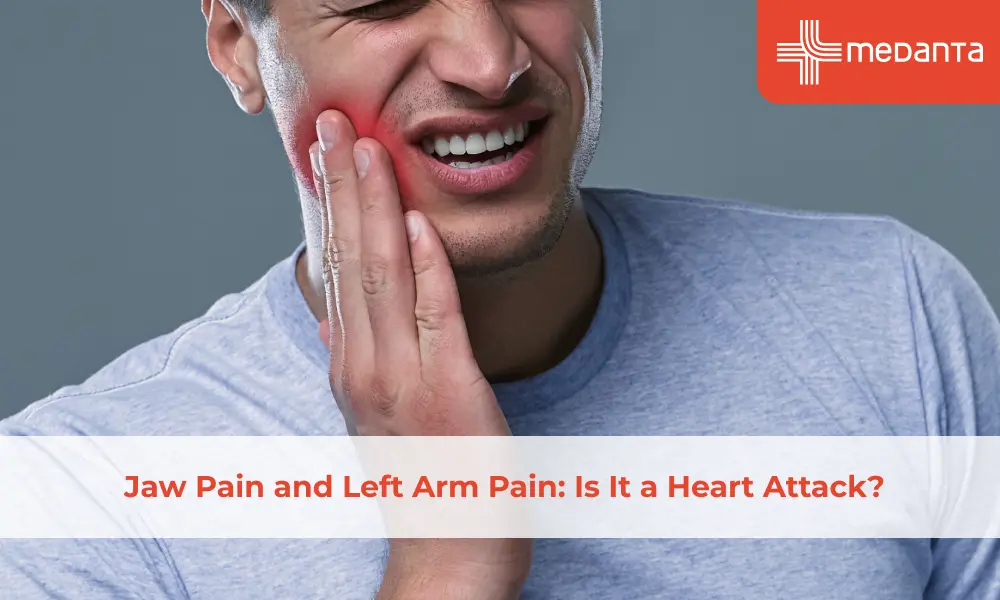
Jaw pain and left arm pain occurring together, particularly when sudden in onset or associated with sweating, breathlessness or nausea, are among the most recognisable warning signs of a myocardial infarction (heart attack). These symptoms occur because the heart and the structures that relay pain signals from the jaw, arm and chest share overlapping neural pathways, causing pain from the ischaemic heart to be perceived in locations distant from the heart itself. This article explains what causes these symptoms, why jaw pain can be a warning sign of heart disease and treatment options.
What Causes Jaw and Left Arm Pain?
Jaw and left arm pain can arise from several causes. They are:
Myocardial infarction (heart attack): Ischaemia of the myocardium triggers pain transmitted through cardiac sympathetic afferent nerve fibres to the spinal cord and perceived in the jaw, neck, left arm and back, in addition to or instead of the chest
Angina pectoris: Transient myocardial ischaemia caused by coronary artery disease or vasospasm. Anginal pain may radiate to the jaw and left arm but resolves within minutes with rest or sublingual nitrates.
Temporomandibular joint (TMJ) disorder: TMJ disorders cause jaw pain that is localised, often associated with clicking, limited mouth opening and jaw tenderness. The pain does not radiate to the left arm.
Musculoskeletal and cervical radiculopathy: A cervical nerve root compression at C5 or C6, from cervical disc herniation or cervical spondylosis (common in India), can produce left arm pain and sometimes jaw pain. The pain is positional.
How Heart Attack Pain Can Spread to the Jaw and Arm
The mechanism by which heart attack pain radiates to the jaw and arm is called referred pain. Visceral afferent nerve fibres from the heart enter the spinal cord at thoracic levels T1 to T5. These spinal cord segments also receive sensory input from the left arm (via the brachial plexus) and the lower jaw (via branches of the trigeminal nerve). When the heart sends intense pain signals during ischaemia, the brain attributes them to the muscles supplied by the same spinal cord segments.
The left arm is most commonly affected because the brachial plexus shares spinal segments T1 and T2 with the cardiac sympathetic afferents. The jaw is affected because cardiac and trigeminal pain signals converge at the trigeminal nucleus caudalis, producing jaw pain the patient experiences as toothache without any dental pathology.
Heart Attack Symptoms That Can Occur Without Chest Pain
A significant proportion of myocardial infarctions present without classic central chest pain. Atypical presentations include the following.
Jaw pain or toothache-like pain without any dental cause particularly in the lower jaw, that is new in onset and associated with exertion.
Left arm pain, heaviness, tingling or weakness without neck or shoulder pathology to explain it.
Sudden onset of unexplained breathlessness or breathlessness on exertion that is new.
Nausea or vomiting particularly in diabetic patients and women, where autonomic symptoms can predominate.
Epigastric pain or discomfort, frequently mistaken for indigestion or gastritis particularly in diabetic patients with autonomic neuropathy.
Sudden sweating without an obvious cause, particularly cold sweat, is a significant autonomic sign in myocardial infarction.
Unexplained fatigue or faintness particularly in elderly patients and women, can be the dominant presenting symptom.
Difference Between Heart Related and Musculoskeletal Pain
Distinguishing cardiac from musculoskeletal jaw and arm pain is clinically important.
Onset and triggers: Cardiac pain typically comes on with physical exertion, emotional stress or at rest (in unstable angina or infarction). Musculoskeletal pain is provoked by specific movements, postures or palpation.
Character: Cardiac pain usually feels like pressure, squeezing, tightness, heaviness or a dull ache. Whereas musculoskeletal pain is more often sharp, stabbing or reproduced by touching or moving the affected area.
Associated symptoms: Cardiac pain is associated with breathlessness, sweating, nausea, palpitations or light-headedness. Musculoskeletal pain does not produce these autonomic features.
Duration and resolution: Anginal pain resolves within minutes with rest or GTN. Whereas heart attack pain persists for more than 15 to 20 minutes. Musculoskeletal pain may last hours to days.
Response to treatment: Cardiac pain may partially respond to GTN. Musculoskeletal pain responds to NSAIDs and warmth.
Jaw Pain as a Warning Sign of Heart Disease
Jaw pain as an isolated or predominant symptom of myocardial ischaemia is well documented but frequently underrecognised. The pain is typically felt in the lower jaw and is often described as a dull ache, pressure or heaviness. Patients frequently attribute it to dental causes. Any new, unexplained jaw pain that is dull, occurs during exertion or is associated with breathlessness or sweating should prompt an ECG as the minimum initial assessment.
Risk Factors That Increase the Chance of a Heart Attack
Understanding the individual risk profile helps assign clinical urgency to jaw and arm pain.
Diabetes mellitus: Diabetic patients are particularly prone to atypical myocardial infarction presentations, including painless or jaw-only presentations, because autonomic neuropathy blunts pain perception.
Tobacco use: India has a very high prevalence of bidi, cigarette and smokeless tobacco use (khaini, gutka, zarda). Tobacco significantly accelerates atherosclerosis and coronary artery disease. Tobacco users with jaw or arm pain must have cardiac causes excluded.
Family history and ethnicity: South Asian populations have a genetic predisposition to visceral fat accumulation, insulin resistance and premature coronary artery disease. A first-degree relative with heart disease before age 55 (male) or 65 (female) increases risk significantly.
How Heart Attack Symptoms May Differ in Women
Heart attack presentations in women are more likely to be atypical than in men, attributed to differences in coronary anatomy (women have a higher prevalence of microvascular coronary disease) and hormonal factors.
Women are more likely than men to experience jaw pain, neck pain, upper back pain, nausea, fatigue and breathlessness as their predominant or sole presenting symptoms, without the classic crushing central chest pain.
When Jaw and Arm Pain Requires Emergency Care
Call emergency services or go immediately to the nearest emergency department if any of the following apply.
Jaw and arm pain that is new, sudden in onset and does not resolve within a few minutes.
Any jaw or arm pain associated with chest discomfort, even if mild.
Jaw or arm pain in a person with known coronary artery disease, previous heart attack or significant risk factors (diabetes, hypertension, tobacco use).
Tests Used to Diagnose a Heart Attack
Investigations are:
Electrocardiogram (ECG): The 12-lead ECG is the first-line investigation. It identifies ST-segment elevation (in STEMI), new left bundle branch block and ischaemic changes (ST depression, T-wave inversion).
Cardiac troponin (high-sensitivity troponin T or I): Troponin is a highly specific biomarker of myocardial injury. Elevated troponin confirms myocardial infarction when ECG changes are absent or non-diagnostic.
Treatment After a Heart Attack
Treatment of a confirmed myocardial infarction is time-critical and depends on the type of infarction (STEMI vs NSTEMI) and local resources
Antiplatelet therapy: Aspirin is given immediately on clinical suspicion of myocardial infarction. A second antiplatelet agent is added as dual antiplatelet therapy.
Reperfusion therapy: For STEMI, primary PCI (balloon angioplasty and stenting of the blocked artery) is preferred where a cath lab is available within 90 to 120 minutes of first medical contact. Where primary PCI is not available, a thrombolytic drug is administered.
Beta-blockers, statins and ACE inhibitors: These are initiated early for long-term secondary prevention and to limit infarct size. Statins are central to post-infarction secondary prevention.
FAQs
Can jaw pain be related to a heart problem?
Yes jaw pain particularly a dull ache in the lower jaw during exertion or associated with sweating or breathlessness, can indicate myocardial ischaemia or infarction. It is caused by referred pain through shared neural pathways.
Why does heart-related pain sometimes spread to the arm?
The left arm and heart share overlapping spinal cord segments (T1 to T2). During myocardial ischaemia, the brain interprets pain signals arriving at these segments as arising from the left arm, producing referred pain felt as heaviness or tingling.
Can a heart attack occur without chest pain?
Yes significant proportions of myocardial infarctions present with atypical symptoms including jaw pain, arm pain, breathlessness, nausea and fatigue without prominent chest pain. Atypical presentations are more common in women, elderly patients and diabetic patients.
How long does heart attack pain usually last?
Heart attack pain typically persists for more than 20 minutes and is not relieved by rest or nitrates. Angina resolves within 2 to 5 minutes of rest or GTN. Pain lasting more than 20 minutes warrants urgent cardiac assessment.
Can jaw pain be caused by something other than the heart?
Common non-cardiac causes include temporomandibular joint (TMJ) disorder, dental abscess, pericoronitis, cervical radiculopathy and trigeminal neuralgia. Non-cardiac jaw pain is typically localised, sharp, worsened by jaw movement or palpation and not associated with exertion.
What should I do if jaw and arm pain occur suddenly?
Call emergency services immediately or go to the nearest emergency department. Do not drive yourself. Chew aspirin if not contraindicated. Do not wait for the pain to resolve.
Can anxiety cause jaw and arm pain?
Yes anxiety and panic disorder can produce jaw tightness, left arm discomfort, breathlessness and palpitations that closely mimic cardiac symptoms. However, anxiety should only be considered after cardiac causes have been clinically and biochemically excluded.
Are heart attack symptoms different in women?
Women are more likely to experience jaw pain, neck and back pain, nausea, fatigue and breathlessness as the predominant symptoms rather than classic crushing chest pain. These atypical presentations contribute to delayed diagnosis and are more common in microvascular disease.
When should jaw pain be treated as a medical emergency?
Jaw pain should be treated as a medical emergency if sudden in onset, associated with left arm pain, chest discomfort, breathlessness, or sweating or if it occurs in a person with known heart disease or major cardiovascular risk factors.
What tests are used to check whether pain is heart-related?
A 12-lead ECG is the first-line test. A high-sensitivity cardiac troponin blood test confirms or excludes myocardial injury. Echocardiography identifies wall motion abnormalities. Coronary angiography is the gold standard for confirming coronary artery disease.
References
1. Philipson JD. Cardiogenic referred pain: cardiac pain patterns and referred pain. J Manipulative Physiol Ther. 1989;12(6):416–26. https://pubmed.ncbi.nlm.nih.gov/2693657/
2. Milner-Brown HS. Jaw pain as the sole presenting symptom of myocardial infarction. Can Fam Physician. 1994;40:1833–5. https://www.ncbi.nlm.nih.gov/pmc/articles/PMC2379900/
3. Prabhakaran D, Jeemon P, Roy A. Cardiovascular diseases in India: current epidemiology and future directions. Circulation. 2016;133(16):1605–20. https://doi.org/10.1161/CIRCULATIONAHA.114.008729
4. Mehta LS, Beckie TM, DeVon HA, et al. Acute myocardial infarction in women: a scientific statement from the American Heart Association. Circulation. 2016;133(9):916–47. https://doi.org/10.1161/CIR.0000000000000351
5. Ibanez B, James S, Agewall S, et al. 2017 ESC guidelines for the management of acute myocardial infarction in patients presenting with ST-segment elevation. Eur Heart J. 2018;39(2):119–77. https://doi.org/10.1093/eurheartj/ehx393