1068
 Request Call Back
 Contact
 1068
Cold Sweats and Clamminess: Could It Be a Heart Disease Sign?
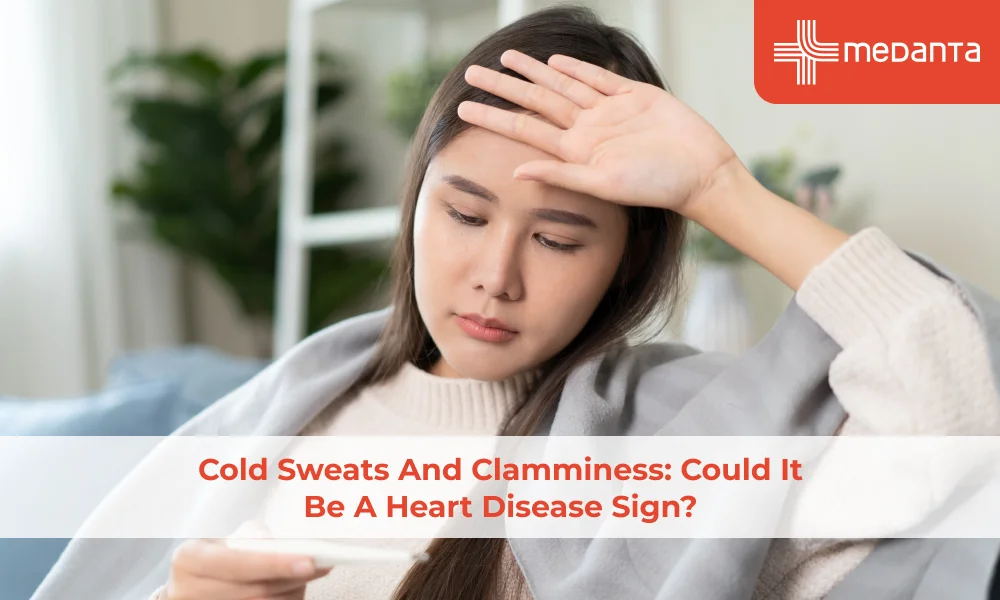
Cold sweats, the sudden onset of clammy, damp skin without physical exertion or a warm environment, are one of the body's most significant autonomic responses. Unlike the sweating that follows exercise or heat, cold sweats occur when the sympathetic nervous system is activated by internal distress: a drop in blood sugar, a surge of adrenaline driven by anxiety or panic, the pain and haemodynamic instability of a myocardial infarction (heart attack) or any one of several other systemic conditions. This article explains what causes cold sweats, their symptoms and how doctors diagnose them.
What Are Cold Sweats?
Cold sweats are defined as sweating that occurs without an obvious environmental or physical trigger. The skin becomes damp or clammy, often pale and typically cool to the touch. The clammy feeling arises because the sympathetic nervous system releases acetylcholine onto the eccrine sweat glands, producing sweating, while simultaneously causing peripheral vasoconstriction (narrowing of the blood vessels near the skin). This combination produces skin that is both damp and cold.
Cold sweats can occur anywhere on the body but are particularly prominent on the forehead, palms and upper lip. The key clinical feature is the absence of an obvious external cause: appearing at rest, during sleep, or in a cool environment can make them potentially significant.
Common Causes of Sudden Cold Sweating
Cold sweats can arise from a wide range of causes, spanning emergency medical events to common benign conditions. They are:
Myocardial infarction (heart attack): One of the most dangerous causes. Cold sweats along with chest pain, jaw pain or left arm pain are a medical emergency requiring immediate assessment.
Hypoglycaemia (low blood sugar): Mild to moderate hypoglycaemia triggers adrenaline release, producing cold sweats, trembling and pallor. In patients on insulin or sulphonylureas hypoglycaemia is a significant daily risk.
Anxiety and panic disorder: Acute anxiety and panic attacks produce intense sympathetic nervous system activation, resulting in cold sweats, palpitations, breathlessness and chest tightness.
Infection and sepsis: Dengue, malaria and typhoid can produce cold sweats, particularly during fever spikes or the defervescence (falling temperature) phase. Sepsis-related cold sweats are a medical emergency.
Medications: Beta-blocker withdrawal, opioid withdrawal and certain antidepressants (particularly SSRIs and SNRIs) can cause cold sweats.
Cold Sweats as a Possible Heart Attack Symptom
Cold sweats are a well-recognised symptom of acute myocardial infarction (AMI). During a heart attack, the abrupt fall in cardiac output activates the sympathetic nervous system, which triggers sweating as part of the systemic stress response. Peripheral vasoconstriction causes the skin to become cold and pale, producing the classic clinical picture of cold, clammy skin that emergency clinicians use as a bedside indicator of haemodynamic compromise. Cold sweats can be the predominant or even the sole presenting feature of a myocardial infarction, particularly in women, elderly patients and those with diabetic autonomic neuropathy.
Connection Between Sweating and the Nervous System
Sweating is controlled by the sympathetic branch of the autonomic nervous system. The sympathetic nervous system is responsible for the fight-or-flight response: it prepares the body for emergencies by increasing heart rate, raising blood pressure, diverting blood flow to vital organs and activating the sweat glands. The eccrine sweat glands, the primary glands involved in stress-related sweating, are innervated by sympathetic nerve fibres that use acetylcholine as their primary neurotransmitter.
When the body detects a threat whether physical (pain, haemorrhage, myocardial ischaemia) or perceived (anxiety, panic) the hypothalamus signals the sympathetic nervous system, which activates sweat gland secretion and peripheral vasoconstriction simultaneously. This explains why cold sweats are a non-specific but reliable marker of systemic stress: the body is signalling that its internal environment is under significant pressure, even when the cause is not immediately apparent.
Anxiety and Panic Related Cold Sweats
Anxiety and panic disorder are among the most common causes of cold sweats. A panic attack activates the sympathetic nervous system in a pattern that closely mimics a cardiac event: the patient develops sudden cold sweats, palpitations, chest tightness, breathlessness, dizziness and a sense of impending doom that can be clinically indistinguishable from a heart attack.
Low Blood Sugar and Cold Sweats
Hypoglycaemia (defined as a blood glucose level below 70 mg/dL in most clinical guidelines) is one of the most common causes of cold sweats in diabetic patients. When blood glucose falls, the adrenal glands release adrenaline (epinephrine) to stimulate glycogenolysis and gluconeogenesis, producing cold sweats, trembling, palpitations, pallor and light-headedness.
Patients on insulin and sulphonylurea medications should be counselled to treat immediately with fast-acting glucose (fruit juice, sugar dissolved in water or Glucon-D).
Other Medical Conditions That Cause Clamminess
They are:
Sepsis and severe infections: Sepsis produces cold clammy skin as the body shunts blood centrally. Dengue, malaria, leptospirosis and bacterial sepsis are important causes. Cold sweats with fever, altered consciousness or low blood pressure are a medical emergency.
Thyroid storm: Severe hyperthyroidism produces profuse sweating, fever, tachycardia, and agitation.
Cold Sweats With Chest Pain and Other Warning Signs
Cold sweats occurring alongside any of the following symptoms are a medical emergency requiring immediate assessment.
Chest pain, tightness, pressure, or squeezing particularly if radiating to the jaw, left arm, or back
Sudden breathlessness or difficulty breathing, at rest or with minimal exertion
Dizziness, light-headedness or fainting
Palpitations or a very rapid, very slow or irregular heartbeat
Nausea or vomiting without an obvious gastrointestinal cause
Sudden severe fatigue or an overwhelming sense that something is seriously wrong.
When Cold Sweats Require Emergency Attention
Not all cold sweats are emergencies. A single brief episode following a stressful event or mild dehydration in otherwise good health is generally not an emergency. The following patterns require urgent attention.
Cold sweats that are sudden in onset and occur at rest without an obvious benign explanation.
Cold sweats in any person with known heart disease, diabetes, hypertension or a family history of cardiac events
Cold sweats accompanied by any of the warning symptoms listed in the preceding section
Repeated, unexplained episodes of cold sweating, even without other symptoms, that are occurring with increasing frequency.
Diagnosis of Unexplained Excessive Sweating
The diagnostic approach to unexplained cold sweats depends on clinical presentation and associated symptoms.
12-lead ECG: The first-line investigation where a cardiac cause is suspected. ECG identifies STEMI, ischaemic changes and arrhythmias.
Cardiac troponin (high-sensitivity troponin T or I): Confirms or excludes myocardial injury when the ECG is non-diagnostic or normal
Blood glucose: Immediate point-of-care blood glucose testing excludes hypoglycaemia as the cause of cold sweats.
Thyroid function tests (TSH and free T4): Identify hyperthyroidism or thyroid storm.
Conclusion
Cold sweats are a reliable and clinically significant signal that the body's internal environment is under stress. In most cases the cause is benign, but in a meaningful proportion of cases, particularly in patients with cardiovascular risk factors who also have chest pain, breathlessness or dizziness, cold sweats represent a cardiac emergency. In India, where coronary artery disease is highly prevalent and where many cardiac events present atypically, cold sweats should always be examined against the full clinical picture and not dismissed without appropriate investigation.
FAQs
Why do I suddenly get cold sweats?
Sudden cold sweats are caused by sympathetic nervous system activation. Common triggers are anxiety, low blood sugar, pain, infection or a cardiac event. Cold sweats without an obvious trigger warrant urgent evaluation.
Can cold sweating be a sign of a heart problem?
Cold sweats are a recognised symptom of myocardial infarction and cardiogenic shock. During a heart attack, sympathetic activation causes sweating and peripheral vasoconstriction, producing cold, clammy skin. Cold sweats with chest pain require assessment.
How are heart-related sweats different from normal sweating?
Heart related sweats occur at rest or during sleep, without exertion or heat and are accompanied by chest pain, breathlessness, dizziness or palpitations. Normal sweating occurs in response to exertion or warmth and stops when the trigger stops.
Can low blood sugar cause cold sweats?
Hypoglycaemia triggers adrenaline release, producing cold sweats, trembling, pallor and palpitations. Diabetic patients on insulin or sulphonylureas are at particular risk. Fast-acting glucose should be given immediately.
Can anxiety cause clammy skin?
Anxiety and panic attacks activate the sympathetic nervous system, producing cold sweats, palpitations, chest tightness and breathlessness that can mimic a cardiac event. A 12-lead ECG is required to exclude a cardiac cause before attributing it to anxiety.
Can cold sweats occur without chest pain?
Yes in women, elderly patients and diabetic patients with autonomic neuropathy, a heart attack can present with cold sweats, breathlessness or fatigue without classic chest pain. In high-risk individuals, cold sweats alone do not exclude a cardiac cause.
What other symptoms may occur with heart-related sweating?
Heart related cold sweats are typically accompanied by chest pain or pressure, left arm or jaw pain, breathlessness, palpitations, dizziness or nausea. If you have any of these with cold sweats it is a medical emergency.
Can excessive sweating be linked to heart disease?
Chronic heart failure produces sympathetic nervous system overactivation that can cause persistently excessive sweating. Arrhythmias, cardiomyopathy and valvular heart disease can also produce episodic sweating, particularly if they cause haemodynamic compromise.
When do cold sweats require emergency medical attention?
Cold sweats require emergency attention if sudden in onset, occurring at rest and accompanied by chest pain, breathlessness, dizziness, palpitations, or nausea particularly in a person with known heart disease, diabetes or hypertension.
What tests can determine the cause of unexplained sweating?
A 12-lead ECG and high-sensitivity troponin exclude cardiac causes. Blood glucose testing excludes hypoglycaemia. Thyroid function tests (TSH, free T4) exclude hyperthyroidism. Blood cultures and inflammatory markers identify infection or sepsis. Plasma metanephrines exclude phaeochromocytoma.
References
1. Thayer JF, Yamamoto SS, Brosschot JF. The relationship of autonomic imbalance, heart rate variability and cardiovascular disease risk factors. Int J Cardiol. 2010;141(2):122–31. https://doi.org/10.1016/j.ijcard.2009.09.543
2. Canto JG, Shlipak MG, Rogers WJ, et al. Prevalence, clinical characteristics, and mortality among patients with myocardial infarction presenting without chest pain. JAMA. 2000;283(24):3223–9. https://doi.org/10.1001/jama.283.24.3223
3. Prabhakaran D, Jeemon P, Roy A. Cardiovascular diseases in India: current epidemiology and future directions. Circulation. 2016;133(16):1605–20. https://doi.org/10.1161/CIRCULATIONAHA.114.008729
4. Cryer PE. Mechanisms of hypoglycaemia-associated autonomic failure in diabetes. N Engl J Med. 2013;369(4):362–72. https://doi.org/10.1056/NEJMra1215228
5. Ministry of Health and Family Welfare, Government of India. National Family Health Survey-5 (NFHS-5) 2019-21: India report. International Institute for Population Sciences. 2022. https://mohfw.gov.in/sites/default/files/NFHS-5_Phase-II_0.pdf