1068
1068
 Request Call Back
 Contact
 1068
1068
What Is a Ligament? Function, Types and Common Ligament Injuries
Published on: Sep 28, 2026
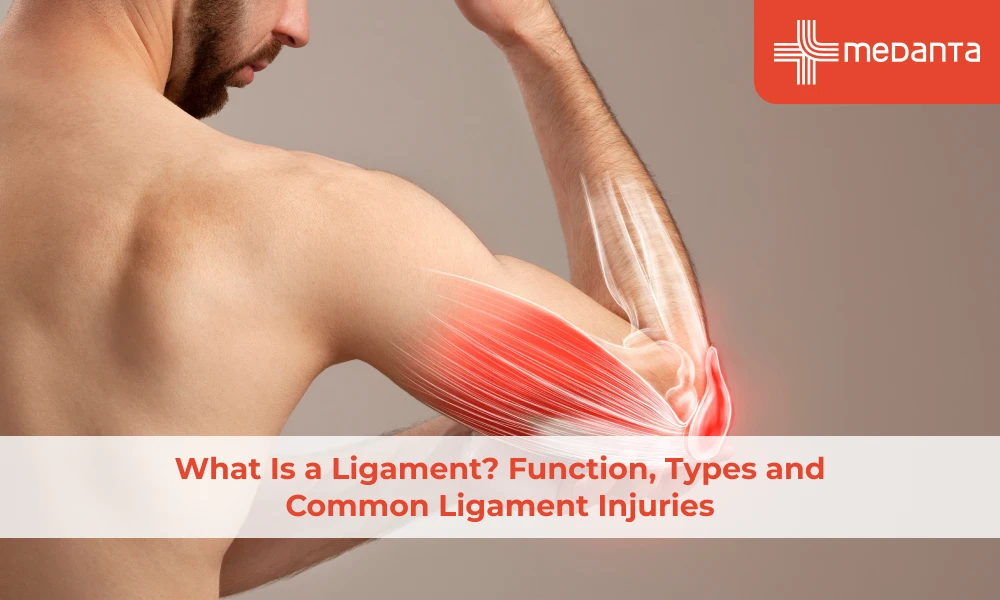
TABLE OF CONTENTS
- Ligament Definition - What Connects Bone to Bone
- Function of Ligaments in the Human Body
- Types of Ligaments
- Common Ligament Injuries
- Symptoms of a Ligament Tear
- How Ligament Injuries Are Diagnosed and Treated
- Recovery Time and Rehabilitation for Ligament Injuries
- How to Keep Ligaments Healthy
- Conclusion
- FAQs
- References
Ligament injuries are among the most common reasons people visit orthopaedic surgeons and emergency departments ranging from anterior cruciate ligament (ACL) tears in cricketers and football players to ankle ligament sprains in weekend athletes. Despite being so common, ligaments are widely misunderstood. People frequently confuse them with tendons, use the terms interchangeably or assume that any soft tissue injury around a joint involves a tendon.
A ligament connects bone to bone. In contrast a tendon connects muscle to bone. This single anatomical distinction defines their different functions, their different failure modes under load, and the different ways in which injuries to each are managed.
Ligament Definition - What Connects Bone to Bone
A ligament is a band or sheet of dense, fibrous connective tissue composed primarily of type I collagen fibres arranged in a parallel or slightly woven pattern that provides great tensile strength along the direction of the ligament's long axis. Ligaments are attached to the periosteum (the outer covering) of bone at both ends and are designed to resist tensile forces like pulling and stretching across a joint.
Ligament tissue is relatively avascular - it has a poor blood supply compared to muscle tissue. This is the primary reason why ligament injuries heal slowly. Ligaments that have healed after a complete tear are typically composed of scar tissue with a collagen fibre architecture that is mechanically inferior to normal ligament tissue.
Function of Ligaments in the Human Body
The primary function of ligaments is to provide passive mechanical stability to joints - holding the bones of a joint in their correct positional relationship to each other while allowing the range of motion appropriate for that joint. Common functions are:
Preventing dislocation and abnormal motion: Ligaments limit joint movement to its normal range and direction, preventing bones from sliding, rotating or angulating in ways that would damage joint surfaces, nerves, or blood vessels.
Proprioception and joint position sense: Ligaments contain mechanoreceptors (specialised sensory nerve endings) that signal joint position and movement to the spinal cord and brain.
Guiding joint motion: Help joints move in the correct direction and maintain normal movement patterns.
Types of Ligaments
Ligaments can be classified by location and function.
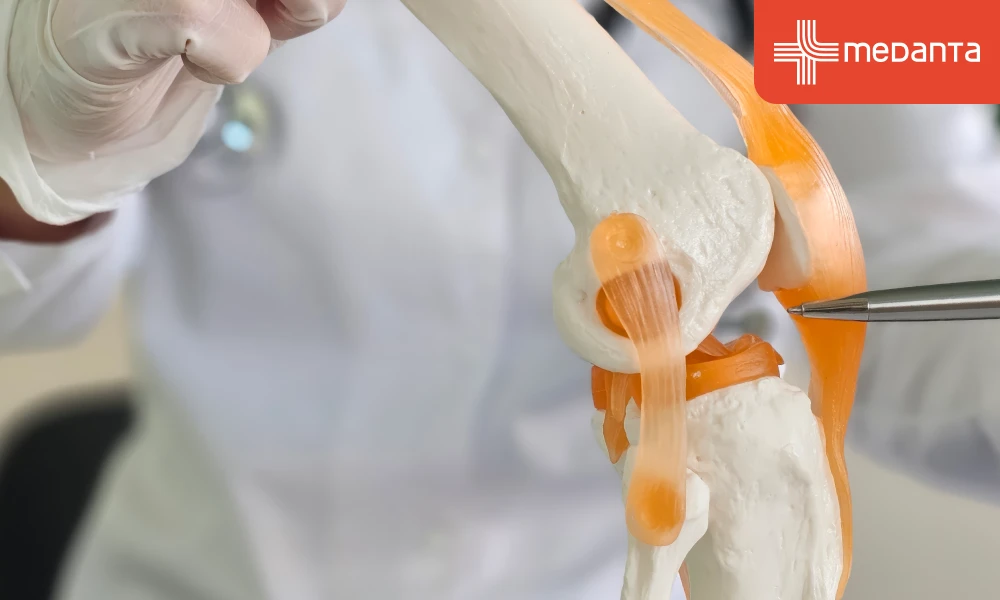
Articular ligaments: Found around joints, where they connect bones and provide stability including the MCL and LCL of the knee (which prevent excessive sideways movement), the ACL and PCL inside the knee joint, the anterior talofibular ligament (ATFL) of the ankle (the most commonly injured ligament in ankle sprains) and the ulnar collateral ligament (UCL) of the thumb (commonly injured in sports).
Suspensory or peritoneal ligaments: Ligaments in the abdominal cavity that suspend or support organs like the falciform ligament that attaches the liver to the anterior abdominal wall, and the uterine ligaments that support the uterus in the pelvis. These are not joint ligaments and are not typically injured in the same way as articular ligaments.
Common Ligament Injuries
Ligament injuries occur when a joint is subjected to a force that exceeds the ligament's tensile strength most commonly through sudden twisting, overstretching, or direct impact. Severity is graded from Grade I (mild sprain with partial fibre disruption) to Grade III (complete ligament tear).
Ankle ligament sprains: The most common ligament injury in both sport and everyday life. The anterior talofibular ligament (ATFL) is typically injured by a sudden inversion of the ankle (the foot rolling inward) - a very common injury among players of kabaddi, football, cricket, and basketball.
Anterior cruciate ligament (ACL) tear: One of the most serious ligament injuries in sport, occurring most frequently in contact sports involving sudden pivoting, cutting, or landing.
Lumbar spinal ligaments: Spinal ligament strains from heavy lifting, twisting, or prolonged bending are among the most common causes of acute low back pain across the Indian working population.
Symptoms of a Ligament Tear
The symptoms of a ligament injury depend on the grade of injury and the joint affected but certain features are common across most ligament injuries. They are:
Pain at the joint: Immediate and sharp at the moment of injury, then transitioning to a deep aching or throbbing pain over the following hour
Swelling around the joint: Develops within minutes to hours
Joint instability: A sense that the joint is giving way particularly with Grade II and Grade III tears
Bruising: Develops over 24 to 48 hours following the injury as blood from the torn tissue tracks under the skin.
How Ligament Injuries Are Diagnosed and Treated
Diagnosis of a ligament injury begins with clinical examination. Specific stress tests are applied to the joint to assess ligament integrity. MRI (magnetic resonance imaging) is the gold standard investigation for confirming ligament injury and identifying associated injuries such as meniscal tears or cartilage damage.
Grade I and Grade II injuries are typically managed conservatively with initial RICE (rest, ice, compression, elevation), anti-inflammatory medicines and physiotherapy to restore range of motion, strength, and proprioception.
Grade III injuries particularly ACL tears typically require surgical reconstruction in active individuals who wish to return to sport. ACL reconstruction using hamstring tendons or the patellar tendon is widely performed at orthopaedic and sports medicine centres with post-surgical rehabilitation taking six to twelve months.
Recovery Time and Rehabilitation for Ligament Injuries
Recovery time depends on the grade of injury, the joint affected and how well the rehabilitation programme is followed.
Mild ankle sprain (Grade I): Return to full sport within two to three weeks.
Moderate sprain (Grade II): Needs four to eight weeks of structured rehabilitation and return to sport at eight to twelve weeks.
Complete tear (Grade III) managed conservatively: Eight to twelve weeks of rehabilitation.
ACL reconstruction: Six to twelve months of structured post-operative rehabilitation before return to competitive sport, progressing through early motion, quadriceps strengthening, neuromuscular re-education and return-to-sport testing.
How to Keep Ligaments Healthy
Many common ligament injuries particularly ankle sprains and ACL tears seen in sport can be significantly reduced in frequency and severity through specific preventive measures. They are:
Neuromuscular and proprioception training: Balance and proprioception training including single-leg balance exercises, wobble board training and the FIFA 11+ warm-up programme is the most effective injury prevention strategy for ankle and knee ligament injuries.
Strength and conditioning: Strong muscles around a joint particularly the quadriceps, hamstrings and hip abductors for the knee, and the peroneal muscles and calf muscles for the ankle absorb force and reduce the load transmitted to the ligament during dynamic activities.
Adequate warm-up: A structured warm-up reduces injury risk.
Healthy body weight: Maintaining a healthy body weight reduces the mechanical load on the knee during weight-bearing activity.
Appropriate footwear: Supportive footwear appropriate to the activity provides the lateral stability that protects ankle ligaments during lateral movement sports such as badminton and basketball.
Conclusion
Ligaments are the essential passive stabilisers of every joint in the human body. They are dense bands of fibrous collagen tissue that connect bone to bone, limit excessive joint motion, guide normal movement patterns and provide the proprioceptive feedback that allows the nervous system to maintain joint stability during dynamic activity. Their relatively poor blood supply makes them slow to heal and vulnerable to incomplete recovery after significant injury, which is why prevention is so much more effective than treatment.
Ligament injuries range from mild sprains that resolve within days to complete ruptures that require surgical reconstruction and months of rehabilitation. In India where sports participation is growing rapidly alongside rising rates of road traffic accidents and occupational injuries, ligament injuries represent a significant and growing burden on orthopaedic services.
FAQs
What is the definition of a ligament?
A ligament is a band of dense, fibrous connective tissue composed primarily of type I collagen fibres. A ligament connects one bone to another bone across a joint. Ligaments are designed to resist tensile forces across a joint and to maintain the normal positional relationship between the bones of a joint during movement and load-bearing. They are distinct from tendons, which connect muscle to bone.
What is the main function of ligaments in the body?
The main function of ligaments is to provide passive mechanical stability to joints - holding the bones in their correct positional relationship to each other while allowing the normal range of motion. They prevent dislocation and abnormal movement, guide the arc of joint motion and provide proprioceptive feedback (joint position sense) through specialised mechanoreceptor nerve endings.
What connects bone to bone in the body?
Ligaments connect bone to bone. This is the defining anatomical distinction between ligaments and tendons. Tendons connect muscle to bone, while ligaments connect bone to bone. At every synovial joint in the body, ligaments span the joint and hold the articulating bones in their correct positional relationship.
What are the different types of ligaments?
Ligaments can be classified as articular ligaments (which span joints and stabilise articulating bones including the ACL and PCL of the knee, the ATFL of the ankle, and the MCL and LCL of the knee), suspensory or peritoneal ligaments (which support organs within the abdominal and pelvic cavities such as the falciform ligament of the liver), and fetal remnant ligaments (such as the ligamentum teres of the liver, which is the remnant of the fetal umbilical vein).
What are the symptoms of a ligament tear?
The symptoms of a ligament tear include immediate pain at the joint, swelling, joint instability or a sense of the joint giving way (particularly in Grade II and Grade III tears), bruising that develops over 24 to 48 hours and reduced range of motion.
How is a torn ligament treated?
Grade I and Grade II ligament tears are typically managed conservatively with initial RICE (rest, ice, compression, elevation), anti-inflammatory medicines or diclofenac gel and progressive physiotherapy. Grade III complete tears particularly ACL tears and complete UCL tears of the thumb typically require surgical reconstruction in active individuals who wish to return to sport.
How long does it take a ligament injury to heal?
A mild (Grade I) ankle sprain typically resolves within two to three weeks. A moderate (Grade II) ligament sprain may take four to eight weeks. A complete (Grade III) tear managed conservatively takes eight to twelve weeks. ACL reconstruction requires six to twelve months of post-operative rehabilitation before return to competitive sport and re-injury rates are significantly higher when athletes return before nine months post-surgery.
What is the difference between a ligament and a tendon?
A ligament connects bone to bone and provides passive stability to joints. A tendon connects muscle to bone and transmits the contractile force of muscle to the skeleton to produce movement. Both are composed primarily of type I collagen fibres and both are relatively avascular tissues that heal slowly, but they differ in their mechanical properties and their failure modes under load.
Can a torn ligament heal without surgery?
Many torn ligaments can heal without surgery. Isolated medial collateral ligament (MCL) tears of the knee frequently heal without surgery when managed with bracing, physiotherapy and progressive loading. Ankle ligament tears even complete Grade III tears often heal well without surgery. However ACL tears do not heal reliably without surgery in patients who wish to return to cutting and pivoting sports, because the ACL lacks the vascularity needed for reliable spontaneous healing.
Which ligaments are most commonly injured in the leg?
The most commonly injured ligaments in the lower limb are the anterior talofibular ligament (ATFL) of the ankle and the anterior cruciate ligament (ACL) of the knee, commonly injured in cricket, football, kho-kho, kabaddi, and basketball. The medial collateral ligament (MCL) and posterior cruciate ligament (PCL) of the knee are also commonly injured in contact sports.
References
1. Frank CB. Ligament structure, physiology and function. J Musculoskelet Neuronal Interact. 2004;4(2):199–201. https://pubmed.ncbi.nlm.nih.gov/15615122
2. Duthon VB, Barea C, Abrassart S, et al. Anatomy of the anterior cruciate ligament. Knee Surg Sports Traumatol Arthrosc. 2006;14(3):204–13. https://doi.org/10.1007/s00167-005-0679-9
3. Maffulli N, Longo UG, Gougoulias N, Loppini M, Denaro V. Long-term health outcomes of youth sports injuries. Br J Sports Med. 2010;44(1):21–5. https://doi.org/10.1136/bjsm.2009.069526
4. Ardern CL, Webster KE, Taylor NF, Feller JA. Return to sport following anterior cruciate ligament reconstruction surgery. Br J Sports Med. 2011;45(7):596–606. https://doi.org/10.1136/bjsm.2010.076364
5. Sousa AN, Tavares AC, Kretly A. Rehabilitation of ligamentous injuries: a systematic review. J Sport Rehabil. 2016;25(3):289–97. https://doi.org/10.1123/jsr.2014-0329