1068
1068
 Request Call Back
 Contact
 1068
1068


At Medanta, quality comprehensive care is our foremost promise.

Enquiry Form

Search for Hospitals
Breast Cancer Highlights

01
360-degree care for all diseases and conditions of the breasts, including cancers
02
Comprehensive multidisciplinary care with end-to-end services under one roof right
03
Multi-superspeciality support for men and women for varied conditions
04
Genetic testing for preventive care, including surgery.
05
Fast biopsy results within 24-48 hours
06
Cutting-edge screening and surveillance of high-risk patients for fast action in fewer visits
About the Speciality
The Medanta Breast Services Department offers end-to-end care for all conditions, diseases and infections of the breast affecting patients across life-stages and genders – right from genetic testing, screening, risk identification, risk reduction through preventive surgeries, breast conservation, to reconstruction and cutting-edge cancer treatment with long-term follow-up. We have created a comprehensive cancer care facility offering unparalleled support under one roof. Our state-of-the-art critical care infrastructure and world-class technology help improve accuracy of diagnosis and treatment. Supported by our award-winning cancer institute’s divisions of medical and haemato oncology, radiation oncology and organ-specific surgical cancer divisions (in case of metastasis), we offer the complete range of services, fast.
Our Chairman Message
Breast cancer is no longer a disease of older women, or just women, and its incidence is rising. But, breast cancer is also one of the most treatable cancers, which when caught in time, and treated promptly and holistically can enhance a patient’s life in years and quality. The Medanta Department of Breast Services is dedicated to achieving this outcome using the most latest technology, and expanding awareness that breast health encompasses a lot more than just cancer. - Dr. Rajeev Agarwal

Breast cancer is no longer a disease of older women, or just women, and its incidence is rising. But, breast cancer is also one of the most treatable cancers, which when caught in time, and treated promptly and holistically can enhance a patient’s life in years and quality. The Medanta Department of Breast Services is dedicated to achieving this outcome using the most latest technology, and expanding awareness that breast health encompasses a lot more than just cancer. - Dr. Rajeev Agarwal

‹
›
Breast Team
At Medanta, compassionate care is our foremost promise


Our multidisciplinary team of medical oncologists, radiation oncologists, and surgical specialists work together seamlessly to tailor treatment plans depending on the types and stage of breast cancer.

State-of-the-art diagnostic facility to accurately detect breast abnormalities in persons of all ages. Biopsy results within 24 to 48 hours for speedy treatment initiation.

We offer complete range of services for screening, risk identification and risk reduction, including BRCA 1 and 2 genetic testing, and preventive surgeries.

Multi-superspeciality support for treatment of metastatic breast cancer

Our breast conservation and reconstruction specialists help women heal with prosthetics and implants
Our Treatments
Treating heart conditions necessitates a collaborative approach and dedicated care for success.
01
Breast Pain
Some women experience pain or pain in the breasts because of the hormonal changes throughout the menstrual cycle. Although breast pain is uncommon, it is not unheard of.
02
Mastectomy or complete breast removal
Mastectomy is a surgical procedure to remove one or both breasts, typically as a treatment for breast cancer. There are different types of mastectomies, including total mastectomy, which removes the entire breast, and modified radical mastectomy, which also includes lymph nodes under the arm. It may be recommended based on the stage of cancer, genetic risk factors, or patient preference.
Ailments
Treating heart conditions necessitates a collaborative approach and dedicated care for success.
Breast cancer
Breast cancer is a cancer that forms in the glandular tissue of the breast. It develops in the lining cells epithelium of the tubes (85%) or lobules (15%). The malignant development is initially contained inside the duct or lobule ("in situ"), where it often exhibits no signs or symptoms and has a low chance of spreading (metastasis).
Gynecomastia
Gynecomastia is the benign enlargement of male breast tissue. It is a common condition affecting up to 65% of men aged 50 to 69 years old and 4% to 69% of adolescent boys with the highest prevalence occurring in boys aged 14 to 15 years old.
Breast abscess
A breast abscess is a localized collection of pus within the breast tissue. It typically occurs due to a bacterial infection, most commonly caused by Staphylococcus aureus. The breast abscess can develop in any part of the breast, but it often forms near the areola or nipple. Incidence and prevalence of breast abscesses can vary depending on various factors, including geographical location, population demographics, access to healthcare, and underlying risk factors.
Breast Fat Necrosis
Breast fat necrosis is a benign condition that occurs when fatty tissue in the breast becomes damaged, leading to the formation of firm lumps. This damage may be caused by trauma, surgery, radiation therapy, or an infection, and results in the death of fat cells, which are then replaced by scar tissue. While breast fat necrosis is not cancerous, it can sometimes mimic the symptoms of breast cancer, such as lumps, skin dimpling, or nipple retraction, leading to concern.
Breast Pain
Breast pain, or mastalgia, is common and can be cyclical, linked to the menstrual cycle, or non-cyclical, unrelated to it. It may cause mild to sharp discomfort in one or both breasts, sometimes extending to the armpit. While often benign, persistent or severe pain should be evaluated by a healthcare provider. Treatment typically includes pain management, lifestyle changes, and addressing underlying causes.
Bloody Nipple Discharge
Bloody nipple discharge can be a concerning symptom and is often associated with benign conditions, though it may also indicate more serious issues. Common causes include intraductal papilloma (a small, non-cancerous tumor in the milk ducts), duct ectasia (widening of the milk ducts), or breast infections. Less commonly, it may be a sign of breast cancer.
If you experience bloody discharge, it's important to seek medical evaluation.
Breast Biopsy
A breast biopsy is a procedure where a small sample of breast tissue is removed and examined to check for cancer or other abnormalities. It is usually recommended when imaging tests like mammograms or ultrasounds show suspicious areas. The biopsy can be done using a needle or through surgery. Results help in diagnosing conditions and determining the appropriate treatment plan, ensuring early intervention if needed.
Breast Cyst
A breast cyst is a fluid-filled sac within the breast, often non-cancerous and common in women aged 30-50. These cysts can vary in size and may cause discomfort, especially before menstruation. Breast cysts can feel like lumps and may be tender or cause pain, though they are typically benign. Diagnosis is usually done through an ultrasound or mammogram. If painful, cysts can be drained, though treatment is often unnecessary unless symptoms persist.
Latest Technology Utilisation
Medanta uses advanced tools for accurate diagnosis of breast conditions:
- Mammography (2D and 3D)
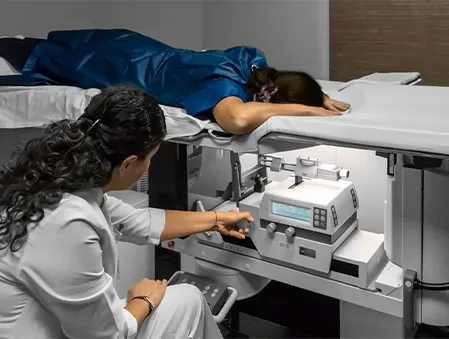
- MRI Guided Vacuum Assisted Breast Biopsy
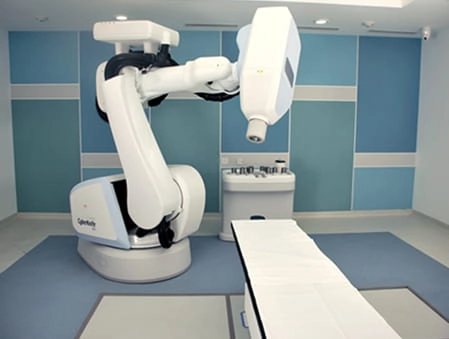
- CyberKnife VSI Robotic Radiosurgery System
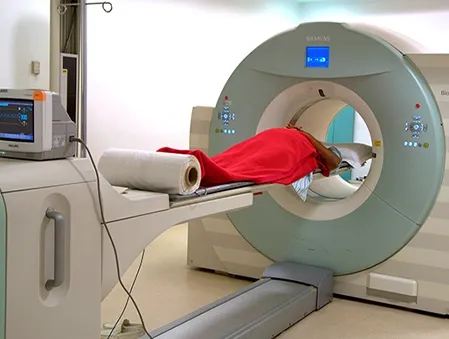
- PET Scan
Mammography (2D and 3D)
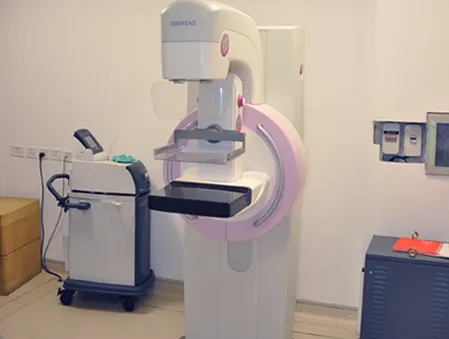
Mammography is an X-ray technique which is used to obtain a picture of the breast. X-ray of the breast is performed by exposure of the breast to low doses of radiations. For a few seconds, breasts are compressed between two thin plates. Mammography is used in early detection of breast cancer, typically through detection of characteristic masses or microcalcifications. With the Mammography machine available at Medanta, radiologists can get a deep insight into the body in 2D and 3D form, which results in early detection with better accuracy.