- All Speciality
- Bone Marrow Transplant
- Breast Cancer
- Cancer Care
- Cardiac Care
- Cardiac Surgery
- Cardiology
- Clinical & Preventive Cardiology
- Critical Care
- Dentistry
- Dermatology
- Diabetes Care
- Dietetics and Nutrition
- Emergency
- Endocrine and Breast Surgery
- ENT (Ear,Nose,Throat)
- Gastroenterology
- Gastrosciences
- GI Surgery
- Gynae-Oncology
- Gynaecology and GynaeOncology
- Internal Medicine
- Interventional Cardiology
- Lab & Pathology
- Medical Oncology
- Neonatology
- Nephrology
- Neurology
- Neurosciences
- Neurosurgery
- Obstetrics & Gynaecology
- Ophthalmology
- Orthopaedics
- Paediatric Cardiology
- Paediatric Care
- Plastic, Aesthetic and Reconstructive Surgery
- Radiation Oncology
- Radiology & Imaging
- Renal Care
- Respiratory & Sleep Medicine
- Respiratory Medicine
- Rheumatology and Immunology
- Robotic Surgery
- Surgical Oncology
- Urology
Endocrine and Breast Surgery Doctors in Patna
- Thyroid
- Parathyroid
- Adrenal
- Pancreas
- Breast Diseases
- Neuroendocrine Tumours
- MCh (Endocrine Surgery) SGPGIMS Lucknow
- MS (General Surgery) IMS BHU Varanasi
- MBBS DMC Laheriasarai
Endocrine surgery is a narrow speciality. There are not many surgeons in India who hold a superspecialty degree in it (an MCh) and fewer still...
Endocrine surgery is a narrow speciality. There are not many surgeons in India who hold a superspecialty degree in it (an MCh) and fewer still who are based outside the major metros. For patients in Bihar, Jharkhand, and the broader eastern India region, access to a dedicated endocrine surgeon has historically meant a long journey. A referral to Delhi or Lucknow, a stay away from home, and the logistical cost on top of the medical one.
Medanta Patna's Department of Endocrine and Breast Surgery changes that picture. Dr. Chandan Kumar Jha, Director, trained at SGPGIMS Lucknow for his MCh in Endocrine Surgery and at IMS BHU Varanasi for his MS in General Surgery. He manages the full range of endocrine surgical conditions like thyroid cancer and goitre, parathyroid disease, adrenal tumours, pancreatic endocrine conditions, breast diseases, and neuroendocrine tumours.
What the Department Covers
Thyroid Surgery
Thyroid problems are among the most common endocrine conditions seen in India, and Bihar has a historically high prevalence of thyroid disorders partly related to iodine deficiency in certain regions. Not all thyroid disease requires surgery as most hypothyroidism and hyperthyroidism are managed medically. Surgery becomes relevant when there is a confirmed or strongly suspected thyroid cancer, when a goitre is causing compression of the trachea or oesophagus, when a nodule has suspicious cytology on FNAC, or when medical management of hyperthyroidism has failed or is not tolerated. Dr. Jha performs total thyroidectomy, hemithyroidectomy, and central and lateral neck dissection for thyroid malignancies.
Parathyroid Surgery
Primary hyperparathyroidism is more common and occurs due to the overproduction of parathyroid hormone. It mostly remains undiagnosed, partly because hypercalcaemia is not always checked for in routine blood work. Patients often present with fatigue, kidney stones, bone pain, or vague cognitive symptoms before the calcium result points toward the parathyroids. Surgical cure rates for a correctly localised and resected parathyroid adenoma are high. The technical challenge is identifying which of the four small glands is abnormal and removing it without disturbing the others. This is work that demands anatomical familiarity built through volume which is precisely what subspecialty endocrine surgical training provides.
Adrenal Surgery
Adrenal tumours come in several forms. Some are hormonally active and cause symptoms (Cushing's syndrome from cortisol excess, Conn's syndrome from aldosterone excess, hypertensive crises from phaeochromocytoma), others are found incidentally on imaging done for an unrelated reason. The decision to operate depends on size, hormonal activity, and imaging characteristics suggestive of malignancy. Adrenalectomy is performed laparoscopically in most cases, with the retroperitoneal approach often preferred for smaller tumours.
Neuroendocrine Tumours and Endocrine Pancreas
Neuroendocrine tumours arise from specialised hormone-producing cells throughout the body, most commonly in the pancreas, small intestine, appendix, and lung. Pancreatic NETs, including insulinomas and gastrinomas, are rare but present in ways that are often initially misattributed like recurrent hypoglycaemia, refractory peptic ulcers, and episodic flushing. Correct diagnosis requires specific biochemical testing and imaging, and surgical management depends on tumour location, size, and whether there is evidence of spread. This is a corner of endocrine surgery that general surgeons rarely see in sufficient volume to develop real expertise. Dr. Jha's training at SGPGIMS, where endocrine surgical volume is high, underpins his experience in this area.
Breast Diseases
Breast surgery within an endocrine and breast surgery department covers both benign and malignant disease. Benign conditions like fibroadenomas that are growing, cysts that recur or cause symptoms, and infections that require drainage are managed alongside breast cancer surgical treatment. For breast cancer, the surgical decision involves lumpectomy versus mastectomy, sentinel lymph node biopsy, and in selected cases axillary dissection. The department works in conjunction with Medanta Patna's oncology and radiology teams to ensure breast cancer management follows current evidence-based protocols.
The Endocrine and Breast Surgery Team
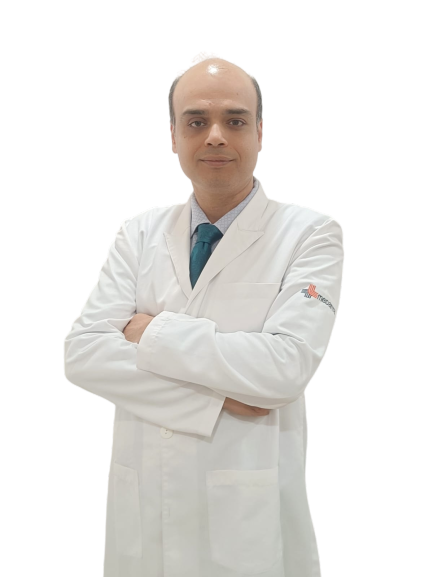
Dr. Chandan Kumar Jha - Director, Endocrine and Breast Surgery
Dr. Jha completed his MBBS at Darbhanga Medical College, Laheriasarai and his MS in General Surgery at IMS BHU Varanasi and his MCh in Endocrine Surgery at SGPGIMS Lucknow. That progression from a Bihar medical college through BHU to one of India's foremost postgraduate surgical institutes reflects a training pathway built on competitive entry at each stage.
His clinical scope including thyroid, parathyroid, adrenal, pancreas, breast, and neuroendocrine tumours is the full breadth of what endocrine surgery as a speciality covers. For patients in and around Patna who previously had no choice but to travel for this level of specialist surgical care, his presence at Medanta Patna is a meaningful change in what is locally accessible.
FAQs
My thyroid ultrasound shows a nodule. Does it need to be removed?
Not necessarily. Thyroid nodules are extremely common and a significant proportion of adults have them, most of which are benign. The decision to proceed to biopsy or surgery depends on the size of the nodule, its ultrasound characteristics, and whether you have symptoms. Nodules with features suspicious for malignancy on ultrasound like irregular margins, microcalcifications, and abnormal vascularity warrant a fine needle aspiration cytology test. If the cytology is benign and the nodule is small, active surveillance is often appropriate. If the cytology is indeterminate or malignant, surgery is generally recommended. Dr. Jha will review your imaging and guide you on the appropriate next step.
I keep having kidney stones and my calcium is slightly elevated. Could it be a parathyroid problem?
It could be. Recurrent calcium oxalate kidney stones combined with persistently elevated serum calcium (particularly if your PTH level is also elevated or inappropriately normal) is a classic presentation of primary hyperparathyroidism. It is more common than many patients or even some physicians realise, and it often goes undiagnosed for years because the symptoms are non-specific. A simple blood test like serum calcium and PTH together is usually the starting point. If the results support primary hyperparathyroidism, imaging is done to try to locate the abnormal gland before surgery. A parathyroidectomy, when the correct gland is identified and removed, is curative in the large majority of cases.
What are neuroendocrine tumours and how are they diagnosed?
Neuroendocrine tumours are a heterogeneous group of neoplasms arising from hormone-secreting cells. They can occur in the pancreas, gastrointestinal tract, lungs, and other sites. Some secrete hormones that cause recognisable syndromes like an insulinoma - causes recurrent low blood sugar and a gastrinoma - causes severe recurrent peptic ulcers. Others are non-functioning and found incidentally. Diagnosis involves specific biochemical markers like chromogranin A and imaging including CT, MRI, and in selected cases a DOTATATE PET scan. Surgery is the mainstay of treatment for localised disease. The management of NETs requires coordination between endocrine surgery, oncology, and nuclear medicine.